The History of Healing
 Alexander Fleming and the Accidental Discovery of Penicillin
Explore the landmark event when Alexander Fleming stumbled upon penicillin, sparking a revolution in antibiotic treatment and medical history.

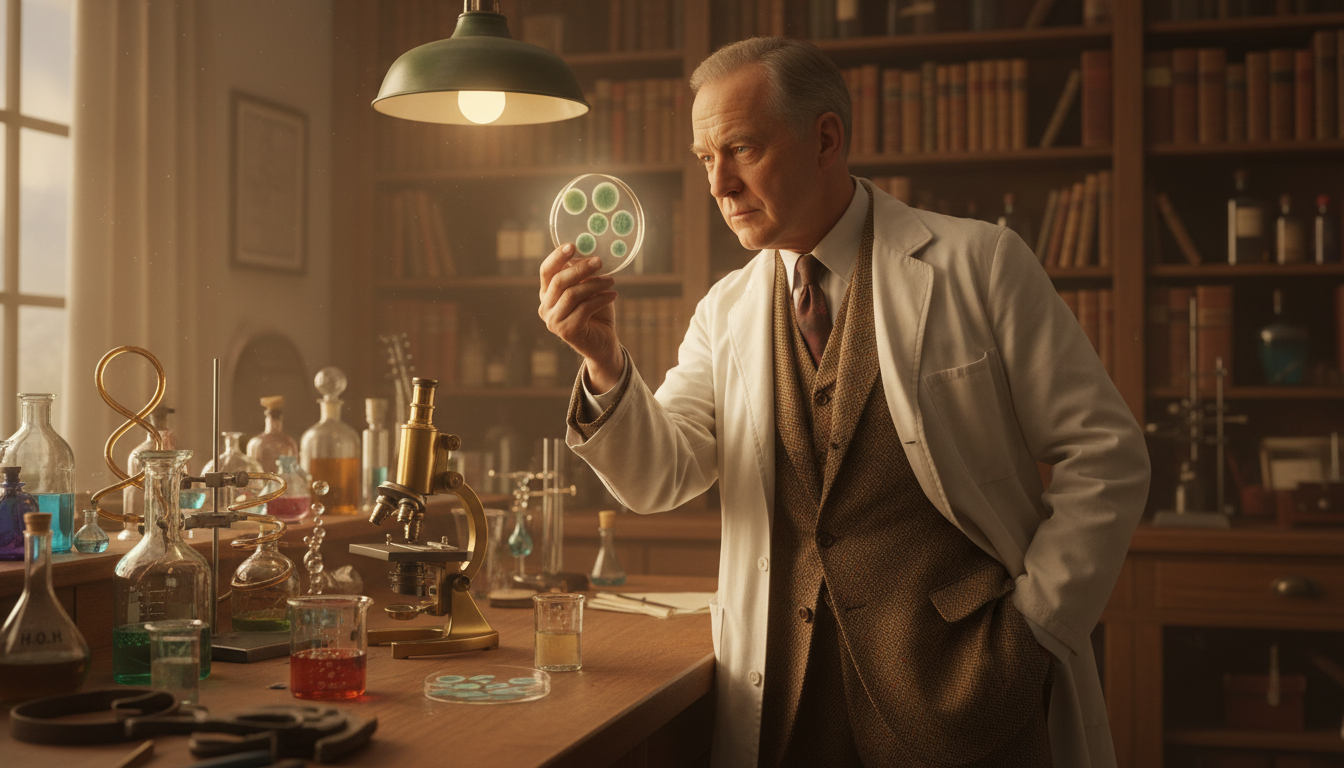
Antibiotics, like Penicillin, have greatly increased our life span. They are so important that it’s hard to imagine medicine without them.
In 1928, Alexander Fleming made a big mistake. He came back to his lab and found a plate ruined by mold. Most would have thrown it away.
Fleming didn’t. He noticed something strange. Bacteria weren’t growing near the mold. This small moment changed medicine forever.
Fleming said it was luck. “I did not invent penicillin. Nature did that. I only discovered it by accident.” But luck needs someone to notice it.
Today, Penicillin is a big deal. The story is seen as a classic “oops” moment. But there’s more to it than just the mess.
Key Takeaways
- Alexander Fleming found the clue to Penicillin on a contaminated culture plate in 1928.
- Fleming’s discovery is often called accidental, but it only mattered because he noticed what others might miss.
- Penicillin helped turn deadly infections into treatable problems and changed medicine fast.
- Fleming credited nature, not himself, for the breakthrough—his role was spotting it.
- The “ruined” Petri dish became one of the biggest turning points in medical history.
- Penicillin remains a key antibiotic today, even as medicine keeps evolving.
Who Was Alexander Fleming?
Alexander Fleming was a man who noticed things others missed. He was a Scottish biologist, but that doesn’t fully capture his curiosity and practicality. His habits, like careful watching and steady routines, were perfect for Bacteriology and Microbiology.
Early Life and Education
Fleming was born on August 6, 1881, at Lochfield Farm in Scotland. His parents were Hugh Fleming and Grace Stirling Morton. Their family life was simple, busy, and grounded.
He moved to London with his siblings after early schooling in Scotland. He finished at Regent Street Polytechnic, which gave him a city pace and a wider view of learning. This was key for his future in Microbiology, where small details are everything.
Career Path and Interests
He didn’t start in medicine right away. For four years, he worked in a shipping office, keeping organized or falling behind. Then, his uncle John’s will changed everything, funding his medical training.
He graduated with distinction from St Mary’s Medical School (University of London) in 1906. While serving in the London Scottish Regiment, he became a skilled marksman. His captain wanted him to stay at St Mary’s for the rifle club, nudging him toward research.
This led him to Sir Almroth Wright, a key figure in immunology and vaccine work. Fleming worked with Wright’s group for his whole career. He built the lab instincts needed for Bacteriology: test, observe, repeat. Working closely with microbes made Microbiology a way of seeing the world.
| Moment | What Happened | Why It Mattered for Bacteriology and Microbiology |
|---|---|---|
| 1881, Lochfield Farm | Born in rural Scotland to Hugh Fleming and Grace Stirling Morton | Early life rewarded patience and attention, the same traits you need when watching bacteria grow |
| Move to London | Joined siblings and studied at Regent Street Polytechnic | Added structured learning and city resources that supported later lab training in Microbiology |
| Shipping office years | Worked four years before medical school | Built discipline and record-keeping habits that fit the careful routines of Bacteriology |
| Family inheritance | Used his share from his uncle John’s will to fund medical training | Created the doorway into medicine that eventually shaped a Scottish biologist’s lab career |
| St Mary’s, 1906 | Graduated with distinction from St Mary’s Medical School | Strengthened core clinical knowledge that later helped connect lab findings to real infections |
| London Scottish Regiment | Became a recognized marksman; captain steered him toward research | A career “swerve” that kept him in the lab environment where Microbiology skills grow fast |
| Work with Sir Almroth Wright | Joined Wright’s research group and stayed his whole career | Long-term exposure to lab method, vaccines, and observation sharpened his instincts in Bacteriology |
The Context of Medical Science in the 1920s
Imagine a hospital ward in the 1920s. It was busy, loud, and full of tension. If an infection started, treatments were limited.
In Microbiology labs, scientists could see bacteria clearly. But stopping them inside the body was hard.
Alexander Fleming knew this gap well. He served in the Army Medical Corps during World War I. He saw how quickly wounds could turn dangerous.
This was before Antibiotics were reliable. The stakes were high and personal.
Common Infections and Treatments
Everyday illnesses could be deadly. Pneumonia, meningitis, and bloodstream infections were serious. A small problem could quickly become a crisis.
Doctors used antiseptics and wound cleaning. Fleming noticed antiseptics could harm healthy tissue. Even with clean surfaces, bacteria could survive where it was dark.
The idea of a Medical breakthrough seemed far away. Doctors could slow infections but not stop them with drugs. This uncertainty guided how doctors treated even small cuts.
| Problem doctors faced | Common approach in the 1920s | What often went wrong |
|---|---|---|
| Deep wound infections after injuries | Antiseptic washes, dressing changes, surgical cleaning | Damaged tissue made healing harder; bacteria could persist deep in the wound |
| Pneumonia spreading through the lungs | Bed rest, oxygen when available, careful nursing | Illness could escalate quickly with no dependable drug to stop it |
| Bloodstream infections | Drainage of infection sources, fluids, observation | Sepsis could outrun treatment and become fatal |
The Role of Bacteria in Health
By the 1920s, Microbiology had changed disease understanding. Germ theory gave doctors a clear enemy. Lab work linked specific bacteria to illnesses. But finding a cure was hard.
Fleming got a glimpse of this in 1922 with lysozyme. Nasal mucus accidentally landed on a Petri dish, slowing bacteria. Lysozyme is found in many body parts.
It wasn’t a complete cure but showed Fleming the power of small effects. This mindset was key as the search for Antibiotics began.
The Unintended Discovery of Penicillin
Imagine a busy lab in 1928. There were petri dishes, notes, and a rush to get results. Alexander Fleming was working with staphylococcal bacteria, doing routine testing. Then, a small accident changed everything.
That moment didn’t start with a grand plan. It started with a plate that looked like a problem.
The Famous Petri Dish Incident
An uncovered dish sat near an open window. It picked up mold spores from the air. When Fleming returned, he saw the mold and thought the sample was ruined.
But he noticed something strange. A clear area where the bacteria should’ve been thriving.
Instead of throwing the plate away, he looked closer. In his 1929 write-up, he described how the staph changed near the mold. He said the mold had “marked inhibitory, bactericidal and bacteriolytic properties” against several bacteria.
“I didn’t plan to revolutionize medicine by discovering the world’s first antibiotic… But I guess that was exactly what I did.”
Importance of Observation in Science
It’s tempting to call this a lucky mess. But that misses the real point. The key was attention. Fleming’s discovery happened because he asked a simple question: why is there a clear zone where bacteria won’t grow?
Penicillin didn’t announce itself with trumpets. It showed up as a pattern—mold here, no bacteria there. It took patience to follow that clue.
| What he noticed | What it suggested | Why it mattered |
|---|---|---|
| A mold colony on a staph-covered plate | Contamination from airborne spores, likely from the open window | Set the stage for Penicillin to show a visible effect on bacteria |
| A clear “no-growth” ring around the mold | Something from the mold was stopping bacterial growth | Turned a “ruined” dish into a testable idea tied to Fleming’s discovery |
| Staph colonies turning transparent (lysis) | Bacteria were breaking down, not just slowing down | Backed the claim that the substance had active bacteriolytic power |
| Mold broth after 1–2 weeks at room temperature | A soluble product could be collected and studied | Moved Penicillin from an observation to a repeatable lab material |
The Properties of Penicillin
Imagine a plain agar plate with mold and a clean ring where bacteria can’t grow. This simple “no-go” zone started a new way of thinking in Bacteriology. It’s about watching microbes and following their clues.
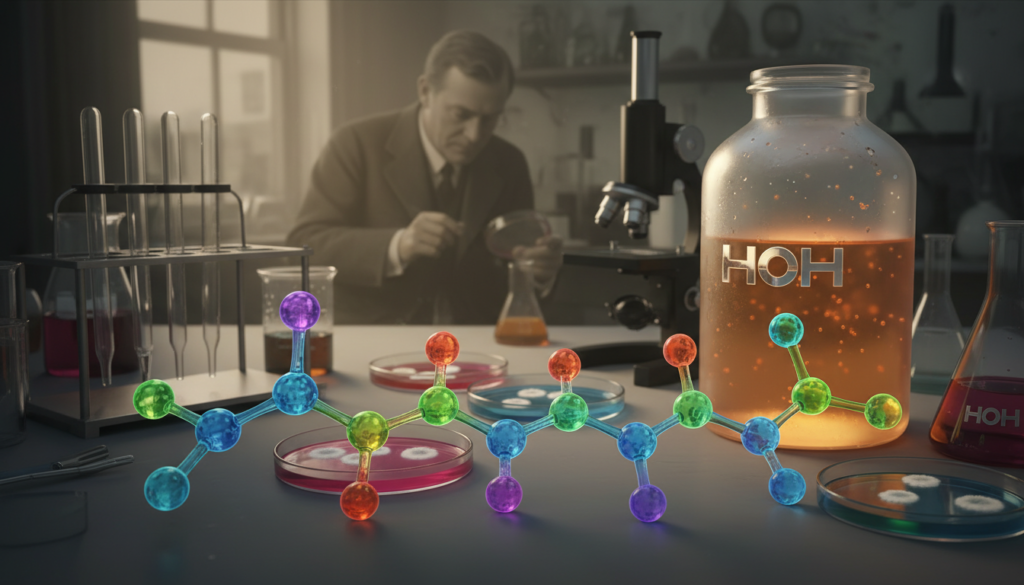
Alexander Fleming didn’t ignore the dish. He isolated the mold and named it Penicillium. He found that the mold’s “mould juice” was killing nearby bacteria.
How Penicillin Works Against Bacteria
Penicillin showed sharp selectivity in early tests. It killed many gram-positive bacteria but not gram-negative ones. This difference helped researchers target their work better.
The clear ring around the mold wasn’t just interesting. It showed that Penicillin was killing bacteria. It wasn’t magic—it was chemistry at work.
| What you could see | What it suggested | Why it mattered for Antibiotics |
|---|---|---|
| A clear halo around the mold on agar | A substance diffused outward and stopped bacterial growth | Pointed to a drug-like effect you could measure and repeat |
| Gram-positive colonies clearing near the “mould juice” | Strong activity against gram-positive organisms | Helped narrow early clinical targets and guide lab testing |
| Gram-negative growth staying mostly unchanged | Limited effect on gram-negative organisms in early trials | Set expectations and pushed the search for other Antibiotics |
| Same pattern across repeated plates | A consistent, testable antimicrobial property | Made Penicillin feel like a tool, not a one-off curiosity |
Its Impact on Infectious Diseases
Penicillin worked against gram-positive pathogens in real-world diseases. It was a game-changer for illnesses like scarlet fever and pneumonia.
Penicillin opened new treatment options for serious diseases. It turned invisible threats into something we could fight back against. It all started with that clean ring on a dish.
The Challenges of Penicillin Production
Discovering a cure should be easy, right? But Penicillin’s journey was far from simple. Finding a germ-killer is one thing. Making it into a stable medicine is another challenge altogether.
When Alexander Fleming shared his findings in 1929, the world barely took notice. The problem wasn’t the idea itself. It was that Penicillin was too fragile and hard to handle.
Initial Production Struggles
Fleming showed Penicillin could stop bacteria in a lab dish. But scaling up was a nightmare. He tried to purify it, but it broke down quickly and was hard to separate from the mold.
Even with top chemists’ help, progress was slow. Fleming left Penicillin research in 1931. The breakthrough was real, but it wasn’t ready for use.
Overcoming Technical Obstacles
Years later, Howard Florey and Ernst Chain took on Penicillin at the University of Oxford. They started fresh in 1937, using better lab methods. It was a tough, detailed process.
At first, making Penicillin was so inefficient. It took gallons of mold broth to make just one dose. The miracle of Penicillin depended on solving these production problems.
| Production hurdle | What went wrong in practice | Why it mattered for Penicillin |
|---|---|---|
| Purification | The active compound was hard to separate from the mold broth without losing strength | Weak or impure batches couldn’t be dosed reliably |
| Stability | The antibacterial effect faded quickly if conditions weren’t just right | Short shelf life made transport and storage risky |
| Low yield | Early methods produced tiny amounts, even from large volumes of culture | Demand could never match supply until the process improved |
| Repeatability | Small changes in growth conditions could shift potency from batch to batch | Microbiology results had to be consistent before clinical use could expand |
The Role of Penicillin in World War II
War pressure grew, and a lab find became urgent. Penicillin went from curiosity to critical tool fast.
By 1940, Alexander Fleming was thinking of retiring. But Howard Florey and Ernst Chain pushed forward. They turned Penicillin into a real treatment. It was a medical breakthrough driven by war needs.
In 1942, the U.S. saw its first Penicillin success. This made the treatment’s promise feel real. But, there was a big demand and a small supply.
Saving Lives on the Battlefield
Infections were as deadly as bullets. Wounds got dirty, and surgeries were rushed. Then Penicillin arrived and changed everything.
Doctors saw fewer deaths from infections. This meant troops got a second chance to heal. It saved lives and limbs.
| Wartime moment | What the records show | Why it mattered to troops |
|---|---|---|
| 1942 (U.S. clinical use begins) | First successful U.S. treatment for streptococcal septicemia, but early supplies stayed limited | Doctors had a powerful option, yet had to ration it for the sickest cases |
| First five months of 1943 | Only 400 million units available | Penicillin was in the fight, but not nearly at the scale the war demanded |
| End of World War II | U.S. companies producing 650 billion units per month | Enough doses to support routine care for wound infections and post-surgery risk |
The Evolution of Antibiotic Use
War sped up production and changed habits. Antibiotics became standard gear.
This shift had tradeoffs. More Penicillin meant new treatment expectations. It also set the stage for future antibiotic use.
Public Recognition and Awards
For years, the lab story spread fast but didn’t get credit. Then, the world noticed. Hospitals started using penicillin, focusing on Alexander Fleming, the Scottish biologist who first saw something useful on a messy plate.
Even with fame, he stayed humble. People who met him said he was quiet and modest. Yet, the honors kept coming because his work was too important to ignore.
Fleming’s Nobel Prize in Physiology or Medicine
In 1945, the Nobel Prize in Physiology or Medicine recognized Fleming’s breakthrough. He shared it with Howard Florey and Ernst Chain. This honored not just the discovery but also the work that made penicillin available on a large scale.
This shared award was significant. It showed the full story: a Scottish biologist saw something important, and a team made it into medicine you could use.
| Year | Honor or Role | Why It Mattered |
|---|---|---|
| 1928 | Professor of Bacteriology, St Mary’s | Gave Alexander Fleming a stronger platform for research and teaching |
| 1943 | Fellow of the Royal Society | Marked top-level scientific respect in the UK |
| 1944 | Knight Bachelor (King George VI) | Public recognition for medical impact during a high-stakes era |
| 1945 | Nobel Prize in Physiology or Medicine (shared) | Highlighted discovery plus the production methods that made treatment widespread |
| 1948 | Emeritus Professor of Bacteriology, University of London | Signaled a career milestone after years of major influence |
Other Recognitions and Honors
Around the same time, Alexander Fleming got about thirty honorary degrees. In 1948, he also got the Knight Grand Cross of the Order of Alfonso X the Wise. This added to his reputation as a Scottish biologist with global impact.
Even after the 1940s, his name kept appearing in the news. Time Magazine listed him among the 100 most important people of the 20th century. This showed that the Nobel Prize was just one part of his lasting legacy.
Legacy of Alexander Fleming
Thinking about a big Medical breakthrough? Alexander Fleming comes to mind. His work changed lab science and how we treat infections. Now, medicine can act fast and confidently in our daily lives.
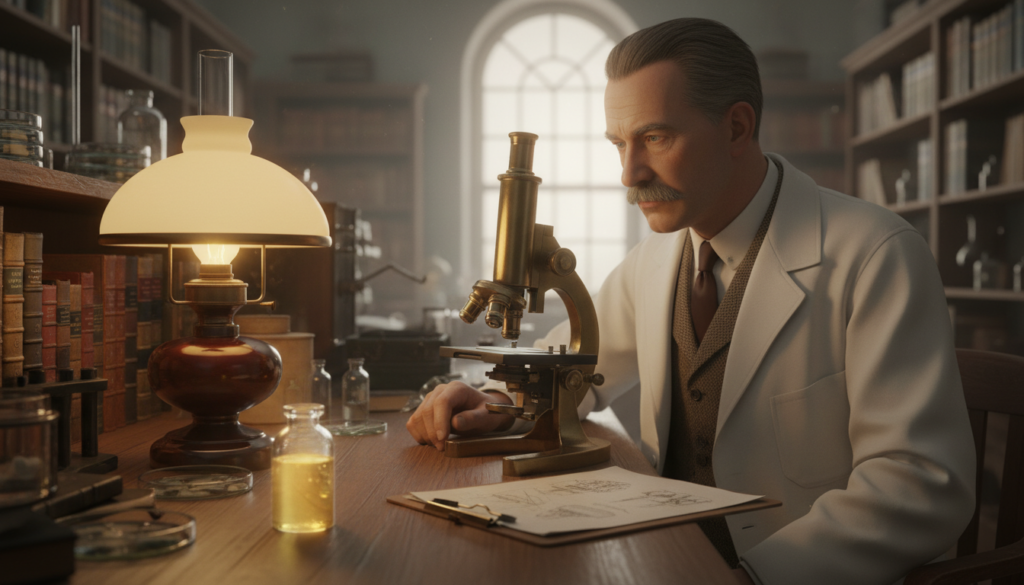
Before penicillin, Fleming was curious about natural defenses. His early research on lysozyme showed the body’s tools were worth studying. Penicillin made these ideas practical, turning Antibiotics into a real treatment.
Penicillin has saved over 500 million lives. This is a huge number that affects families and communities every day.
Influence on Modern Medicine
Today, you see Fleming’s impact in many ways. From strep throat tests to dental procedures, Antibiotics are a key part of care. This shows how one breakthrough changed medicine.
It also changed what we expect. Now, we use targeted tools to fight infections. This has led to new standards in care, from testing to dosing.
| Then (before penicillin scaled) | What shifted after the Medical breakthrough | What you notice today |
|---|---|---|
| Infections often spread fast, with limited ways to stop them | Reliable treatment became possible once penicillin could be produced widely | Common bacterial infections are treated early to prevent serious complications |
| Doctors leaned on wound care, isolation, and rough trial-and-error remedies | Testing and matching treatments to bacteria gained real momentum | Labs guide choices, not guesswork, in hospitals |
| Many surgeries carried high infection risk | Antibiotics made complex surgery safer and more routine | Now, procedures that were once extreme are common, with clear plans |
| Few models existed for turning a lab observation into a mass therapy | Penicillin set the template for developing and scaling new drugs | Drug development follows that path: observe, test, refine, manufacture |
Ongoing Research and Developments
The legacy of Fleming is not static. Researchers continue to build on his work. They look for new ways to fight infections, inspired by Fleming’s discovery.
But, bacteria keep evolving. This means we need new Antibiotics and better ways to use them. The story of Fleming’s discovery keeps inspiring us to find new solutions.
Criticisms and Controversies
Penicillin’s story is exciting but a bit messy. Fleming’s discovery in 1928 gets all the attention. But turning that into a real Medical breakthrough took time, teamwork, and lots of trial and error.
Some say Fleming was lucky, like it was an accident. But finding that mold stopped bacteria was skill, not luck.
Debates on Attribution
Fleming’s discovery was published in 1929. But making it into a usable drug took more time. Howard Florey and Ernst Chain made big leaps in making it practical.
The Nobel Prize is a topic of debate. It celebrates a Medical breakthrough. But that breakthrough wasn’t just one moment. It was a journey of observation, lab work, and making penicillin reliable.
| Milestone | What happened | Why people argue about it |
|---|---|---|
| 1928 | Fleming’s discovery: mold inhibits bacterial growth in a dish | Some call it “accidental,” while others point to the insight it took to recognize the pattern |
| 1929 | Fleming publishes the finding | Publication shows intent and method, but not a ready-to-use medicine |
| Early 1940s | Howard Florey and Ernst Chain drive purification, testing, and practical treatment | This work turns the idea into a repeatable Medical breakthrough |
| Wartime scale-up | Industrial production expands fast | Credit shifts from one lab to a whole system of science, funding, and manufacturing |
The Commercialization of Penicillin
World War II made penicillin a big deal. It became a race to make it fast. Commercialization changed the story, adding engineers, factory lines, and big decisions.
By the end of the war, U.S. companies made 650 billion units a month. This made penicillin a true Medical breakthrough for everyone, not just a rare treatment.
So, when we talk about the Nobel Prize, think in layers. There’s the spark, the hard work, and the industrial effort. Arguing over one hero misses the science journey of leaps, stumbles, and teamwork.
Cultural Impact of Penicillin
Penicillin didn’t just stay in a lab. It became a legend you’ve probably heard of. The story has a messy workspace, a “moldy Petri dish,” and a moment that sounds too good to be true.
People love the story of waking up on Sept. 28, 1928 and changing medicine. It feels human. Alexander Fleming is seen as a sharp-eyed person who noticed something odd.
Fleming described the mold as a “fluffy white mass” in his 1929 writing. It grew and changed colors. This detail makes the story vivid and real.
Representation in Media
Media loves a good story, and this one is no exception. The Petri dish moment became a symbol of luck and careful observation. It’s a story you can picture in your mind.
Big names like Time Magazine helped make Fleming famous. He’s now known worldwide. His name is like a brand, earned through his impact.
| Pop-culture shorthand | What gets repeated | Why it sticks |
|---|---|---|
| “Moldy Petri dish” moment | An overlooked plate leads to Penicillin | It’s simple, visual, and easy to retell |
| Sept. 28, 1928 wake-up quote | Accident + timing changes medicine | It feels like fate, but grounded in real work |
| Observation as the hero | Noticing the bacteria-free zone matters | It flatters the idea that anyone could discover something by paying attention |
| Time Magazine recognition | Fleming’s name enters public memory | A mainstream seal makes the story “official” |
Significant References in Literature
In books, Penicillin is a symbol of a turning point. It shows how infections were once a sure thing. Fleming’s story is easy to remember.
Writers love to say nature invented penicillin; he just discovered it. It’s humble and memorable. It reminds us that microbes were there first, waiting to be noticed.
The Future of Antibiotics and Resistance
Penicillin changed medicine fast. But it showed us no drug lasts forever. It didn’t work well against many bacteria, showing its limits.
Now, we face a bigger challenge. The more we use Antibiotics, the more bacteria adapt. This turns simple infections into big problems.
Current Issues with Antibiotic Resistance
Antibiotic resistance isn’t just a hospital problem. It’s everywhere, from urgent care to nursing homes. Bacteria share tricks and build defenses, making drugs less effective.
Penicillin is a great example. It’s widely used, but that’s risky. Overuse tests its limits, making it less powerful.
| What you do | What bacteria “learn” | Why it matters for Antibiotics |
|---|---|---|
| Stop a prescription early because you feel better | Survivors stick around and bounce back stronger | Raises the odds that Antibiotic resistance shows up in the next round |
| Take Antibiotics for colds or the flu | They get extra practice facing drugs for no reason | Wastes treatment power and speeds up resistance pressure |
| Use the “strongest” drug first when a narrower one would work | They adapt to bigger weapons sooner | Makes future infections harder to match with the right medicine |
| Skip lab testing when symptoms keep coming back | The real culprit stays hidden and keeps evolving | Leads to repeat exposure and more chances for Antibiotic resistance |
Fleming’s Warning on Overuse
Alexander Fleming knew treatments often fail. He saw the power of Penicillin but also its limits. He warned about overusing Antibiotics.
His warning is practical and true. To keep Antibiotics working, we must use them wisely. This means careful dosing and smart choices. It’s a way to slow resistance without expecting a quick fix.
Conclusion: The Lasting Impact of Fleming’s Work
It’s amazing to think how Alexander Fleming’s story began in Scotland in 1881. It ends with a huge change in medicine. He went from being a Scottish biologist to a key figure at St Mary’s Hospital in London.
World War I came, and the need for better treatments grew. Fleming’s discovery was a game-changer. Before him, there was lysozyme in 1922, showing the body fights germs.
In 1928, a chance discovery changed everything. A bit of mold in a Petri dish led to penicillin. Fleming wrote about it in 1929, but it wasn’t widely recognized.
Howard Florey and Ernst Chain took Fleming’s work further. They made penicillin practical. By World War II, it was saving lives on a massive scale. In 1945, Fleming won the Nobel Prize, and the world took notice.
The human side of Fleming’s story is just as important. He was humble and not after fame. He married Sarah McElroy in 1915 and later Amalia Koutsouri-Vourekas in 1953. His son, Robert, became a doctor.
After Sarah died, Fleming married again. He died on March 11, 1955, from a heart attack. His ashes were placed in St Paul’s Cathedral. Fleming’s story teaches us about the power of noticing and following chance discoveries.
FAQ
Who was Alexander Fleming, and why do people talk about him?
Where and when was Alexander Fleming born?
Did Fleming always plan to become a doctor or researcher?
What pushed Fleming into medical training?
Where did Alexander Fleming study medicine?
How did a rifle club influence Fleming’s career?
What was infection treatment like before penicillin and modern antibiotics?
Why were infections so dangerous in the early 1900s?
What was lysozyme, and why does it matter in Fleming’s story?
What actually happened in the “moldy Petri dish” penicillin story?
Why is penicillin called an accidental discovery if Fleming was a skilled scientist?
When did Fleming publish his findings about penicillin?
What mold did Fleming identify, and what was the “mould juice”?
How does penicillin work against bacteria?
Did penicillin work against all bacteria right away?
Which diseases did penicillin help treat once it became usable?
If Fleming discovered penicillin in 1928, why didn’t everyone get it right away?
Who turned penicillin into a practical medicine?
How did World War II change penicillin’s story?
How fast did penicillin production scale in the United States during WWII?
When was the first successful penicillin treatment in the United States?
Did Fleming win a Nobel Prize for penicillin?
What other honors did Fleming receive?
Why is Fleming sometimes described as “careless” in the lab?
Who deserves credit for penicillin—Fleming or Florey and Chain?
How widely used is penicillin today, and how many lives has it saved?
Why does penicillin’s story matter for antibiotic resistance today?
What are the key dates in Fleming’s personal life?
When did Alexander Fleming die, and where is he buried?
Why did penicillin become such a powerful cultural legend?
What’s the real lesson you can take from Fleming’s discovery?
Get More Medical History
Join our newsletter for fascinating stories from medical history delivered to your inbox weekly.