The History of Healing
 Marie Curie’s Lasting Impact on Medical Science
Explore how Marie Curie revolutionized medical science with her groundbreaking work on radioactive elements and their applications.

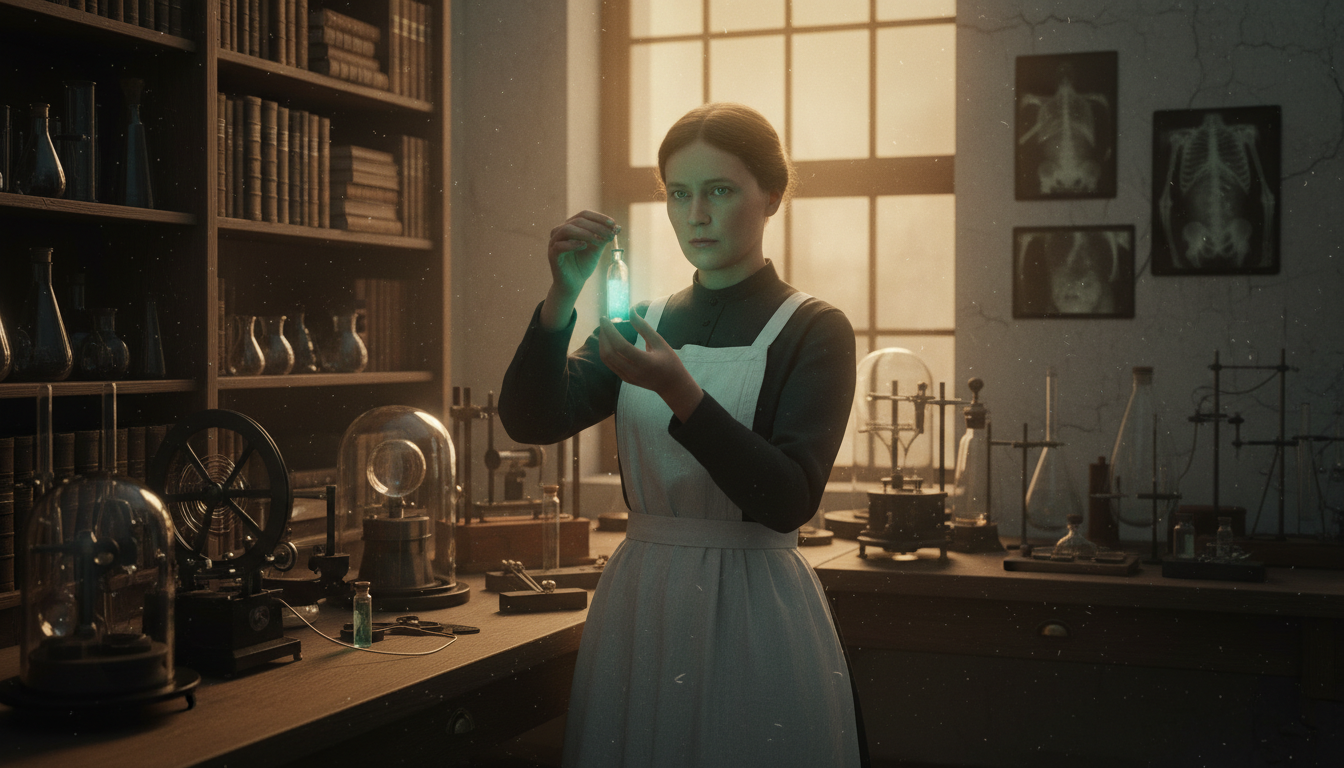
Did you know that Marie Curie made radiology useful for finding hidden injuries? She wanted science to help people, not just be interesting. Her work was life-saving.
Marie Curie is a big name in medical science, thanks to her work on cancer and imaging. She was a scientist, physicist, and chemist. She made radioactivity useful for medicine.
In 1898, Marie Curie and Pierre Curie found polonium and radium. They also isolated pure radium in 1910. This was a big deal for doctors.
Her work led to new cancer treatments. During World War I, her team used X-rays to help soldiers. This saved many lives.
But Marie Curie faced many challenges. She faced sexism, public shame, and health risks from radiation. She died in 1934 from health problems caused by radiation.
Key Takeaways
- Marie Curie helped turn radioactivity into real tools for medical science.
- As a physicist and chemist, she pushed research beyond theory and into hospitals.
- She and Pierre Curie discovered polonium and radium in 1898.
- She isolated pure radium in 1910, setting the stage for wider medical use.
- Her work helped spark radium-based cancer treatment and modern radiology.
- Her World War I “Little Curies” brought X-ray imaging to wounded soldiers faster.
- Long radiation exposure harmed her health and led to her death in 1934.
Early Life and Education of Marie Curie
Before Marie Curie changed the world, she was a kid in Warsaw. She faced tough times in school and at home. Her early years were filled with family pride, loss, and a strong will to learn.
Childhood Influences
Marie Curie was born Maria Salomea Skłodowska on November 7, 1867, in Warsaw, Poland. The Russian Empire ruled the area then. Her family loved learning. Her father taught math and physics, and her mother ran a girls’ boarding school.
But life was hard. Russian rules limited Polish culture and education. She lost her oldest sister to typhus and her mother to tuberculosis when she was 11.
| Early pressure point | What it looked like in Warsaw | How it shaped Marie Curie |
|---|---|---|
| Political control | Restrictions in classrooms and public life under Russian rule | More drive to study privately and protect ideas that mattered |
| Family of educators | A father teaching science and a mother running a school | Early comfort with labs, books, and disciplined practice |
| Personal loss | Typhus took her sister; tuberculosis took her mother | A tougher focus and patience for long, hard goals |
Academic Pursuits
Women in science faced big barriers. So, she found the Flying University in Warsaw. It offered secret classes for women.
Money was a problem. She made a deal with her sister Bronisława. Marie would help pay for Bronya’s medical training in Paris. Later, Bronya would help Marie study.
From age 17, she worked as a governess and tutor. She studied whenever she could. In 1891, she moved to Paris to study at the Sorbonne.
She earned a physics degree in 1893, finishing first. She got a math degree the next year. In 1894, she met Pierre Curie in a lab. They married in 1895.
Her education kept growing. On June 25, 1903, she defended her Sorbonne thesis. She became the first woman in France to earn a doctorate. This moment showed her determination and growth from Warsaw to becoming a renowned scientist.
Pioneering Work in Radioactivity
A strange glow on a photographic plate. A result that won’t behave. That’s the spark that pulled Marie Curie in.
She treated radioactivity like a real, measurable thing—not a parlor trick. She tracked it across materials, compared readings, and kept asking the same question: why is this sample stronger than it “should” be?
Once you notice that some ores act more intense than uranium alone, you don’t unsee it. Curie followed that clue straight into a world of radioactive elements hiding in plain sight.
Discovery of Polonium and Radium
Henri Becquerel’s uranium tests showed invisible rays could pass through black paper and darken a plate. Curie grabbed that idea and made it her own, building careful experiments around it instead of chasing quick headlines.
Working with Pierre Curie, she focused on pitchblende, because its signal was too strong to explain. In 1898, their work pointed to new substances in the mineral—one later named polonium, a nod to her homeland, and another that would become radium.
Those names mattered, but the bigger deal was the method. When you can prove a hidden source is driving the readings, the periodic table stops feeling finished.
Techniques in Radioactive Research
Curie even gave the phenomenon its everyday word: radioactivity. She measured, re-measured, and compared sample after sample, showing the effect wasn’t limited to one element and hinting that more radioactive elements were out there.
Then came the hard part: processing massive amounts of ore to concentrate the active material. It wasn’t glamorous—more like endless stirring, heating, dissolving, and sorting, with results that arrived in tiny fractions.
Years later, isolating pure radium in 1910 made the science cleaner and more testable. And while she studied radium, the idea sharpened that the energy wasn’t coming from molecules—it was coming from inside the atom itself.
| What Curie tracked | What you would’ve seen in the lab | Why it pushed the story forward |
|---|---|---|
| Pitchblende readings stronger than uranium | Measurements that stayed unusually high across repeated tests | Suggested unknown radioactive elements were mixed into the ore |
| polonium signals in separated fractions | Small, “hot” portions that stood out after chemical steps | Backed the claim that a new source of radioactivity existed |
| radium concentrated over long processing runs | Brighter activity in more refined material, even in tiny amounts | Made it possible to study radium as its own substance, not just a hunch |
| Consistent measurements across different compounds | Similar behavior even when the chemical form changed | Pointed to an atomic source, not a surface reaction |
Contribution to Medical Science
Marie Curie’s lab work changed a lot for people in hospitals. With radium, doctors had a real tool to use. It wasn’t just talk anymore.
It also made radiology better. Doctors started tracking doses and watching results. This helped make treatments safer over time.
Advances in Cancer Treatment
Curie and Pierre Curie found that radiation hurts diseased tissue more than healthy. This was a big clue. It showed doctors that cancer treatment could be more precise.
In the early 1900s, doctors started using radium in new ways. They put it in tubes, needles, and small containers. This helped treat some cancers, like skin and breast cancers.
This wasn’t magic, but it was a new start. It led to careful treatment plans and patient follow-up. These ideas are part of cancer treatment today.
Development of Radiation Therapy
Understanding radium led to the start of radiation therapy. It moved from discovery to a medical method.
Curie’s work is in the heart of today’s care. It’s about measuring doses and planning treatments. This made radiology more than just imaging.
Today’s radiation therapy is far from the early days. But the idea is the same: aim the energy, protect the body, and treat with evidence. This made cancer care feel more planned and less random.
| What changed | Early use of radium | How it shaped radiology and care | Why it mattered for oncological treatments |
|---|---|---|---|
| Targeting the tumor | Radium placed close to the tumor with tubes or needles | Encouraged precise placement and careful documentation | Supported the idea that cancer treatment could be localized |
| Thinking in dose and time | Exposure planned by duration and distance, then adjusted by results | Pushed radiology toward measurement and repeatable protocols | Made radiation therapy less experimental and more systematic |
| Balancing benefit and harm | Clinicians learned quickly that healthy tissue could be injured too | Led to more caution, shielding habits, and safer routines | Set the stage for risk-aware oncological treatments in clinics |
| From discovery to practice | Radium became a medical material, not just a lab curiosity | Helped connect research culture with hospital decision-making | Opened a durable route into modern radiation therapy programs |
Nobel Prizes and Scientific Recognition
Marie Curie’s achievements were like a lightning strike. The world gave her applause and scientific recognition. This changed what people thought about lab work.

The timeline of her achievements is clear. You can feel the doors opening and closing. It shows her grit and determination.
First Female Nobel Laureate
In 1903, Curie won the Nobel Prize in Physics. She shared it with Pierre Curie and Henri Becquerel for their work on radiation. The French first nominated only Pierre and Becquerel.
Pierre fought for Marie to be included. This moment was important. It showed the real work in the lab was done by Curie, the physicist.
In 1911, Curie won the Nobel Prize in Chemistry. She discovered radium and polonium and studied their properties. This work was based on her isolation of pure radium in 1910.
| Year | Award | Field | What it recognized | Why it hit differently |
|---|---|---|---|---|
| 1903 | Nobel Prize | Physics | Research on radiation phenomena with Pierre Curie and Henri Becquerel | French nominators first left Marie out; Pierre demanded her name be added |
| 1911 | Nobel Prize | Chemistry | Discovery of radium and polonium and deep study of their properties | Built on the isolation of pure radium completed in 1910 |
Her Impact on the Scientific Community
By 1911, Curie was unmatched. She was the only person to win Nobel Prizes in two science categories. This achievement is rare and stands alone.
Her status changed how her work was viewed. She led the Curie Laboratory at the Radium Institute. She was a chemist and physicist, always focused on data.
Her discoveries pushed nuclear physics and chemistry forward. They helped establish radioactivity as a basic atom property. Later generations built fields on this.
The Legacy of Research Methods
Marie Curie’s daily work was truly remarkable. She didn’t just dream big; she focused on precise numbers. Her work shows how scientists handle radioactive elements carefully and patiently.
Innovation in Laboratory Techniques
Curie’s methods were all about steady measurements. She tested many samples, not just one. Her work turned radioactivity from a mystery to something measurable.
She also explored thorium compounds, expanding our knowledge of radioactive elements. Then, she extracted radium salts from tons of ore in harsh conditions. It was tough work.
By 1910, Curie had isolated pure radium. This made it easier for labs to compare results. It moved research from “something strange is happening” to “here’s what it does, and how we can track it.”
| Method habit | What Curie did | Why it mattered later |
|---|---|---|
| Repeatable measurement | Checked readings across many materials and reran tests to confirm patterns | Made claims easier to verify in other labs and reduced one-off mistakes |
| Systematic sampling | Looked beyond uranium and included thorium compounds and mixed ores | Helped researchers spot new behaviors in radioactive elements faster |
| Hard-core purification | Processed tons of pitchblende ore to isolate radium salts and later pure radium | Gave radium research stable reference material for comparison and calibration |
| Careful recordkeeping | Logged procedures, amounts, and outcomes with tight consistency | Supported safer, clearer training standards for future laboratory techniques |
Influence on Future Scientific Research
Curie’s work changed the lab forever. She taught the importance of rigor, clear communication, and never giving up. After Pierre Curie’s death, she became the first female professor at the University of Paris (Sorbonne).
Her daughter, Irène Joliot-Curie, won the Nobel Prize in Chemistry in 1935. This shows Curie’s methods lived on through her family and students. They carried her legacy into the future.
World War I and Medical Applications
In World War I, the time from a wound to the operating table was critical. Marie Curie made radiology a reality in field care. This turned medical imaging into a vital need, not a luxury.
Role in Mobile X-ray Units
Curie thought, “If surgeons can’t reach an X-ray machine, the machine must move.” She created mobile radiography cars, known as “Little Curies.” These units brought X-ray diagnostics to the front lines.
Each unit had everything needed for X-rays, like power and darkroom supplies. This idea made radiology practical and immediate, not distant.
Impact on Battlefield Medicine
X-ray diagnostics helped surgeons find bullets and shrapnel quickly. This led to cleaner surgeries and fewer infections. Radiology brought precision to battlefield medicine.
Marie Curie worked with her daughter Irène in hospitals during World War I. They set up X-ray units, like at Hoogstade Hospital in Belgium in 1915. In these moments, medical imaging became routine on the battlefield.
| Battlefield problem | What X-ray diagnostics changed | Why it mattered in radiology |
|---|---|---|
| Hidden shrapnel and bullets | Showed foreign objects and rough position before surgery | Medical imaging supported faster, more targeted decisions |
| Unclear fracture patterns | Revealed breaks and splintering that hands couldn’t confirm | Radiology helped guide splinting and surgical planning |
| Overcrowded field hospitals | Helped sort urgent cases from those who could wait | X-ray diagnostics became a practical triage tool |
| Limited time and supplies | Reduced repeat procedures caused by wrong first attempts | Medical imaging lowered wasted effort under extreme constraints |
The tech worked, and it traveled. Marie Curie made radiology mobile and practical for World War I. This was exactly what doctors needed at that time.
Formation of the Curie Institutes
Marie Curie didn’t just stop at discovery. She wanted places where ideas could become real work. She wanted steady funding, skilled staff, and patients nearby. This is why the Curie Institute is a big part of the story, not just a small note.
Establishment of Research Facilities
By her second Nobel Prize, Curie led a busy lab at the Radium Institute in Paris. It was a permanent base for radiation science, built to last.
The radium institute became the Curie Institute over time. Its mission was clear: measure carefully, document everything, and keep the work useful. It wasn’t just about studying radium. It was about building a system for cancer research and medical practice to grow together.
| What the institute built | Why it mattered day to day | How it supported cancer care |
|---|---|---|
| Dedicated laboratories for radiation measurement | Reduced guesswork with consistent methods and calibrated tools | More dependable data to guide radiotherapy plans |
| Shared spaces for researchers and clinicians | Faster feedback between lab results and patient needs | Quicker improvements in cancer research and treatment routines |
| Training and standard procedures | Helped new teams learn the same safe, repeatable techniques | More consistent radiotherapy delivery across staff |
Ongoing Contributions to Health
The big shift was simple but powerful: research and care under one roof. At the Curie Institute, the path from discovery to a clinic visit didn’t have to cross town—or cross years.
This setup shapes modern radiotherapy and cancer research today. It ties back to public health, too. Careful methods, shared knowledge, and better tools help everyone who comes next.
- Faster learning loops: lab findings can inform clinical choices without long delays
- Better consistency: shared protocols make care less dependent on “who’s on shift”
- Wider impact: training and standards spread beyond one building and into public health practice
Public Awareness and Education
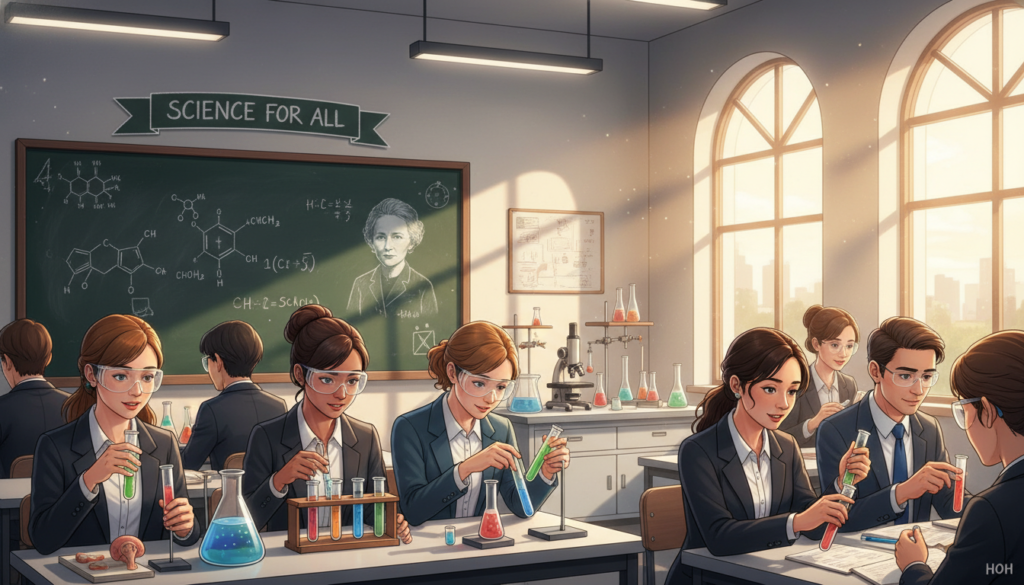
Marie Curie’s story is more than just a famous scientist. She wanted everyone to understand why research is important. Even when it doesn’t seem useful at first.
Promoting Science to the Public
Curie knew she couldn’t predict the future. She said radium was for pure science, not for making money. She was all about curiosity.
Then, something amazing happened. Hospital care got better. New tools came out. Basic research can lead to big changes without warning.
She believed in sharing knowledge with everyone. “Radium is not to enrich any one… it is for all people.” She thought knowledge should help everyone, not just a few.
Inspiring Future Generations
For women in science, Curie was a big role model. She became the first female professor at the University of Paris. This showed that doors could open for others.
Her labs taught students by doing. They learned through hands-on work and careful measurements. It was a cycle of testing, recording, and questioning.
Her family followed in her footsteps. Her daughter, Irène Joliot-Curie, won the Nobel Prize in Chemistry in 1935. This shows how learning can create new scientists.
| What you can borrow from Curie’s approach | How it shows up in real science education |
|---|---|
| Share discoveries for the public good, not private gain | Open lectures, public museums, and classroom demos that connect lab work to everyday health |
| Respect basic research, even when results aren’t immediate | Funding and teaching that reward careful experiments, not just fast answers |
| Mentorship built into daily work routines | Lab apprenticeships, research internships, and guided projects where students learn by doing |
| Make space for women in science through visible leadership | More role models in faculty roles, plus clearer pathways for students who don’t see themselves represented |
Challenges Faced by Marie Curie
Looking back at Marie Curie’s achievements, it’s easy to imagine a smooth journey. But it wasn’t. Women in science faced tough battles, not just in the lab but also in classrooms and offices.
Gender Bias in Science
In Warsaw, Marie Curie hit a barrier: women couldn’t attend the University of Warsaw under Russian rule. So, she studied where she could and dreamed of Paris, a rare chance for her.
Even after her groundbreaking discoveries, gender bias persisted. In 1903, French academics nominated her for a Nobel Prize but left her out. Pierre Curie fought for her inclusion, showing the world her value.
Personal Sacrifices
Before fame, survival was the goal. She studied hard in cold rooms and worked as a governess to fund her education. This hard work paved the way for her breakthroughs.
Life took a harsh turn when Pierre Curie died in 1906. Marie Curie carried on, balancing grief with her relentless research.
Working with radioactive materials took a toll. She handled these dangerous substances in poor conditions, showing the risks women faced in science.
Controversies Surrounding Her Work
Marie Curie’s story is not just about genius and awards. It’s also about discovery, ego, and harm. Radioactivity changed medicine but raised big questions.
The lab was once a place of wonder. Now, it feels like a warning. This tension is at the heart of her legacy.
Ethical Considerations of Radiation
Curie and her team didn’t fully understand radiation risks. The excitement around radium made safety an afterthought. This shaped early research ethics badly.
Marie and Pierre often got sick. Pierre even exposed his arm to radium on purpose. This shows how danger felt in the rush of discovery.
Today, Curie’s 1899–1902 notebook is very radioactive. It will stay that way for about 1,500 years. Some of her work is kept in lead boxes, reminding us of radioactivity’s power.
Debates on Research Practices
Curie’s work wasn’t just about science. Her affair with Paul Langevin caused a scandal. This backlash was harder because she was a woman.
There were also fights over credit and visibility. Even with two Nobel Prizes, people questioned her work. This mix of status and rivalry made fairness and recognition key in research ethics.
| Flashpoint | What people argued about | Why it matters today |
|---|---|---|
| Lab handling of radium | Whether studying radioactivity was worth the risks | It led to modern safety rules and limits |
| Health fallout in early labs | How much risk scientists should take | It led to discussions on research ethics |
| Curie–Langevin scandal | Should personal life affect scientific trust | It shows how bias affects who is believed |
| Recognition and credit | How contributions were assigned | It relates to today’s debates on authorship and gender gaps |
Recognition After Death
Marie Curie died on July 4, 1934, at 66. She was at the Sancellemoz Sanatorium in Passy, France. Her death was due to aplastic anemia from radiation.
Her story didn’t fade. It grew stronger. She won the Nobel Prize in 1903 and 1911. This showed her bravery in science.
Reading about her is a mix of awe and pause. Her legacy is about discovery and its cost.
Awards and Honors
Even after her death, Marie Curie’s honors kept coming. She’s the only person to win Nobels in Physics and Chemistry. This shows why she’s a key figure in medical history.
In 1935, her daughter Irène Joliot-Curie won a Nobel Prize. This kept the Curie name in the news. It showed their research tradition continued.
| Milestone | Verified detail | Why it matters |
|---|---|---|
| Death and cause | Died July 4, 1934, age 66, at Sancellemoz Sanatorium in Passy, France; aplastic anemia linked to prolonged radiation exposure | Adds a sobering truth to radiology history and the early days of lab safety |
| Nobel standing | Nobel Prize winner in 1903 and 1911; only person with Nobels in two different science categories (Physics and Chemistry) | Sets a rare benchmark that keeps her legacy in public view |
| Family continuation | Irène Joliot-Curie received a Nobel Prize in 1935 | Extends the Curie impact beyond one lifetime and highlights a lasting scientific lineage |
Commemoration in Popular Culture
Marie Curie’s fame grew outside the lab. She’s seen as a “martyr to science.” This phrase is dramatic but true.
Her radioactive notebooks and papers are kept safe. Her lab and wartime photos show how we learned about radiation.
Continuing Influence on Medical Science
Marie Curie’s work in radiology and oncology is amazing. She started with a simple question about invisible rays. Her hard work led to a guide for measuring and documenting everything.
Current research echoes her approach. Today’s teams use her findings with polonium and radium. They aim to use radiation to fight disease safely.
Current Research Inspired by Curie
Her work is seen in today’s care. Medical imaging is getting better and faster. This helps doctors find problems early and treat them better.
In oncology, researchers are improving radiation therapy. They aim to target tumors better and protect healthy tissue.
The Future of Radiology and Oncology
Curie’s work on mobile X-rays was ahead of its time. Today, patients want quick and precise imaging. The future will bring even more precise treatments and better protection.
This makes us wonder what new discoveries will become tomorrow’s treatments. Marie Curie showed us how science can lead to real medicine.
FAQ
Why do you hear Marie Curie’s name in radiology and cancer care?
Who was Marie Curie before she became famous?
How did Marie Curie get an education when women couldn’t attend university in Warsaw?
What did Marie Curie do before studying at the Sorbonne?
When did Marie Curie move to Paris, and what did she study?
How did Marie Curie meet Pierre Curie?
What was Marie Curie’s doctoral thesis, and why was it historic?
Did Marie Curie really coin the term “radioactivity”?
What discovery pushed Marie Curie toward studying radioactive materials?
How did Marie and Pierre Curie discover polonium and radium?
When did Marie Curie isolate pure radium, and why did it matter for medicine?
What was Marie Curie’s big conceptual breakthrough about atoms?
How did radium become part of early cancer treatment?
What kinds of cancers were treated with early radium therapy?
How is Marie Curie connected to modern radiation therapy and radiation oncology?
When did Marie Curie win the Nobel Prize, and for what?
Why is Marie Curie’s Nobel record unmatched?
What roles did Marie Curie hold after her major discoveries?
What was so physically demanding about Curie’s lab work?
How did Marie Curie influence future scientists, including her own family?
What were the “Little Curies” in World War I?
How did mobile X-rays change battlefield medicine?
What is the Curie Institute, and why does it matter in healthcare?
What did Marie Curie believe about science and the public good?
What kinds of gender barriers did Marie Curie face?
What personal sacrifices did Marie Curie make for her research?
Did Marie Curie and her peers understand radiation dangers at the time?
What are some chilling examples of radiation risk from Curie’s era?
What was the Paul Langevin scandal, and why did it matter?
How did Marie Curie die, and when?
How has Marie Curie been remembered in popular culture?
How does Curie’s work influence medicine today?
What does Marie Curie’s story suggest about the future of radiology and oncology?
Get More Medical History
Join our newsletter for fascinating stories from medical history delivered to your inbox weekly.