The History of Healing
 Avicenna and The Canon of Medicine Explained
Explore the genius of Avicenna and his groundbreaking work, The Canon of Medicine, that reshaped medical understanding for centuries.

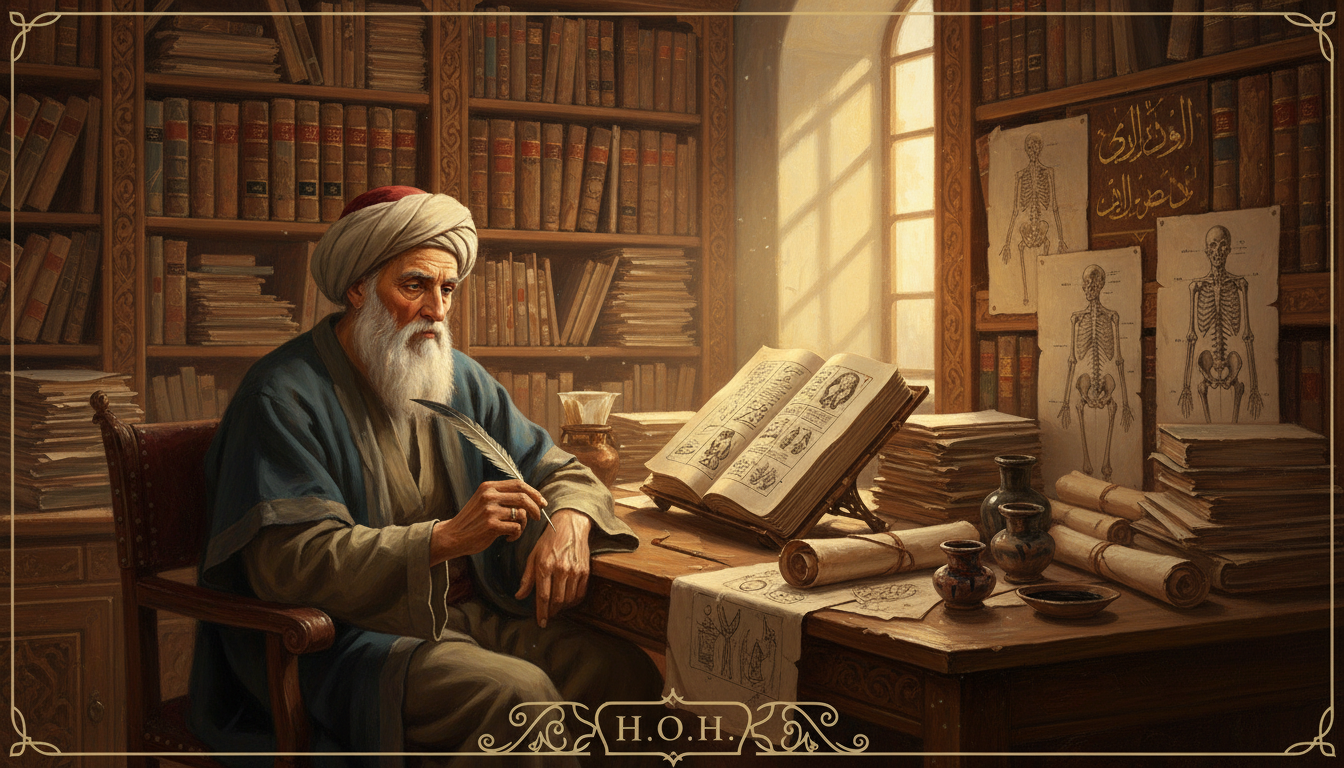
More than one million words make up The Canon of Medicine. It’s a huge medical encyclopedia written almost a thousand years ago. After being translated into Latin in the 1100s, it shaped medical teaching in Europe for centuries.
Avicenna, whose real name was Ibn Sina, is at the heart of this story. He was born around 980 in Bukhara and died in 1037 in Hamadan, both in Persia (now Iran). His life was big, his mind was busy, and his writing is hard to believe.
It’s important to note that Avicenna wasn’t Arabic—he was Persian. But he wrote The Canon of Medicine in Arabic. This choice helped his ideas spread quickly across borders and centuries.
So, why does Avicenna matter to you? The Canon didn’t just copy ancient Greek and Roman medicine. It organized it, tested it, and added clinical details that doctors used for generations. Sir William Osler called Avicenna the “author of the most famous medical textbook ever written.” He said the Canon was a “medical bible” for longer than any other work.
In this article, we’ll explore who Avicenna was, what he wrote, and why his Canon trained doctors for so long.
Key Takeaways
- The Canon of Medicine is a massive medical encyclopedia, often estimated at over a million words.
- Avicenna (Ibn Sina) was a Persian physician and polymath, not Arabic, even though he wrote in Arabic.
- A quick Avicenna biography: born around 980 in Bukhara and died in 1037 in Hamadan (both in Persia, now Iran).
- The Canon blended ancient medical sources with practical methods from Avicenna’s own era.
- After a 12th-century Latin translation, the book became a major force in European medical education for centuries.
- Avicenna significance is backed by Sir William Osler’s famous praise of the Canon’s long-lasting influence.
Who Was Avicenna?
Ever wondered how one person could change medicine and big ideas? The Avicenna biography is a great start. Known as Ibn Sīnā, he moved between courts, libraries, and clinics with energy. He wasn’t just collecting facts; he was trying to make knowledge fit together like a map.
That’s why he’s called an Avicenna philosopher, not just a doctor. His ideas didn’t stay in one place. They moved between logic, nature, and treating sick people.
Early Life and Education
Avicenna was born near Bukhara, the Sāmānid Dynasty’s capital. His father, a local governor, had discussion circles. Imagine growing up with smart adults debating at dinner.
He had a private tutor early and memorized the Qur’an by ten. He also learned Arabic poetry, which helped him think clearly. Soon, he dove into Aristotelian logic and metaphysics.
One teacher, Abū ʿAbd Allāh al-Natili, saw his talent fast. Avicenna tested ideas, asking “why,” and then improved them. This pattern shows in his works—learn the rules, then improve them.
As a teenager, he struggled with Aristotle’s Metaphysics but kept coming back. Then, he turned to medicine and found it easier. Reading Galen in Arabic translation gave him a practical toolset, and he quickly mastered diagnosis and treatment.
Influences on His Work
Avicenna’s mind was at a crossroads. He used Aristotle’s framework for nature and reasoning. He also learned from Islamic physicians, including his own experience.
His big move was not pretending every source agreed. He pointed out where Aristotle and Galen disagreed. Then, he tried to build one view. This “synthesizer” instinct makes his biography feel modern.
Two titles show the range of Avicenna’s works:
- The Canon of Medicine, for practice—how to think, observe, classify, and treat.
- The Book of Healing (Kitāb al-shifāʾ), an encyclopedia that blends philosophy and science.
Together, they show Avicenna as a philosopher who wanted medicine to be precise. He wanted ideas to connect, not just pile up. A living system, not a collection of facts.
| Influence | What Avicenna Took From It | How It Shows Up in Avicenna Works |
|---|---|---|
| Aristotle | Logic, cause-and-effect thinking, and a structured way to explain nature | Clear definitions, careful categories, and step-by-step reasoning that guides diagnosis |
| Galen | Clinical observation, medical writing traditions, and detailed physiological debates | Practical focus on symptoms and therapies, plus arguments where he adjusts or critiques earlier views |
| Islamic medical practice | Real-world patient care, pharmacy know-how, and hospital-based routines | Advice that reads like it was tested in a busy clinic, not just imagined in a library |
The Historical Context of Avicenna’s Era
To understand Avicenna, imagine his world. Cities were alive with debates, book copying, and medical practice. This environment shaped his philosophy and helped spread Avicennism far and wide.
The Golden Age of Islam
In Avicenna’s time, Islamic medicine drew from Greco-Roman traditions, like Galen. But it also welcomed ideas from Persia, India, and China through trade and translation.
Politics were unstable, and Avicenna often had to move. His secular views sometimes made him feel out of place. Yet, he kept contributing to knowledge, even when his life was unpredictable.
Language played a big role too. The Canon of Medicine was written in Arabic, the language of scholarship. Writing in Persian was risky in some places, despite many scholars doing it.
Key Thinkers and Their Contributions
Avicenna didn’t work alone. He was part of a vibrant scene where scholars wrote on many subjects. This was the world of Al-Biruni, Al-Razi, and Omar Khayyam.
Avicennism was special because it mixed Islamic and Western ideas in a practical way. This blend made Avicenna’s work valuable in clinics and classrooms for centuries.
| Thinker | What people often associate with them | How this shaped the shared knowledge culture |
|---|---|---|
| Avicenna | Medicine and philosophy working side by side | Showed how careful reasoning could guide practice, which later fed Avicennism |
| Al-Biruni | Measurement, astronomy, and close observation of the natural world | Raised the bar for precision and method, which supported serious study across disciplines |
| Al-Razi (Rhazes) | Clinical writing and hands-on medical judgment | Kept medicine grounded in cases and experience, a helpful counterweight to pure theory |
| Omar Khayyam | Mathematics and astronomy, with a sharp eye for patterns | Added tools for calculation and structure that scholars could reuse in many fields |
Overview of The Canon of Medicine
Ever opened a huge book and thought, “Where do I start?” That’s what the Canon of Medicine was for. Avicenna made it easy to follow, from big ideas to specific treatments.
The title might sound scary, but it’s simple. “Canon” comes from the Latin Canon Medicinae (from Arabic) and means a complete system. It’s a full medical guide in one place.
Avicenna didn’t write it quickly. He started in Gorganj, worked in Rey, and finished in Hamadan. He finished the first book around 1010–1015. By 1025, the whole encyclopedia was complete.
Structure and Organization
The Canon of Medicine has five books. Each book has a different role. It’s like a medical toolkit: basics first, then materials, then body region problems, then whole-body issues, and lastly, recipes for remedies.
- Foundations: core medical principles, anatomy basics, regimen, and general therapy
- Simple drugs: medical substances organized alphabetically (after explaining general properties)
- Local diseases: illnesses tied to specific body parts, with diagnosis and treatment
- General diseases: conditions that spread across multiple parts or the whole body, including fevers, toxins, and tumors
- Compound remedies: a formulary-style guide to mixed preparations and pharmacology
| Book | What it covers | How you’d use it while reading | What it helps you find fast |
|---|---|---|---|
| 1 | Physiology, basic anatomy, regimen, general treatment logic | Start here to learn the “rules of the game” in Avicenna medicine | Definitions, body functions, and broad care plans |
| 2 | Simple substances listed alphabetically, with shared properties explained first | Use it like a lookup list when a remedy mentions a single ingredient | Names, qualities, and typical uses of individual substances |
| 3 | Diseases organized by body part, paired with diagnosis and treatment | Go here when the problem is clearly “located” (eye, stomach, lung) | Signs to watch for and targeted care by organ or region |
| 4 | Conditions affecting the whole body, including fevers, toxins, tumors | Use it when symptoms feel systemic, not tied to one spot | Patterns that connect wide-ranging symptoms and broad interventions |
| 5 | Compound remedies and practical pharmacology, with many formulations | Turn to it after you’ve chosen ingredients and need a prepared mix | How multi-ingredient medicines are combined and applied |
Key Themes and Principles
One big idea drives the whole Canon of Medicine: medicine should be taught as a single, connected system. Avicenna believed no earlier work had pulled everything into one organized “whole,” so he tried to do it himself in the Avicenna Canon.
In Book 1, he frames medicine as the science of knowing the body in health and sickness, how health is lost, and how it’s restored. This idea is practical because it is. It’s a working definition that guides what belongs in the text.
He also leans on a clean cause-and-effect mindset. In Avicenna medicine, illness can be discussed through four causes: material, efficient (both extrinsic and intrinsic), formal, and final. This structure comes from Aristotelian thinking, but he uses it for down-to-earth aims, like sorting symptoms, weighing likely sources, and choosing treatments that fit the case.
So as you move through the Canon of Medicine, you’re not just collecting facts. You’re watching a method at work: philosophy and logic pressed into service for real clinical decisions, page after page.
Significance of The Canon of Medicine
The Canon of Medicine is more than a big book. It’s a system that organizes old ideas and new techniques. This makes it a valuable resource for doctors.
Avicenna, a Persian writer, created this work in Arabic. His book is special because it treats medicine as a craft with rules. This is different from just a collection of tips.
Impact on Medical Practice
The book set standards in the Islamic world and medieval Europe. It taught doctors to look for causes of health and disease. Then, they match treatments to what they observe.
It also emphasizes careful checking. Doctors watch the pulse, study urine, and track changes. This approach is seen as early evidence-based medicine.
The book’s toolkit feels broad. It includes minor surgery and pharmacology as key skills. Drugs are treated as a central part of treatment.
- Causes matter: symptoms aren’t enough on their own.
- Routine monitoring (pulse and urine) guides decisions.
- Minor procedures belong in the physician’s world.
- Pharmacology sits at the center of treatment, not the margins.
Influence on Later Scholars
The book’s life is fascinating. After Toledo’s translation movement in the 12th century, it gained European fame. Gerard of Cremona translated it into Latin in the 12th century. This made it a top medical textbook for about seven centuries.
By the late 1200s, using the Canon was common in medical education. Copies were found in monasteries and personal libraries. By the 1300s, it was translated into vernacular languages, reaching more people.
Later scholars kept studying it. In the 1500s, Andrea Alpago retranslated parts into Latin. Printers made over sixty Latin editions in the 16th century. These editions came with commentary to update the text while keeping it authoritative.
| Milestone | What happened | Why it mattered for medical learning |
|---|---|---|
| 12th century, Toledo | Latin translation movement brings the Canon from Arabic into Latin | Medical ideas become portable across Europe’s schools and scriptoria |
| Gerard of Cremona (c. 1114–1187) | First complete Latin translation widely credited to him | Creates a standard classroom text that teachers and students can share |
| Late 1200s | Use in university medicine becomes common, even in selected parts | Turns Avicenna contributions into routine curriculum, not rare reading |
| 1300s | Major portions appear in vernacular languages | Pushes the content beyond elite Latin circles into broader readership |
| 1500s | Andrea Alpago’s Latin retranslation influences later editions | Refreshes wording and technical clarity for new generations of readers |
| 16th century print era | 60+ Latin editions printed, often with commentary meant to “modernize” | Keeps Avicenna works in active use while scholars argue with and refine them |
Fundamental Concepts in Avicenna’s Medicine
Ever wish you had a guide for old-school health ideas? Avicenna’s medicine is like a clear system, not just vague thoughts. He talks about balance, patterns, and what your body leans towards.
He’s very direct. One famous Avicenna quote is: “The body is a kingdom.” He sees this kingdom as running on fluids, qualities, and forces that make organs work.
The Four Humors Theory
The Four Humors are like his medical system: blood, phlegm, yellow (red) bile, and black bile. He builds on Hippocrates but adds more details. He sees a “humor” as a moist body fluid made when food changes inside you.
He even describes what “healthy” blood should be like: red, no bad smell, and sweet. That’s not poetry—it’s a checklist. He also uses elemental qualities like hot, cold, moist, and dry to understand temperament.
He gets very hands-on. He talks about simple and compound imbalances. He assigns organs and tissues “degrees” of heat or moisture. Then, he matches foods and remedies based on how they change your temperament, not temperature.
| Humor | Temperament “Lean” | What Avicenna Tracks | How a Remedy Is Labeled |
|---|---|---|---|
| Blood | Hot & moist | Color, odor, taste; signs of “healthy” flow | “Cooling” or “drying” if it reduces an overly hot/moist tilt |
| Phlegm | Cold & moist | Slowness, heaviness, excess dampness in the body | “Warming” if it shifts the body away from cold tendencies |
| Yellow (red) bile | Hot & dry | Sharp irritation, heat signs, dryness patterns | “Moistening” if it softens dryness and calms heat-driven strain |
| Black bile | Cold & dry | Hardness, fixed pain, dark or thickened residues | “Warming” or “moistening” if it lifts cold/dry rigidity |
Then, he adds another layer: “spirits,” or life-essences tied to organs like the heart and brain. When these spirits are disturbed, the whole system can wobble. It’s a signature move in Avicenna medicine—mixing the physical with the functional without losing the plot.
The Role of Reproduction and Growth
Avicenna doesn’t treat life as one long, flat timeline. He breaks it into four big periods: Growth (up to 30), Prime (to about 35–40), Elderly decline (to around 60), and Decrepit age (to the end of life). Then he zooms in early on—infancy, teething, childhood, puberty, and youth—because the body changes fast there.
This ties straight back to temperament. Youth, in his view, tends to run “hot.” He connects that heat to plentiful, thicker blood, plus things you can actually notice—like why nosebleeds show up more often. He also links youth to sperm and bile, as the body is in high-output mode.
His spirit framework shows up again here, too. Alongside the natural spirit (liver), brutal spirit (heart), and sensual spirit (brain), he describes a generative spirit that lives in the gonads. It’s a practical way to map reproduction into the same body logic the Avicenna philosopher uses everywhere else.
If you like quick, memorable lines, there’s a reason Avicenna quotes stick around. He makes growth and reproduction feel like part of one coherent system—fluid balance, organ force, and changing life stages all moving together.
Avicenna’s Contributions to Medical Ethics
Medieval medicine often seems like guesswork and chaos. But Avicenna worked to bring clarity and order. His work is surprisingly modern, affecting more than just clinics.

Avicenna did more than treat patients. He worked in courts and government, as both doctor and advisor. This meant his decisions had big impacts on reputation and stability.
Ethical Considerations in Medicine
In the Canon of Medicine, Avicenna pushed for clear rules. It’s like a guide for doctors: how to think and act with care. This helped shape what people expected from doctors for centuries.
Avicenna’s philosophy is clear in the Canon. It balances big ideas with real-world needs. The message is: know your principles, but stay true to what you see.
| Ethical pressure | What a careful physician must do | How the Canon supports it |
|---|---|---|
| Court politics and high-status patients | Stay consistent under scrutiny; avoid rushed claims | Sets operating principles and a structured medical mindset in Book 1 |
| Public trust in outcomes | Use disciplined methods and clear reasoning | Frames competence as repeatable practice, not lucky guesses |
| Limited tools and uncertain cases | Monitor closely; adjust care as the body changes | Builds a habit of ongoing assessment tied to regimen and treatment |
The Doctor-Patient Relationship
Avicenna started practicing medicine at sixteen. At seventeen, he helped treat a ruler, earning access to a royal library. This shows his early trust and skill.
Think about the trust Avicenna earned at seventeen. He was in a ruler’s sickroom, where every detail mattered. His contributions were not just medical but also relational, built on careful observation and results.
The Canon focuses on diagnosis, treatment, and follow-up. It shows a doctor who keeps checking and responding. Avicenna’s philosophy makes the relationship active, not just a one-time visit.
A Closer Look at Diagnostic Methods
When you enter Avicenna medicine, you see something unique. He didn’t guess. He followed patterns. In the Avicenna Canon, he aimed to find what affects health and what keeps it off balance.
He looked at small clues too. Pulse, urine, appetite, sleep, pain, mood—nothing was too small. His quotes suggest careful attention over quick labels.
Techniques and Tools
In Book 1 of the Avicenna Canon, he used tools you can check again and again. He saw pulse as a signal, not just a fact. Urine was key, showing changes in color, clarity, and sediment.
He talked about intemperaments—simple or mixed imbalances. He looked at visible signs. Not just a fever, but how it behaves. Is the skin dry? Is thirst intense? Does the patient worsen at night?
Book 4 looked at whole-body problems, like long fevers and the moment a fever “turns” in a crisis. He also focused on toxins and tumors, seeing them as part of a story, not random events.
He didn’t blame illness only on “bad air.” He pointed to contaminated water and soil as possible causes. He described tuberculosis as contagious. He noted how intestinal worms can weaken the system over time, making other problems harder to shake.
| Diagnostic focus | What you check | What it can reveal | How it guides next steps |
|---|---|---|---|
| Pulse reading | Rate, rhythm, strength, and changes over time | Rising strain, weakness, or shifts linked to fever and stress | Prompts repeat checks and closer tracking instead of a single snapshot |
| Urine review | Color, clarity, odor, and visible sediment | Clues about internal heat, hydration, and systemic imbalance | Supports adjusting diet, fluids, and timing of care based on trends |
| Fever pattern | Timing, spikes, chills, sweating, and “turning points” | Whether a fever is progressing toward a crisis or drifting into a longer course | Encourages watching the full cycle before making bold changes |
| Exposure and spread | Shared spaces, water quality, soil conditions, sick contacts | Risk that illness spreads through routes beyond air alone | Pushes practical prevention and separation when contagious disease is suspected |
| Hidden burdens | Appetite loss, fatigue, belly issues, long-term weakness | Possible system drain, including the effects of intestinal worms | Builds a plan that restores strength while symptoms are tracked closely |
Avicenna’s Approach to Observation
The real “wow” in Avicenna medicine is his focus on watching. He became famous for building treatments from what he could see. Symptoms, timing, small changes, and daily responses were key.
He didn’t just follow Aristotle or Galen. The Avicenna Canon tried to blend big theory with real-world observations. It was like a working notebook that kept him honest.
There’s a twist in history: later Western medicine moved toward dissection and lab science. But Avicenna’s quotes and habits remain. They remind us to observe first, and let the details argue their case.
The Legacy of Avicenna in Modern Medicine
Even if you’ve never heard his name in a U.S. clinic, you’ve felt the ripple. The Avicenna philosopher cared about clean structure. He sorted facts, named patterns, and made choices he could defend. This habit feels modern.
Avicenna’s significance isn’t about one “magic” cure. It’s how his writing turns messy symptoms into organized decisions. Many of his works read like an early playbook for clear thinking under pressure.
Relevance to Contemporary Healthcare
Today, you see the same mindset in triage, differential diagnosis, and clinical guidelines. You don’t just treat pain; you hunt causes. This cause-first instinct is a big part of Avicenna’s significance, pushing practical reasoning over guesswork.
He also had public-health instincts that land surprisingly well now. He warned about contaminated water and soil spreading illness. He noted contagious tuberculosis and described intestinal worms as a drain on the body’s strength. For an Avicenna philosopher, that’s a wide lens—individual care, plus the environment around the patient.
But it’s worth keeping it real. In Western medicine, the Canon’s authority faded as dissection, lab science, and the scientific revolution took over in the late 1600s. By around 1700, Avicenna’s works weren’t treated as the latest medical word in Europe anymore. Yet, his long-term influence never stopped shaping how people learned medicine.
| Modern healthcare habit you recognize | What Avicenna emphasized | How it shows up in real life |
|---|---|---|
| Organized clinical knowledge | Classification, clear categories, and searchable structure | Guidelines, checklists, and standardized charting |
| Cause-based treatment | You can’t treat well without understanding causes | Workups that look for root problems, not just symptom relief |
| Connected thinking across fields | Medicine + logic + philosophy in one usable toolkit | Clinical reasoning taught alongside ethics and decision science |
| Early public-health awareness | Water, soil, contagion, and parasites matter | Sanitation, infection control, and prevention messaging |
Avicenna in Medical Education
The classroom story is direct and kind of wild. A 12th-century Latin translation in Toledo opened the door. European universities adopted the Canon as a core text. Book 1 often stood alone as the theory standard-setter, which helped lock in Avicenna’s significance for generations of students.
It was taught at places like Padua and Salerno and became a standard part of medical education by the late 1200s. Copies spread through libraries, and by the 1300s, vernacular translations brought parts of the text to wider audiences. Later, Andrea Alpago’s 16th-century retranslation refreshed the Latin version, and the printing boom helped: more than sixty Latin editions appeared in the 1500s.
And the legacy isn’t only European. The Canon is important in Unani medicine, a traditional medical system practiced in India. In that setting, Avicenna’s works stay alive as a learning tool—less as a museum piece, more as a living reference you can argue with, test, and return to.
Conclusion: Avicenna’s Enduring Influence
If you’ve made it this far, you can probably feel the Avicenna significance without anyone spelling it out. He didn’t just collect medical ideas; he organized them. The Avicenna Canon turned healing into a teachable system, spread across five books.
What hits today is how practical it was. It covers regimen, prevention, diagnosis, and monitoring. Plus, surgery and pharmacology are treated as essentials, not side notes.
No wonder William Osler called it the “most famous medical textbook ever written.” It’s amazing that a 1025 medical encyclopedia shaped European classrooms for centuries.
Lessons from The Canon of Medicine Today
When you look at Avicenna contributions, the big lesson is simple: clarity lasts. He wrote for real practice and teaching. This is why the structure holds up even when science changes.
The Avicenna Canon shows how a smart framework can keep knowledge usable for centuries.
Future Directions for Research and Study
There’s plenty to dig into if you’re curious. Watch how Avicenna blended Aristotle and Galen. Then, track how that mix traveled through translation networks in places like Toledo.
Follow the commentaries that tried to update the Canon. And then, see how its authority cracked as dissection and post-17th-century scientific methods changed the rules. In the end, Avicenna significance is a reminder that medical history isn’t a straight line; it’s a long relay race of ideas crossing languages, empires, and universities.
FAQ
Why should you care about Avicenna (Ibn Sina) today?
Was Avicenna Arabic or Persian?
What did Sir William Osler say about Avicenna?
Where and when did Avicenna live?
What’s Avicenna’s origin story—how did he get educated?
Why did Avicenna pivot from philosophy to medicine as a teen?
What traditions shaped Avicenna’s works?
Beside the Canon, what is Avicenna famous for writing?
What was the Golden Age of Islam like in Avicenna’s lifetime?
Why did Avicenna write major works in Arabic instead of Persian?
Which other thinkers are often mentioned alongside Avicenna?
What is the Canon of Medicine, in plain English?
Why is it called a “Canon”?
How is the Canon of Medicine organized?
When and where did Avicenna write the Canon?
What was Avicenna trying to fix in medicine?
What are Avicenna’s “four causes” of illness?
How did the Canon change medical practice?
What practical diagnostic habits show up in Avicenna medicine?
How did the Canon spread into Europe?
Who translated the Canon into Latin?
How widely was the Canon used in European medical education?
Did the Canon get taught at specific schools?
What parts of Avicenna’s medical thinking seem modern?
Is the Canon of Medicine relevant outside Western medicine?
What are the best “future research” angles if you want to dig deeper?
Do we have famous Avicenna quotes beside Osler’s praise?
Get More Medical History
Join our newsletter for fascinating stories from medical history delivered to your inbox weekly.