The History of Healing
 Louis Pasteur and the Rise of Germ Theory
Explore how Louis Pasteur revolutionized science with the germ theory of disease, pasteurization, and groundbreaking vaccinations.

In the mid-1800s, nearly 1 in 4 new mothers died from childbed fever. People thought it was because of “bad air,” not germs.
Back then, illness seemed like a curse in the air. Louis Pasteur changed this by asking a simple question. What if tiny, invisible microbes were the real troublemakers?
Louis Pasteur was a French chemist in Paris. He tackled problems like sour beer and spoiled milk. He wanted to find out why these things happened.
His swan-neck flask tests proved that life doesn’t just appear. If microbes don’t just pop up, they must come from somewhere. This made the germ theory seem like a real clue.
Louis Pasteur’s work didn’t just stay in the lab. He found that mild heat could slow down germs. He also created vaccines for anthrax and rabies. This made prevention feel possible for the first time.
His ideas sparked debates with famous scientists. They argued over how the world works. It was a big fight in science.
Key Takeaways
- “Bad air” was once a common explanation for disease, even during deadly hospital outbreaks.
- Louis Pasteur helped turn everyday spoilage problems into proof that microbes mattered.
- Louis Pasteur discoveries linked living organisms to fermentation and contamination.
- The swan-neck flask experiments challenged spontaneous generation and boosted lab-based evidence.
- Pasteurization showed how simple heat could reduce microbial spread in food and drink.
- Vaccines for anthrax and rabies helped make the germ theory of disease feel practical, not abstract.
Introduction to Louis Pasteur
Ever wondered how one curious mind can change medicine, food, and science? You’re in the right place. This part of the Louis Pasteur biography focuses on his early life and the events that shaped him before his big breakthroughs.
We’ll use a simple Louis Pasteur timeline to guide us. Then, we’ll dive into the key influences around him. Louis Pasteur quotes will show his practical, stubborn, and proof-seeking nature.
Early Life and Education
Pasteur’s path wasn’t straightforward. In 1844, he joined the science section at the École Normale Supérieure in Paris. There, he faced long hours, tough exams, and sharp debates.
By 1847, he earned a doctorate in physics and chemistry. The next year, 1848, he became a professor of physics at the lycée in Dijon. He was young, busy, and already known for his careful lab work.
In 1857, he took a key role as director of scientific studies at the École Normale Supérieure. He stayed there until 1867. This period is a cornerstone of any Louis Pasteur timeline.
| Year | Where Pasteur Was | What Changed for Him | Why It Mattered |
|---|---|---|---|
| 1844 | École Normale Supérieure, Paris | Entered the science section | Gained rigorous lab habits and a network of ambitious peers |
| 1847 | Paris | Doctorate in physics and chemistry | Formal proof he could tackle complex experiments with discipline |
| 1848 | Lycée in Dijon | Professor of physics | Learned to teach clearly and defend ideas in plain language |
| 1857–1867 | École Normale Supérieure, Paris | Director of scientific studies | Built the base for early landmark work and bigger public fights ahead |
Key Influences on Pasteur
Pasteur didn’t emerge from nowhere. He was influenced by earlier scientists like Charles Cagniard de la Tour (1835). They noticed sugar breaking down and carbon dioxide appearing after yeast was added.
Then, Pasteur got caught up in big debates. Justus von Liebig argued fermentation was chemical decomposition, while Marcellin Berthelot believed in a “modified chemical basis.” Pasteur tested these ideas with his own experiments.
He also worked with Claude Bernard, despite Bernard’s doubts. This collaboration shows Pasteur’s approach: challenge, counterchallenge, repeat.
Louis Pasteur quotes from later years highlight his approach: don’t just argue, show it. This made him hard to ignore, even if not everyone agreed with him.
The Scientific Landscape of the 19th Century
In the mid-1800s, miasma theory was popular across Europe. People blamed “bad air” for disease, despite earlier ideas like Girolamo Fracastoro in 1546 and Marcus von Plenciz in 1762.
Pasteur’s work in the late 1850s marked a turning point. Lab evidence started to challenge traditional views. France under the Second Empire valued prestige and order, making Pasteur’s ideas suspect.
There was also a rivalry between France and Germany. This rivalry affected how scientific claims were seen, leading to clashes like Pasteur vs. Robert Koch.
Tracking Pasteur’s timeline alongside the wider world shows the pressure he faced. National pride, medical fear, and a lab culture demanding proof were all part of his world. Louis Pasteur quotes take on a different meaning when you imagine him speaking in this storm.
The Concept of Germ Theory
Imagine medicine before we had lab tests and microscopes. People tried to figure out why sickness spread. The germ theory of disease was a big surprise back then.
What is Germ Theory?
The germ theory says many illnesses come from tiny pathogens getting into your body. These tiny invaders multiply and cause harm. You can’t see them with your eyes, so we use tools like microscopes.
“Germ” isn’t just bacteria. It also means protists, fungi, parasites, viruses, prions, and viroids. When these spread and make people sick, it’s infectious diseases.
But, it’s not just about germs. Your environment and genes also play a part. Even with the same germ, one person might get sick and another won’t.
| Pathogen type | What it is (quick, human terms) | How it usually spreads | Common example |
|---|---|---|---|
| Bacteria | Single-celled microbes that can grow fast in the right conditions | Food, water, wounds, close contact | Tuberculosis |
| Viruses | Tiny particles that hijack your cells to make more copies | Droplets, blood, sex, surfaces | Influenza |
| Fungi | Spore-formers that can irritate skin, lungs, or deeper tissue | Airborne spores, contact with damp areas | Ringworm |
| Parasites | Organisms that live on or in a host to survive | Contaminated water/food, insects | Malaria |
| Prions | Misfolded proteins that trigger more misfolding in the brain | Rare; contaminated tissue exposure | Creutzfeldt-Jakob disease |
How Germ Theory Challenged Existing Beliefs
Before germ theory, doctors believed in miasma theory. They thought bad air from rotting matter caused sickness. Places that smelled bad were seen as the main culprit.
But, hints of contagion were around for a long time. Thucydides talked about sickness spreading in ancient Athens. Lucretius mentioned sickness-causing seeds. Varro and Avicenna also discussed how sickness could spread.
But, it took Louis Pasteur’s work in the late 1850s to prove germ theory. He became known as the father of microbiology. This shift changed how we think about infectious diseases.
Pasteur’s Early Contributions to Microbiology
When the tiny stuff starts to matter, you can feel the room change. Louis Pasteur’s work began with everyday problems. He wondered what was causing spoiled drinks and cloudy liquids.
His curiosity led him to the world of microbes. This was long before most people believed in it.
The Study of Fermentation
Imagine the shock when Pasteur said yeast is alive. He saw fermentation as a real biological event, not just a chemical reaction.
He measured what went in and what came out. He found that nitrogen turned into ammonia inside yeast. Sugar was converted into complex stuff inside yeast cells.
He also watched yeast grow. This showed that fermentation needed living organisms. These organisms could multiply while the reaction continued.
Pasteur noticed yeast could work without oxygen. This explained why sealed vats could make alcohol and carbon dioxide. Different yeasts made different products, showing that living things were behind the changes.
Pasteurization Process Explained
When beer or wine went sour, Pasteur looked for contamination. He found mixed populations of yeast under the microscope. This showed that the environment was the problem.
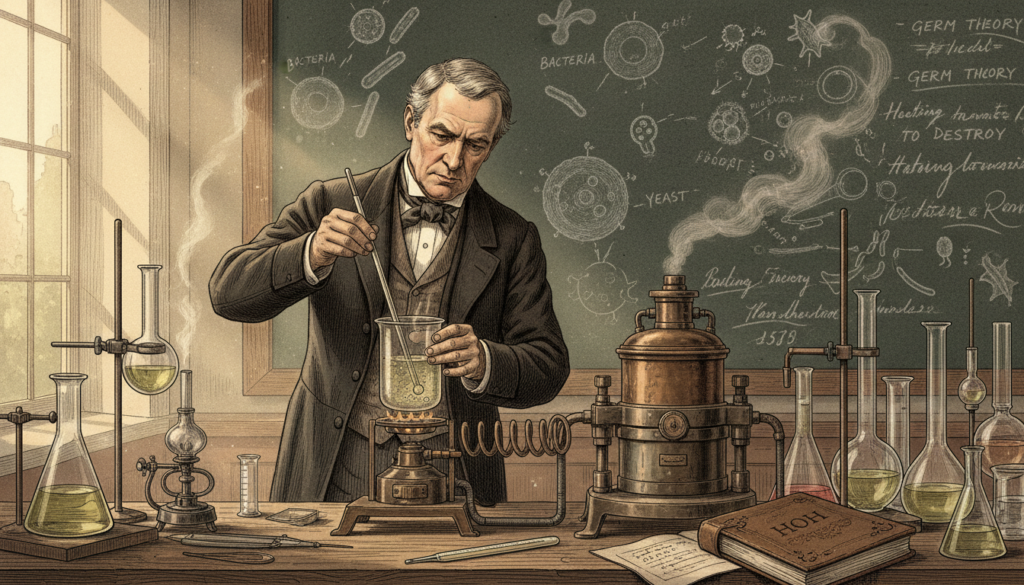
The pasteurization process was born. It involves mild heating followed by rapid cooling. The goal was to kill off unwanted microbes.
In 1862, Pasteur and Claude Bernard used this method to preserve milk. This was a practical application of his lab work. Swan-neck flasks kept broths clear by blocking environmental particles.
| What Pasteur Looked At | What You’d Notice | Why It Mattered |
|---|---|---|
| Yeast growth during fermentation | Yeast mass increased while sugar dropped | Supported the idea that fermentation depends on living organisms, a key Louis Pasteur contribution to science |
| Oxygen levels in sealed vs. open setups | Fermentation ran in low-oxygen conditions | Showed yeast can act anaerobically, shaping microbial metabolism |
| Soured beer and wine samples | Multiple microbe types appeared in spoiled batches | Pointed to environmental contamination and set up pasteurization as a fix |
| Swan-neck flask broths | Broth stayed clear unless dust and particles reached it | Helped separate “air” from what air carries, reinforcing Pasteur’s discoveries |
The Battle Against Infectious Diseases
When sickness spread, everyone felt the pressure. People wanted answers that worked. Louis Pasteur’s discoveries became a survival guide. He asked, “What makes living things get sick?”
Understanding the Causes of Diseases
In 1865, the French government asked Pasteur to solve pébrine, a silkworm disease. He found a microorganism in the silkworm egg. This was a big discovery.
Pasteur suggested simple steps to prevent disease. Keep healthy eggs separate and avoid bad feed. He also said the air can carry germs. This idea helped people understand how diseases spread.
Pasteur’s Research on Anthrax
Anthrax was a big challenge. Pasteur believed a specific germ caused it. He tested if a weakened germ could protect animals.
In 1880–1881, Pasteur learned heat could kill microbes. He used this to create an anthrax vaccine. Around the same time, Robert Koch’s work helped prove the link between germs and diseases.
The Rabies Vaccine Development
Rabies was a major fear because symptoms came late and death was common. Pasteur tried a bold idea: a vaccine after exposure could prevent the disease if done fast.
Pasteur worked before we knew much about the immune system. He sometimes got the mechanism wrong. But his work moved medicine towards understanding immunity.
| Problem in front of Pasteur | What he focused on | What changed in practice | Why it mattered to germ theory |
|---|---|---|---|
| Pébrine in silkworms (1865) | Microorganism linked to the silkworm egg; contamination control | Isolate healthy eggs; use bacterium-free leaves; limit spread | Made “cause” feel concrete and preventable, not mysterious |
| Anthrax outbreaks in livestock (1880–1881) | Specific bacillus; weakening or inactivating the germ | Testing inoculation with an anthrax vaccine to build resistance | Connected one microbe to one disease and to a repeatable prevention strategy |
| Rabies risk after bites | Therapeutic vaccination after exposure; timing matters | Using a rabies vaccine as urgent protection, not just a pre-risk shield | Expanded germ theory into real medical decision-making under pressure |
The Impact of Pasteur’s Work on Medicine
Once you understand germ theory, medicine becomes more than guesswork. It turns into daily habits. Louis Pasteur made invisible causes practical.
He’s called the father of microbiology. But his work’s impact is huge. You see it in kitchens, clinics, and city planning.
Advancements in Public Health
Pasteur’s pasteurization showed heat can reduce microbial risk. This idea applies to milk, beer, wine, and vinegar. It led to prevention, not panic.
It matched John Snow’s work on cholera. Boiling and filtering water became common sense, not superstition.
Changes in Medical Practices
Germ theory made cleanliness a medical standard. Pasteur said stopping infection stops disease. This led to aseptic techniques in surgery.
Joseph Lister used carbolic acid to disinfect wounds. He followed Pasteur’s work on fermentation.
Ignaz Semmelweis proved handwashing with chlorinated lime works. It cut maternal mortality from 18% to 2.2% in a year. Many peers resisted him, but germ theory explained the numbers.
Pasteur also explored targeted antimicrobial care. He used boric acid in the female genital tract to fight infections. It’s all about reducing exposure and risk.
The Establishment of Vaccination Protocols
Vaccination started before Pasteur. Edward Jenner’s 1798 smallpox vaccine was used across Europe. But the reasons behind immunity were unclear.
Pasteur showed vaccination could target microbial diseases. He made prevention feel repeatable. This was a big step toward vaccination protocols.
His work on anthrax and rabies made vaccination more public. It gave a strong base for public health planning.
| Shift you can actually see | Before germ theory caught on | After Pasteur’s ideas spread | Why it mattered for public health |
|---|---|---|---|
| Safer food and drink | Spoilage blamed on “bad air” or chance | Pasteurization used to lower microbial load in milk, beer, wine, and vinegar | Fewer everyday exposures, clearer prevention habits |
| Cleaner surgery | Infection treated as an unavoidable outcome | Lister’s carbolic acid antisepsis tied wounds to environmental microorganisms | Lower risk during treatment, not just after it |
| Hand hygiene in hospitals | Handwashing seen as optional or insulting | Semmelweis-style chlorinated lime handwashing made more convincing by germ theory | Hospital routines start protecting patients on purpose |
| Standardized prevention | Jenner’s smallpox method used, but not easily generalized | Attenuation supports repeatable vaccination protocols for more diseases | Prevention becomes something systems can plan and scale |
Public Reaction to Germ Theory
The germ theory of disease didn’t get an instant yes. It was more like a slow, loud debate. People were curious but wanted proof they could see and trust.
Acceptance and Skepticism
Some scientists were quick to believe. Others were not. Even with Louis Pasteur’s discoveries, many thought he was going too far.
Marcellin Berthelot, a famous chemist, said fermentation was all about chemistry. Claude Bernard, who worked with Pasteur, also had doubts. Fame, pride, and real questions made the debate loud.
But experiments kept showing the truth. Over time, the germ theory won more people over. It offered clear causes and results. The shift was slow but sure.
| What people argued about | Why it mattered in daily life | What Pasteur leaned on |
|---|---|---|
| Whether fermentation was chemical or driven by living microbes | It changed how you blamed spoilage in wine, beer, and milk | Careful lab setups that isolated contamination and tracked changes |
| Whether invisible germs could explain sickness | It reshaped how you saw hospitals, surgery, and dirty hands | Patterns that matched outbreaks and improved with cleaner practice |
| Whether new vaccines were “real science” or risky guesswork | It affected which families felt safe trying prevention | Observations of weakened microbes triggering protection |
How Pasteur Communicated His Findings
Pasteur didn’t just publish and disappear. He showed up, argued, and explained at the Academy of Sciences, starting in 1857. He spoke like a chemist who loved numbers: measure the mix, count what changes, and don’t ignore what’s left in the flask.
He pointed out that lactic fermentation didn’t produce just lactic acid. You could also find butyric acid, alcohol, mannitol, and a viscous material in the same messy brew. To him, that complex mix made more sense if living organisms were doing the work.
“Chance favors the prepared mind”
This quote became famous. It matched Pasteur’s style: discovery looks like luck from far away, but up close it’s attention, patience, and timing. It also fit his vaccine observations, where inactive microbes could spark immunity.
Collaborations and Influences
Big ideas don’t travel alone. Many of Louis Pasteur’s discoveries came from teams and rivals. They all asked the same hard questions.
He is called the father of microbiology for a reason. It’s not just because he worked alone. He helped make lab work reliable and trustworthy.
Key Collaborators in Pasteur’s Research
Pasteur had people who helped prove his theories. Claude Bernard believed in using experiments to settle debates, not opinions.
His work on preserving beverages was also important. It made everyday products safer. This was a quiet but key part of his science.
Later, Pasteur worked with Émile Roux on vaccines and animal studies. Roux was a skilled physician. His help was key when experiments moved to living animals.
Together, they made the lab work like a system. They observed, tested, measured, and adjusted. This approach is why Pasteur’s discoveries are seen as disciplined process today.
| Person | What they brought to the work | Why it mattered for results |
|---|---|---|
| Claude Bernard | Experimental thinking, tight controls, and a focus on measurable physiology | Helped normalize the idea that strong methods beat strong personalities in scientific debates |
| Émile Roux | Medical training and hands-on skill with small and large animal experiments | Made vaccine-related studies more reliable by improving handling, observation, and follow-through |
Influence on Future Scientists
Pasteur didn’t just appear out of nowhere. Francesco Redi challenged spontaneous generation in 1668. His “show me the proof” attitude was a big influence.
Anton van Leeuwenhoek described “animalcules” in 1676. Robert Hooke coined “cell” in Micrographia (1665). These discoveries made the microscopic world seem real.
Friedrich Henle linked microbes to disease decades before the tools were ready. His ideas helped Robert Koch later.
Pasteur and Koch had big disagreements. Politics and pride were involved. But their work complemented each other. Pasteur showed microbes could cause disease and be weakened for vaccines. Koch sharpened methods and criteria for causality.
In short, Pasteur’s work is part of a larger chain. His contributions to science sit alongside Koch’s, Redi’s, Leeuwenhoek’s, Hooke’s, and Henle’s.
The Legacy of Louis Pasteur
The Louis Pasteur timeline shows more than just lab wins. It reveals a new way to tackle everyday problems. These include spoiled wine, sick animals, and infections that seemed to come out of nowhere.
His work made germ theory feel real and useful. It showed us that heat, cleanliness, and careful handling are tools, not just hopes.
Long-lasting Contributions to Science
Pasteur changed how we see fermentation. He showed it depends on living microbes, not “bad air” or random decay. This was a big deal back then.
He also tied spoilage to contamination from the environment. This led to practical fixes like pasteurization. You can see these in food and lab routines today.
- Fermentation as a microbial process you can test and control
- Contamination as a cause of spoilage that can be reduced with technique
- Prevention as a real goal, not just a wish after people got sick
Impact on Modern Medicine
Once microbes looked like believable causes, medicine changed fast. Hygiene and aseptic habits became more important. This helped doctors like Joseph Lister bring new ideas into practice.
Vaccination started to feel like a flexible strategy. Work on anthrax and rabies showed the body could resist disease before it hits. Even if Pasteur didn’t understand immunity fully, his work made prevention seem doable.
| Theme | What Pasteur pushed forward | What it shaped in medicine |
|---|---|---|
| Microbes and everyday change | Fermentation and putrefaction linked to living organisms | Lab culture techniques and cleaner handling in clinics |
| Contamination control | Environmental exposure as a source of spoilage and spread | Asepsis, sterilization routines, and stronger hygiene norms |
| Vaccination as a strategy | Anthrax and rabies work that made prevention feel practical | Broader vaccine development as a long-term medical goal |
| How proof looked | Careful experiments that made germ-based ideas convincing | More trust in testable causes over guesswork in treatment |
The Louis Pasteur timeline shows his legacy as momentum. Microbes became measurable, risks manageable, and prevention part of the plan. This thread runs through his discoveries and influences modern care.
The Role of Pasteur’s Findings in Today’s Medicine
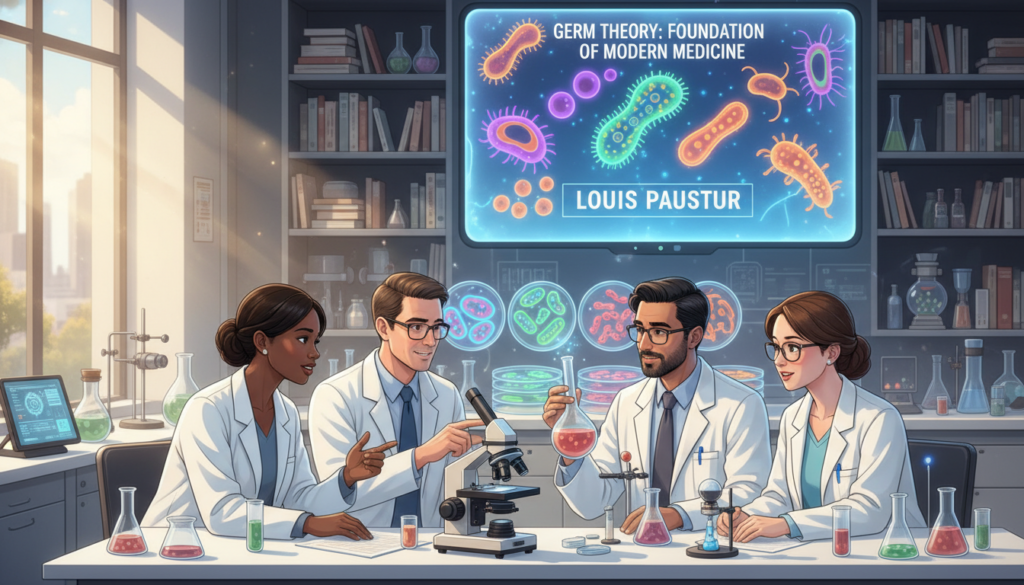
Louis Pasteur’s work is everywhere, even in simple daily actions. These actions help keep you healthy by stopping germs before they spread. The germ theory of disease is key, affecting everything from grocery shopping to waiting rooms.
Current Applications of Germ Theory
The pasteurization process is a great example. It uses heat and cooling to kill off microbes in milk and drinks. This method doesn’t kill everything, but it makes food safer.
In clinics, the germ theory is used to block microbes. Hands are washed, tools are disinfected, and water is treated. The goal is to stop germs from spreading, protecting those with weak immune systems.
| Modern habit you see | What it’s trying to block | Where you’ll notice it | How it connects back to Pasteur |
|---|---|---|---|
| Heat-treated drinks and dairy | High microbe counts that can spoil food or cause illness | Milk jugs, cold-case juices, coffee shop steamed milk | The pasteurization process applies controlled heat to reduce microbes |
| Hand hygiene between patients | Transfer from skin to surfaces to another person | Hospitals, urgent care, dental offices | Built on the germ theory of disease: contact spreads contamination |
| Instrument cleaning and sterilization | Hidden microbes on tools used for exams or procedures | Vaccination clinics, surgery centers, tattoo studios | Matches the same prevention mindset that fueled a vaccination pioneer |
| Safe water systems | Waterborne microbes entering the body | City water treatment, boil-water notices, disaster response | Tracks the idea that prevention works when you break the route of spread |
Ongoing Research Inspired by Pasteur’s Work
Pasteur’s vaccine work is also influential today. He showed the power of weakening germs so our bodies can fight them. This idea is used in some vaccines, helping protect us.
But working with bacteria is complex. There are thousands of genes, and many factors affect how harmful they are. Scientists use genetics, safety checks, and patience to make vaccines.
In the 1930s, Max Theiler and Hugh Smith made a live Yellow Fever vaccine. They used mutation and luck to weaken the virus. This shows how smart work and a bit of luck can lead to breakthroughs.
The word virus has changed over time. It used to mean any infectious “poison.” But now, we know viruses are smaller and can be seen with tools. Pasteur’s work and the germ theory of disease helped us understand this.
Educational Initiatives Inspired by Pasteur
Sharing Louis Pasteur’s story in class or at events can be exciting. It’s like discovering amazing facts. The germ theory of disease becomes real and interesting.
Teaching Germ Theory in Schools
Start with what students can picture. Louis Pasteur didn’t just have an idea. He used simple setups to show microbes.
The swan-neck flask is a great example. It shows how broth stays clear until contamination gets in. This makes the germ theory easy to understand.
Fermentation is another great topic. It turns microbes into something you can see. Yeast grows and changes, affecting things like bread and yogurt.
Pasteurization is also easy to grasp. Louis Pasteur showed that heating can prevent spoilage. This leads to discussions about milk safety and food storage.
| Timeline anchor | What students can remember | Quick classroom hook |
|---|---|---|
| 1857 | Fermentation builds momentum for microbes doing real work | Compare yeast activity in warm vs. cool conditions |
| 1862 | Pasteurization moves beyond wine and beer and reaches milk | Talk through why “heat, then cool” slows spoilage |
| 1865 | Pébrine investigation shows problem-solving in a real industry | Track how one disease can ripple through jobs and food supply |
| 1881 | Anthrax vaccine demonstration makes prevention visible | Discuss why public proof matters when people doubt science |
| Rabies (post-exposure idea) | Vaccination isn’t only “before”—timing can matter after exposure | Map a “risk window” to show why quick action changes outcomes |
These anchors make Louis Pasteur’s story exciting. It’s about experiment, surprise, and real-world benefits. This makes the germ theory of disease memorable.
Community Awareness Programs
Outside school, we aim to make big ideas into habits. Once people understand microbes, they change quickly. This shift is seen throughout history and today.
Start with food basics. Teach safe cooking, clean cutting boards, and pasteurization. It connects Pasteur’s work to everyday life.
Clean water is another key topic. John Snow’s ideas on cholera are simple and effective. They show how to keep water safe without complicated steps.
Highlighting past prevention efforts is also helpful. Ideas from 1658 show how long we’ve been thinking about these issues. It shows the power of believing in the germ theory.
Done right, these programs are engaging. They feel like solving problems together. Louis Pasteur’s story sparks action, not just lectures.
Conclusion: The Lasting Influence of Pasteur
By the end of this story, it’s hard not to be amazed by Louis Pasteur’s arc. He started as a chemist chasing tiny clues. Then, he helped flip medicine on its head.
That’s the real Louis Pasteur contribution to science. He made the invisible feel real, practical, and urgent.
Reflection on Pasteur’s Life and Legacy
Pasteur showed that fermentation is alive, not magic. He proved mild heat could guard food (pasteurization). He also showed that specific microbes can spark specific diseases like anthrax.
He pushed the idea that weakened or inactivated microbes can teach the body to fight back through vaccination.
He didn’t get every detail right, including parts of how immunity works. But the payoff was huge. Cleaner tools, safer hospitals, and a new habit of prevention.
No wonder people call him the father of microbiology. And they pass around Louis Pasteur quotes like “Chance favors the prepared mind.”
The Future of Microbiology and Germ Theory
Germ theory didn’t stop with bacteria. It grew to include viruses and even prions. Our proof tools got sharper too, from Koch’s postulates to Stanley Falkow’s 1988 gene-based framework for virulence.
If you take one thing forward from Louis Pasteur, it’s the mindset. Watch closely, test what you think you know. Connect small causes to big everyday outcomes—food safety, infection control, and smarter vaccines.
FAQ
Who was Louis Pasteur, and why do people call him the father of microbiology?
What’s the quick Louis Pasteur biography timeline (with key dates)?
What was the world believing before germ theory—was it really all about “bad air”?
Were there early “seed” ideas about contagion before Pasteur?
What is germ theory in plain English?
How did Louis Pasteur help germ theory beat miasma theory in the late 1850s?
What were Pasteur’s swan-neck flask experiments, and why did they matter?
What did Pasteur discover about fermentation—was it chemistry or biology?
Who influenced Pasteur’s fermentation work, and who fought him on it?
What is the pasteurization process, and why did Pasteur invent it?
When did pasteurization move beyond wine and beer into milk?
How did the silkworm disaster help prove microbes cause disease?
What did Pasteur do with anthrax, and why was it a turning point for vaccination?
How did Robert Koch fit into the anthrax story—and why was there rivalry?
What was revolutionary about the rabies vaccine?
Did Pasteur understand the immune system the way we do today?
How did Pasteur’s work change public health in everyday life?
How did germ theory reshape surgery and hospital practice?
Where does Ignaz Semmelweis fit into this story?
What medical detail about Pasteur surprises most people?
How did Pasteur change vaccination compared with Edward Jenner’s smallpox work?
Did everyone accept Pasteur’s ideas right away?
How did Pasteur communicate his findings so they stuck?
Who were Pasteur’s key collaborators?
Which earlier scientists paved the way for Pasteur’s microbiology?
What are Louis Pasteur’s most important discoveries and contributions to science?
How is Pasteur’s legacy used in medicine today?
What are current applications of germ theory you recognize instantly?
How did Pasteur’s vaccine idea influence later research, like the Yellow Fever vaccine?
How did the meaning of “virus” change over time?
What’s the easiest way to teach germ theory in schools using Pasteur’s story?
What can community awareness programs take from germ theory without turning into a lecture?
What’s a reliable Louis Pasteur quote that captures his approach?
Where does microbiology go after Pasteur—how do we prove causation now?
Why does the Pasteur vs. Koch era feel like a “scientific showdown”?
What should you remember most from the Louis Pasteur timeline of germ theory?
Get More Medical History
Join our newsletter for fascinating stories from medical history delivered to your inbox weekly.