The History of Healing
 Ancient Egyptian Medicine: 15 Medical Practices That Stil Influence Healthcare
Ancient Egyptian Medicine pioneered surgical techniques, pharmaceutical treatments, and diagnostic methods that shaped modern healthcare practices we still use today.

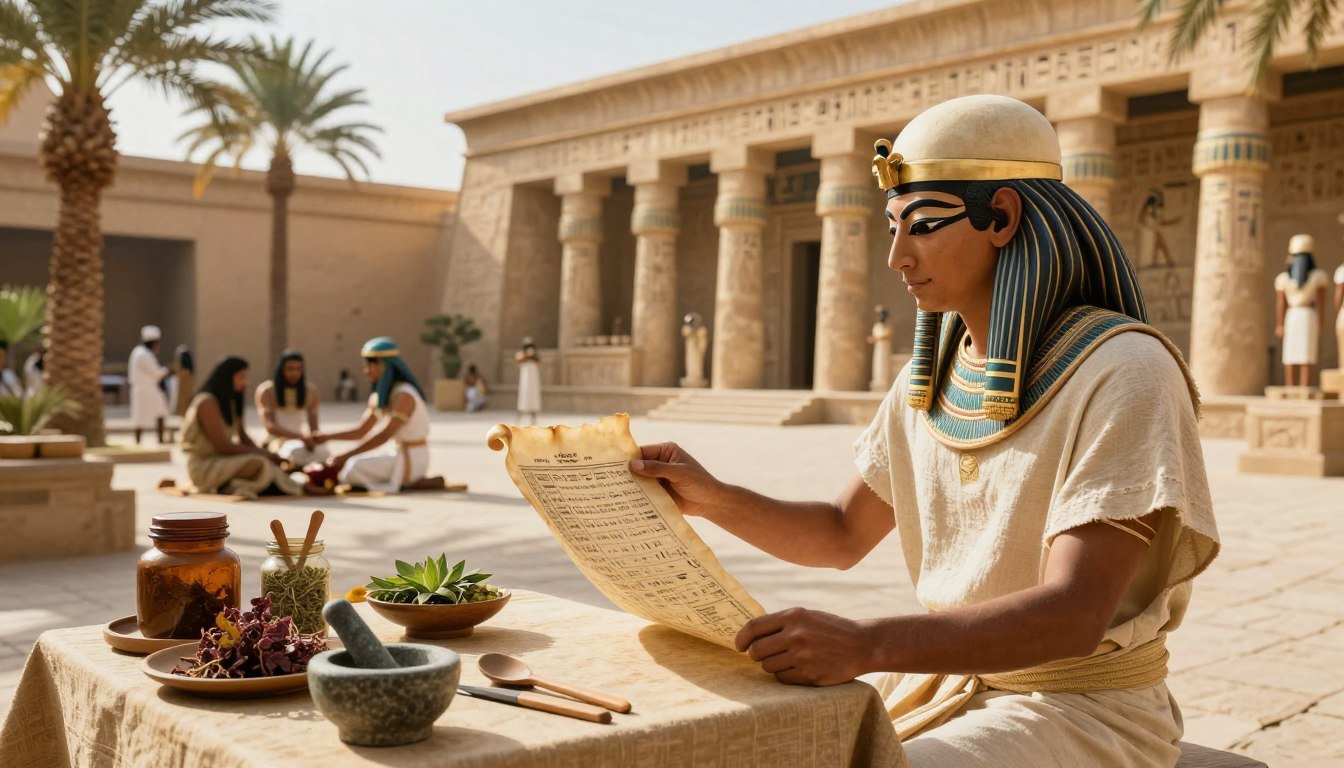
More than 70% of today’s surgical tools come from designs made over 5,000 years ago along the Nile. This shows how ancient Egyptian medicine has shaped today’s healthcare.
The healthcare system in ancient Egypt was advanced. From 3300 BCE to 525 BCE, doctors there developed treatments that would impress today’s doctors. They could diagnose diabetes, perform surgeries, and even specialize in areas like eye care and dentistry.
What’s amazing about ancient Egyptian medicine? It actually worked. Hippocrates and Galen, famous Greek doctors, traveled to Egypt to learn from these medical deities. They then shared this knowledge with the ancient world, influencing medicine for centuries.
The first recorded doctor in history was an Egyptian named Sekhet’enanch. He worked for Pharaoh Sahura around 3533 BCE and cured the ruler’s nasal disease. This started the tradition of professional medicine. Egyptian medicine was based on strict rules from the Hermetic Books of Thoth, making it the first standardized medical system.
Key Takeaways
- Ancient Egyptian medicine dates from 3300 BCE to 525 BCE, making it one of the oldest documented medical systems
- Egyptian physicians specialized in specific medical fields thousands of years before modern medical specialization
- The Edwin Smith and Ebers papyri contain surgical and pharmaceutical knowledge stil relevant today
- Egyptian doctors could diagnose and treat diabetes, cancer, and perform complex dental procedures
- Greek medical pioneers studied in Egyptian temples, spreading this knowledge throughout the ancient world
- Over 70% of modern surgical instruments have designs originating from ancient Egyptian tools
Ancient Egyptian Medicine and Its Lasting Legacy
Many think modern medicine began with the Greeks or Romans. But, ancient Egyptian medical practices started thousands of years before them. These early doctors created a healthcare system that influences doctors today. They sorted injuries and illnesses into three groups: treatable, worth trying, and beyond help.
This system shows wisdom that echoes in today’s medical triage.
The Foundation of Modern Medical Practice
Traditional Egyptian healing went beyond simple remedies. Egyptian doctors developed detailed examination methods, kept case histories, and set treatment plans that seem modern. They knew bodies had complex systems, like mtw vessels, that carried blood and air.
When these vessels got blocked by wekhedu, disease would occur. This idea is similar to our understanding of heart health today.
Documentation Through Papyrus Medical Texts
Egyptian medical papyri offer a glimpse into advanced medical knowledge from 1800-300 BCE. Over 40 papyrus texts have survived, filled with detailed procedures. After the Rosetta Stone’s translation in 1822, scholars could read these hieroglyphic documents.
These texts were not just random notes. They were organized medical knowledge passed down through generations.
The Role of Maat in Healthcare Philosophy
The concept of Maat—order, balance, and justice—guided healing. Good health meant Maat was balanced, while illness showed a disruption. Egyptian medical papyri show doctors could adjust treatments after four days if needed.
Medical Papyrus Scrolls as Knowledge Repositories
Imagine ancient Egyptian doctors carefully unrolling papyrus sheets. Their surfaces were covered in detailed hieroglyphic medical texts. These were not just random notes but advanced medical encyclopedias that influenced healthcare for centuries.
The medical papyrus scrolls we’ve found show an incredible depth of medical knowledge. It’s surprising how modern it feels when you look into the details.
Edwin Smith Papyrus and Surgical Techniques
The Edwin Smith Papyrus is like a trauma surgeon’s handbook from 1600 BCE. It presents 48 surgical cases in great detail, covering skull fractures to spinal injuries. What’s amazing? Each case follows a systematic approach: examination, diagnosis, treatment, and prognosis.
The papyrus describes surgical techniques like suturing wounds and using honey to prevent infections. It also talks about applying raw meat to stop bleeding. Even the methods for immobilizing head and neck injuries are documented.
These Egyptian medical papyri show knowledge that saves lives in emergency rooms today.
Ebers Papyrus and Pharmaceutical Knowledge
The Ebers Papyrus is like the world’s oldest pharmacy manual. It’s 68 feet long and dates back to 1550 BCE. This scroll lists 876 prescriptions using 328 different ingredients.
The ancient Egyptians didn’t just mix herbs randomly. They documented specific formulas for various ailments. This includes stomach problems, skin conditions, eye diseases, and respiratory issues.
Kahun Papyrus and Gynecological Treatments
The Kahun Papyrus was written around 1825 BCE. It shows that women’s healthcare was a specialized field even back then. This collection of texts has 34 sections on gynecological issues, including contraception and pregnancy treatments.
Some remedies might seem strange today, like using crocodile dung. But others, like honey and sodium carbonate, have real antimicrobial properties.
Imhotep and the Birth of Professional Medicine
Imagine an architect who becomes a god. That’s what happened to Imhotep around 2780 BCE. He wasn’t just a imhotep physician – he created the concept of professional medicine. Serving Pharaoh Zoser, Imhotep was a chief vizier, high priest, sculptor, and royal doctor.
From Physician to Medical Deity
Imhotep’s journey from doctor to healing god is incredible. Two thousand years later, people built three temples for him. They worshipped him, visiting temples for healing and leaving offerings.
Establishing Medical Hierarchy and Specialization
Medical specialists in ancient Egypt were organized. They had titles like swnw (regular doctors) and wr swnw (chief physicians). Women like Peseshet, who became “Lady Overseer of Lady Physicians” around 2400 BCE, also practiced medicine.
The First Medical Schools at Per Ankh
The Per Ankh (Houses of Life) changed medical education. Starting in the First Dynasty, these places were libraries, scriptoriums, and schools. Ancient Egyptian doctors studied there, learning anatomy and surgery. These were serious places where medicine was respected.
Advanced Surgical Instruments and Procedures
It might surprise you to know that ancient Egyptian surgery was quite advanced for its time. Egyptian doctors didn’t just use herbs and prayers. They performed surgeries with tools that look like today’s.
Imagine a surgeon in 2350 BCE using bronze scalpels, forceps, and bone saws. These tools weren’t simple stone objects. Archaeologists found well-preserved instruments in Qar’s tomb from the Sixth Dynasty. They included copper knives, pincers, scales, and hooks used with great precision.
The medical practices of pharaohs were quite impressive. Egyptian surgeons did circumcisions, drained abscesses, and treated hernias. They used linen thread to sew wounds and stopped bleeding by burning tissue.
These doctors also made prosthetics. Archaeologists found artificial toes and eyeballs. Some were for the afterlife, but others were used by people while alive.
Egyptian doctors had tools for setting bones. They made splints from reeds and wood, padding them with plant fibers. They used linen strips to hold everything in place. They even made a plaster-like substance to harden around fractures, similar to modern casts.
Herbal Remedies in Ancient Egypt
It’s amazing to think that ancient Egyptian doctors had access to over 160 plant products. They used these to create herbal remedies in ancient egypt that we know today. From garlic for bug bites to complex medicines, their knowledge was impressive.
Plant-Based Pharmaceuticals
The plants used in herbal treatments in ancient egypt were diverse. Doctors used willow buds for pain and poppy seeds for relief. Garlic was used for more than cooking, treating bites and hemorrhoids.
Aloe vera was used for burns and skin issues, just like today. This shows their deep understanding of plants.
Egyptian doctors often mixed herbs for better results. Acacia gum was used for diarrhea and skin problems. Cannabis and incense were used for both spiritual and medical reasons.
Preparation Methods and Drug Administration
Egyptian pharmacists didn’t just mix herbs. They created pills, ointments, and more. They even used aromatic smoke and herbal baths for treatments.
They used volume to measure prescriptions, ensuring treatments were consistent everywhere.
Therapeutic Use of Honey and Natural Compounds
Honey was a key part of herbal remedies egypt. It was used for wounds and as a medicine base. Doctors mixed it with herbs for internal treatments.
Pomegranate juice was used as a medicine base and astringent. Even unusual items like animal feces and metals were used. Each had a specific purpose, documented in medical texts.
Anatomical Knowledge Through Mummification Practices
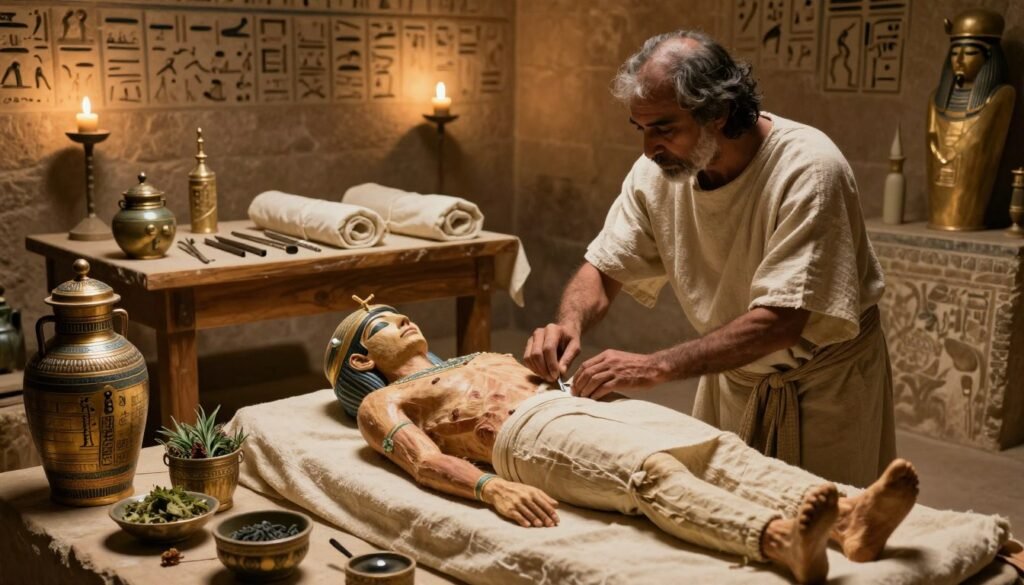
Mummification was more than just preserving bodies. Ancient Egyptian embalmers were conducting early anatomy lessons. They learned a lot about our bodies, shaping medicine for centuries.
Understanding of Internal Organs
The mummification process offered a unique look at human anatomy. Embalmers removed organs through small cuts in the left groin. They showed incredible skill, like removing the brain through the nose with bronze tools.
They discovered the heart pumps blood, even if they made some mistakes. Their knowledge was groundbreaking for its time.
The Concept of Metu Vessels
The metu system was Egypt’s way to understand circulation. Through embalming, they found a network of vessels carrying blood, air, and fluids. It was like their circulatory system, but with extra features.
| Metu Type | What It Carried | Modern Equivalent |
|---|---|---|
| Blood metu | Blood | Arteries and veins |
| Air metu | Breath | Respiratory passages |
| Fluid metu | Mucus, semen, urine | Various ducts |
Preservation Techniques and Medical Learning
Mummification was not just a ritual—it was an anatomy class. The Ebers Papyrus shows how mummification influenced medicine. Doctors even checked pulses to keep these vessels open, using lessons from mummification.
Dental Medicine and Oral Health Practices
Think ancient Egyptians had perfect smiles? Think again. Their diet, full of sand from grinding grains, wore down their teeth fast. This led to early dental innovations.
The earliest dentist we know by name, Hesy-Ra, worked for King Djoser around 2670 BCE. He was known as “Great one of the dentists.” This shows dentistry was a special field in ancient Egypt over 5,000 years ago.
Archaeologists have found cool stuff about ancient dental care. They found skulls from the Fourth Dynasty (2625-2510 BCE) with holes drilled for abscesses. They also found a mummy with teeth bound together with golden wire. Professor Euler said this was done while the mummy was alive.
Ancient Egyptians treated many dental problems, like cavities and gum issues. They even treated jaw problems and abscesses. But, most treatments didn’t work well, and teeth were often pulled.
They found replacement teeth in mummies, but it’s unclear if they were used. Maybe embalmers added them for looks after death.
Wound Care and Infection Prevention
Wound care has a long history, and ancient Egypt played a big role. Egyptian doctors used methods that would be familiar today. They mixed practical techniques with natural remedies that were effective.
Suturing Techniques and Bandaging Methods
Egyptian doctors used linen thread to stitch wounds. They wrapped injuries with linen, the same material used for mummification. This kept wounds clean and covered.
They used raw meat to stop bleeding fast. Special bandaging patterns helped keep dressings in place.
Use of Honey as an Antiseptic
Honey was a key part of ancient Egyptian medicine. They used it to prevent infections in wounds. Modern research shows honey’s antimicrobial properties are real.
They mixed honey with other natural ingredients to make healing poultices. These poultices drew out infections from boils and abscesses.
Treatment of Fractures and Dislocations
Broken bones and dislocated joints got surprisingly modern treatment in ancient Egypt. Doctors made splints from reeds and wood, padding them with plant fibers.
They created a plaster-like substance by soaking linen in sticky materials. This hardened around fractures. The Edwin Smith Papyrus shows their knowledge of shoulder dislocations, similar to today’s methods.
They also understood spinal injuries, describing symptoms and treatments for different types of injuries.
Medical Specialization and Professional Training
Ancient Egypt had the world’s first organized medical system. It had clear standards and formal training. Doctors specialized in body parts and diseases, a practice that started over a thousand years before Greek medicine.
Hierarchy of Egyptian Medical Practitioners
The medical field in ancient Egypt had a strict ranking. At the bottom were the swnw (general physicians) who treated common illnesses. The kherep swnw (controllers of doctors) supervised teams. The wr swnw (chief physicians) were at the top, often serving pharaohs.
Palace doctors had a special status. They had access to the best medical papyri of Egypt.
Specialized Fields of Practice
Herodotus noted that Egyptian doctors focused on one disorder. Eye doctors treated only eye issues, and intestinal specialists handled digestive problems. Dentists like Hesy-ra were highly respected, earning royal titles.
Female physicians like Peseshet worked in obstetrics. They were respected centuries before other cultures allowed women in medicine.
Medical Education at Houses of Life
The Per-Ankh (Houses of Life) were medical schools attached to temples. Students learned from experienced doctors and studied ancient texts. Training lasted years, combining practical experience with text study.
The Ebers Papyrus shows medical wisdom passed down through generations. This tradition of mentorship is followed in modern medical education.
Diagnostic Methods and Patient Examination
Imagine stepping into an ancient Egyptian doctor’s office 3,000 years ago. You’d find a surprisingly modern approach to diagnosis. These doctors used a method that might feel familiar today.
The term “placing the hand” was more than just a phrase. It was how *swnw* physicians diagnosed patients. It’s like the ancient version of “laying on of hands” in today’s medicine. They checked your pulse at 22 spots, looking for blockages called *wekhedu*. They knew about the heart and blood flow, centuries before the Greeks.
Medical papyri like the Edwin Smith Papyrus show a triage system that would impress ER doctors:
- Treatable injuries – addressed right away
- Contestable cases – observed before deciding
- Untreatable conditions – comfort care only
Ancient Egyptian medicine combined physical checks with spiritual diagnosis. Doctors checked pulses and wounds, while *wab* priests and *sau* magicians used *heka* (magic power) for healing. It wasn’t just superstition; it was science and magic together. The same papyri that showed surgeries also had healing incantations.
Women’s Healthcare and Gynecological Medicine
Ancient Egyptian doctors were ahead of their time in women’s health. They knew a lot about pregnancy, birth control, and women’s health issues. Their knowledge of reproductive health was centuries ahead of others.
Pregnancy Testing Methods
The ancient Egyptians had a clever way to check if a woman was pregnant. They used barley and emmer wheat to test it. If barley sprouted, it meant a boy was coming. If emmer grew, it was a girl. No sprouting? Then she wasn’t pregnant.
This test was based on science. Pregnant women’s urine has hormones that can make seeds grow.
Contraception Techniques
The Egyptians had many ways to prevent pregnancy. They used pessaries made from crocodile dung, honey, and sour milk. These were mixed with natron and used vaginally.
Though it sounds odd, these ingredients might have stopped sperm from reaching the egg.
Treatment of Female-Specific Ailments
Doctors in ancient Egypt treated women’s health issues with care. They observed symptoms, diagnosed, and then treated. The Kahun Papyrus has 34 sections on gynecology, showing their detailed treatments.
Peseshet, a “Lady Overseer of Lady Physicians” around 2400 BCE, might have been the first female doctor. She shows women were key in ancient Egyptian medicine.
Mental Health and Holistic Healing Approaches
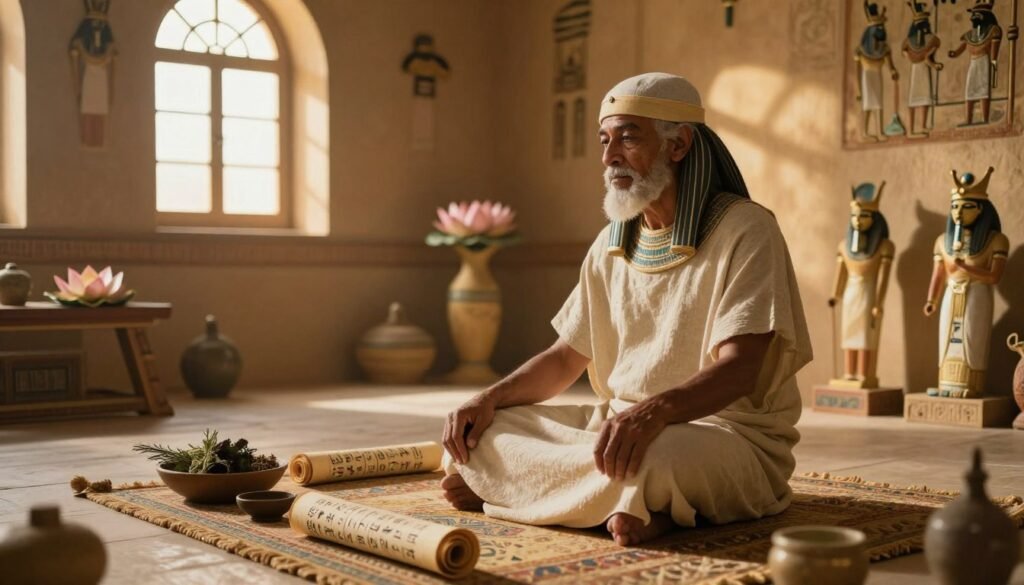
The Egyptians were ahead of their time in mental health treatment. They knew the mind and body were connected. The Ramesseum library was called the “Healing Place of the Soul,” where scrolls were used to heal troubled minds.
They treated depression with letters to the dead, a form of early journaling. Dream interpreters helped diagnose mental issues. They saw illness as a sign of imbalance, or maat.
Traditional Egyptian treatments combined medicine and spirituality. There were three types of healers:
- The swnw (physicians) who handled physical symptoms
- The wab priests who dealt with ritual purity
- The sau healers who specialized in magical protection
They used over 700 magical formulas from the Ebers Papyrus. Staying pure was key to avoiding illness. Their treatments included herbal remedies, spells, and rituals, addressing all aspects of health.
Pharmaceutical Formulations and Drug Delivery Systems
Ancient Egyptian doctors were the first pharmacists, but you wouldn’t want to meet them in a dark alley. They mixed potions with the skill of today’s pharmacists, but with ingredients that would make your stomach churn. They used crocodile dung, fly droppings, and ground-up mummies. Despite this, their methods for making and delivering medicines were surprisingly advanced for 3000 BCE.
Routes of Drug Administration
Egyptian doctors knew that different problems needed different solutions. They gave patients pills, liquids, and ointments. They even made suppositories and eye drops. The Ebers Papyrus shows they used nasal sprays made from milk and herbs.
They understood that medicine delivery wasn’t one-size-fits-all. They knew how to get medicine into the body in various ways.
Compound Medications and Prescriptions
These ancient healers didn’t just use one herb. They mixed 10, 20, or even 30 ingredients together. Each prescription had detailed instructions – mix with beer, blend with honey, heat over a fire.
The Chester Beatty Papyrus has formulas that look like medieval magic spells. But they were actually careful pharmaceutical recipes. They combined animal fats, plant oils, minerals, and herbs in ways that sometimes worked.
Dosage Measurements and Preparation Methods
Egyptian pharmacists used a unit called the “ro” (about 14 milliliters) to measure ingredients. They had special tools for grinding, mixing, and straining medicines. Their instructions were precise – boil for a certain time, strain through linen, let it sit overnight.
They even adjusted doses based on age and condition severity. While their use of lizard blood might seem strange today, their systematic approach to drug preparation is studied by pharmacy students at universities like Cairo.
FAQ
Who was the first recorded physician in ancient Egyptian history?
What medical papyri are the most important for understanding Egyptian medicine?
Did ancient Egyptians perform surgery with specialized tools?
How did mummification contribute to medical knowledge?
What herbal treatments did ancient Egyptians use that we recognize today?
Were there female doctors in ancient Egypt?
How accurate were ancient Egyptian pregnancy tests?
What was the role of magic in Egyptian medical practices?
How were Egyptian doctors trained and organized?
What diagnostic methods did ancient Egyptian doctors use?
Did ancient Egyptians understand mental health?
How effective were ancient Egyptian dental practices?
Get More Medical History
Join our newsletter for fascinating stories from medical history delivered to your inbox weekly.