The History of Healing
 Andreas Vesalius and the Birth of Modern Anatomy
Discover how Andreas Vesalius transformed medicine with his groundbreaking work on human anatomy, reshaping medical knowledge forever.

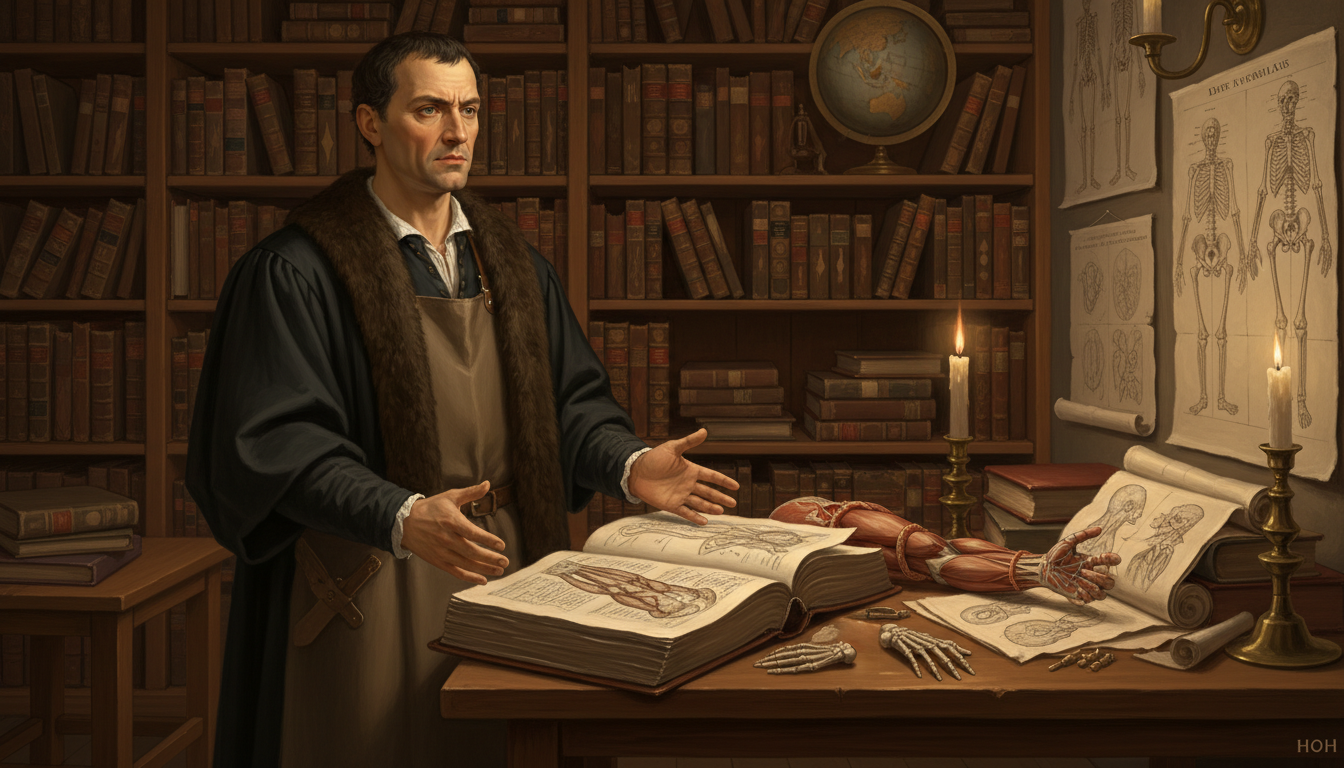
In the early 1500s, anatomy classes often didn’t use real bodies. Professors read from Galen, and someone else did the cutting. This was the world Andreas Vesalius entered.
He was born on December 31, 1514, in Brussels. This Renaissance anatomist didn’t just study anatomy. He made it real.
Vesalius changed medicine by using real bodies. He moved it from following old books to exploring nature. This idea is key to the Vesalius medical revolution.
Andreas Vesalius didn’t just talk. He did real dissections and corrected Galen’s mistakes. His book,
De humani corporis fabrica
(1543; revised 1555), changed how doctors learned. It made them question and prove their knowledge.
Key Takeaways
- Andreas Vesalius helped flip anatomy from book-repeating to hands-on observation.
- He was born December 31, 1514, in Brussels, in the Habsburg Netherlands.
- This Renaissance anatomist is widely known as the Father of Anatomy for modern human anatomy.
- Vesalius challenged Galen’s claims by checking them against real human bodies.
- De humani corporis fabrica (1543; revised 1555) became a turning point in medical learning.
- The Vesalius medical revolution changed medicine’s habits, not just its diagrams.
Introduction to Andreas Vesalius
You don’t have to be a doctor to find this story interesting. Andreas Vesalius treated the human body like a puzzle. His curiosity made his name famous.
Who Was Andreas Vesalius?
Andreas Vesalius was born Andries van Wezel on December 31, 1514, in Brussels. He died on October 15, 1564, on Zakynthos (Zante) in the Venetian Ionian Islands, at just 49.
Medicine was a big part of his family. His grandfather, Everard van Wesel, was a royal physician. His father, Anders van Wesel, was an apothecary and valet to Charles V. His mother was Isabel Crabbe.
His surname, “weasel,” is quite interesting. The Vesalius family coat of arms shows three weasels. It’s like a personal stamp on De humani corporis fabrica.
Historical Context of Vesalius’s Work
Before Andreas Vesalius, anatomy class was like a language lesson. In Paris, a major medical hub, teaching focused on Latin and famous doctors like Hippocrates and Galen.
Students used the medieval standard by Mondino de’ Liuzzi, first printed in 1475/1476. Dissections were rare and followed a strict plan.
| What students often saw | How it played out in the room | Why it shaped learning |
|---|---|---|
| Lectures based on “authorities” | The professor (lector) read aloud in Latin while others watched | Books sounded final, even when bodies didn’t match the text |
| Split dissection roles | An assistant (ostensor) pointed, and a barber-surgeon (sector) did the cutting | The person with the most status often didn’t touch the body |
| Printed tradition as the default | Mondino’s manual and inherited notes guided the steps | Routine could outrank fresh observation |
Renaissance humanism was also around. Scholars wanted to go back to the sources. Vesalius, who knew many languages, wondered about the body itself.
This mix of old texts and real bodies makes Vesalius’s story feel modern. It’s where his discoveries and facts start to make sense.
The Scope of Vesalius’s Contribution
Looking at Vesalius’s work, you see more than just facts. You see a new way to study the body. He worked hard, learned fast, and changed how we learn anatomy.
He started at the Catholic University of Leuven in 1529. He studied arts and languages. Then, he went to the University of Paris (1533–1536) for book learning.
By the time he reached Padua, things were different. It was more hands-on and had a strong printing culture.
Innovations in Human Anatomy
At Padua, he got his medical degree in 1537. The next day, he became a professor of Anatomy and Surgery. This was in a place where learning was free and open.
He made dissection the main focus. He used clear drawings and printed sheets for students to follow. This made learning easier and more accurate.
Challenging Classical Views
Galen’s work was often based on animals, not humans. Vesalius showed that humans are different. He found that humans don’t have the rete mirabile at the base of the brain like some animals do.
He also proved that the human mandible is one bone, not two. And he couldn’t find the invisible pores in the heart’s ventricles that others claimed existed.
He even showed that old ideas can sneak in. In his early work, he showed a human carotid pattern that matched some animals. This showed how deep tradition was, even in the Vesalius medical revolution.
| What Vesalius checked | What the old claim said | What he saw in human bodies | Why it mattered in class |
|---|---|---|---|
| Rete mirabile near the brain | It exists in “human” anatomy | Not present in humans; common in sheep and other ungulates | Students learned to separate animal anatomy from human anatomy |
| Mandible structure | The lower jaw is made of two bones | One continuous bone | Clear bone identification improved surgical thinking and teaching diagrams |
| Interventricular septum “pores” | Blood passes through invisible openings | No pores found by direct inspection | Forced learners to question inherited explanations during dissection |
| Carotid artery pattern (early work) | Human carotids emerge from a shared trunk | That pattern aligns with some primates, not typical human anatomy | Showed how observation corrects even a skilled anatomist’s first draft |
Importance of Direct Observation
Vesalius’s biggest move was how he worked. He did everything himself: reading, pointing, and cutting. This was a big change from the old way.
In the preface to De humani corporis fabrica, he criticized doctors who ignored hands-on work. He believed that using hands made medicine better. This idea is at the heart of his impact on medicine.
He also had a way to get cadavers for study. In 1539, a judge helped him get bodies from executed criminals. This made studying anatomy real and repeatable.
Publishing “De humani corporis fabrica”
You can almost picture the road dust on his coat. A Renaissance anatomist with a deadline, a stack of notes, and a stubborn need to get the details right.
That’s the energy behind Vesalius De Humani Corporis Fabrica—part book, part bold move, and very much a product of hands-on work.
Overview of the Publication
Before the famous volume, there was a warm-up: Tabulae anatomicae sex in 1538, six oversized anatomy plates that made students look twice.
By summer 1542, Vesalius had finished his main text. In January 1543, he traveled to Basel to watch the presses himself, working with printer Johannes Oporinus (1507–1568).
The full title ran long—De humani corporis fabrica libri septem, seven books—and it landed in 1543, when Vesalius was 28. For a Renaissance anatomist, that timing was wild.
The business side mattered too. Copyright protection came through the Venetian Senate and Emperor Charles V, which helped the book travel with more authority and fewer obstacles.
| What came out | When it happened | Why it mattered to readers |
|---|---|---|
| Tabulae anatomicae sex | 1538 | Six large plates that previewed the visual style behind Andreas Vesalius discoveries |
| Vesalius De Humani Corporis Fabrica (first edition) | 1543 (Basel printing supervised by Vesalius; printer Johannes Oporinus) | Seven-book anatomy that paired close observation with high-end Renaissance printing |
| Epitome | 1543 | Student-friendly digest: six chapters, nine illustrations, lower-quality paper, but a bigger page that made details easier to see |
| Revised Fabrica edition | 1555 | More strongly tied to Vesalius’s own observations, with sharper breaks from Galen-style tradition |
And he didn’t stop with the big book. The same year, he put out the Epitome, a stripped-down guide meant to be used, flipped through, and carried around.
It was cheaper paper, yes, but larger pages—so your eye could actually follow the lines.
Illustrations and Their Impact
Here’s where the book hits you. The images aren’t just “nice extras”—they’re the engine.
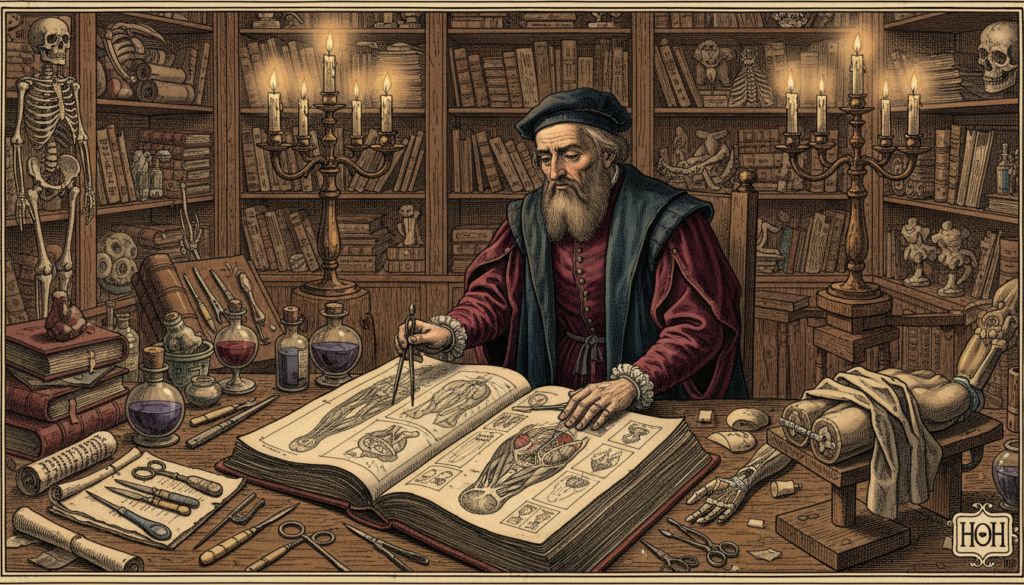
The Fabrica delivered 273 illustrations, merging text and visuals in a way most readers hadn’t seen before. Instead of stiff, label-heavy diagrams, the bodies look observed—posed, weighted, real.
Jan van Calcar (c. 1499–1546), a Brabant-born painter linked to Titian’s workshop, is tied to the look of the plates and had illustrated the earlier Tabulae. But, the speed and scale make it unlikely one person produced every image alone.
What mattered was the method. The pictures were built from what was seen at the table, which helped spread Andreas Vesalius discoveries faster than any lecture could.
Readers could “map” organs in space, not just memorize names. In practice, the layout even encouraged hands-on learning—people used cut-out, layered organ diagrams to build a 3D sense of the body.
And once those visuals were out in the world, they didn’t stay put. Pirated and plagiarized copies showed up quickly across Western Europe, between 1553 and 1564, often reusing the images while swapping in new text.
For a Renaissance anatomist trying to control his message, that had to feel messy. For everyone else, it meant the look of Vesalius De Humani Corporis Fabrica kept echoing—page after page, press after press.
Reactions to Vesalius’s Work
When De humani corporis fabrica arrived in Europe in 1543, it caused a stir. People praised it in one corner and criticized it in another. The Father of Anatomy, Vesalius, kept pushing the idea that what you can see in the body matters.
The book was a hit because of its stunning visuals and clear message. Vesalius showed that anatomy should be based on dissection, not just tradition. This made anatomy feel like a living, testable subject.
Acceptance from the Medical Community
Some doors opened quickly. Vesalius showed the Fabrica to Charles V, and soon he was named a household physician. This was a big deal for the Father of Anatomy.
He also proved the book was useful beyond lectures. He treated injuries and gave medications while traveling with the court. These actions showed why people took him seriously.
The high-quality prints made the work spread fast. Doctors, surgeons, and students could discuss the same images. This shared language strengthened the Vesalius impact on medicine.
Criticism and Controversy
Not everyone was happy. Some court physicians called him a “barber-surgeon,” not a true scholar. This was about who got to speak for medicine.
Jacques Dubois, his old mentor, led a group that attacked Vesalius. They said the human body had changed, to explain away the mismatches. This shows how hard people fought to protect old authority.
There was also tension in religion and politics. In 1551, Charles V ordered an inquiry in Salamanca into Vesalius’s methods. He was cleared, but the criticism didn’t stop.
Later, a rumor spread that Vesalius dissected someone while the heart was beating. Modern biographers say this is likely false. The rumor shows how reputations could swing on a story.
| Reaction | Who pushed it | What it said about anatomy | What happened next |
|---|---|---|---|
| Imperial validation | Charles V and the court | Dissection-based anatomy could guide real medical work | Vesalius became a household physician and traveled with the court |
| Print-driven momentum | Students, surgeons, and physicians across Europe | Clear images and direct description could standardize learning | The Fabrica became a must-have reference in many circles |
| Galen-loyal backlash | Jacques Dubois (Jacobus Sylvius) and allies | Ancient texts should outrank new observations | Public attacks on Vesalius for “departing” from tradition |
| Religious scrutiny | Officials in Salamanca under Charles V’s order | Anatomy methods could raise moral questions | Inquiry held; Vesalius cleared, criticism lingered |
Vesalius and the Advancement of Medical Education
Imagine being a medical student and seeing a huge change. It’s not a new drug or tool. It’s a new way of learning. Andreas Vesalius brought this change.
His classes moved anatomy from books to real bodies. This change lasted a long time.
Looking at Vesalius contributions, you see a key idea. Don’t just repeat what others say. Go see, touch, test. This mindset changed medical education before it changed hospitals.
Changes in Medical Curriculum
Before Vesalius, anatomy teaching in Paris relied on famous books. You studied what others said, not real bodies.
Vesalius didn’t ignore old knowledge. His 1537 thesis showed he could understand and comment on it. But he went further, describing what he saw himself.
At Padua, Vesalius taught anatomy as a skill. He used prints, labels, and art to help students understand. It was less about memorizing and more about seeing and doing.
| What students were used to | What Vesalius pushed in class |
|---|---|
| Reading authorities as the main source of truth | Checking claims against real human anatomy |
| Lectures built around set texts like Galen and Mondino | Lessons built around what the body shows you that day |
| Anatomy as a memory test | Anatomy as a visual and hands-on map for medicine |
| Separate worlds: art over here, medicine over there | Art techniques used to make structure easier to understand |
Hands-on Dissection Practices
Vesalius made dissection a key part of learning. He dissected himself and encouraged students to do the same.
His methods were detailed and practical. In De humani corporis fabrica, he described using a pulley to move cadavers. This helped students see layers clearly.
He started with animals before using human bodies. He studied bones from the Cemetery of the Innocents in Paris. He even built a skeleton from remains. Vesalius believed the body should teach anatomy.
Vesalius’s work wasn’t just about new facts. It changed how doctors were trained. This revolution spread to future generations.
The Legacy of Vesalius
Looking into Vesalius’s life, we find a big impact. His work didn’t just stay on paper. It spread through schools, studios, and hospitals, changing how people saw anatomy.
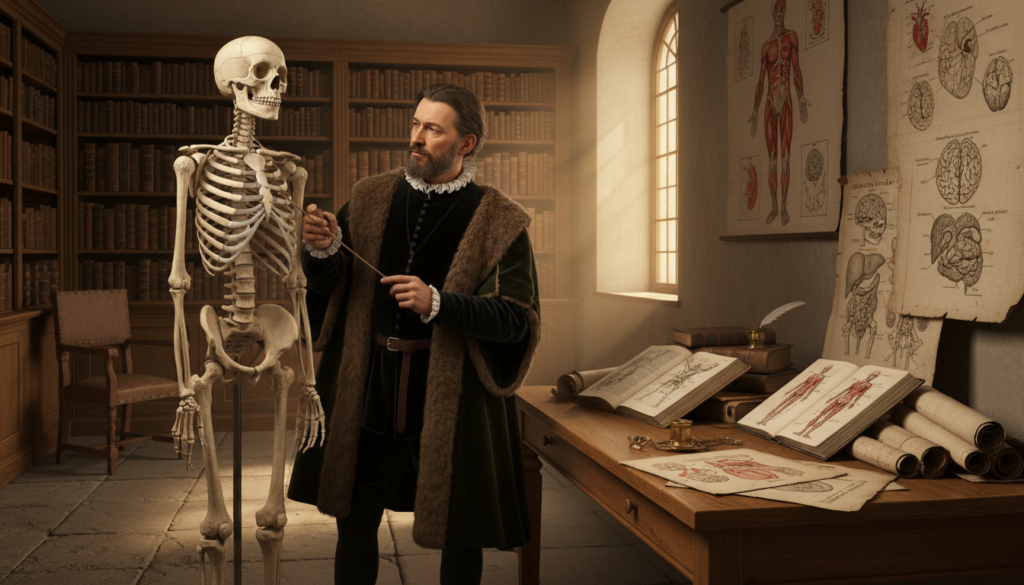
Being called the Father of Anatomy is more than just dissecting first. It’s about making detailed anatomy the norm for everyone else.
Influence on Future Anatomists
At the University of Padua, students learned by watching. Vesalius taught them to trust their eyes first. This habit lasted.
Realdo Colombo and John Caius were influenced by him. They questioned if the body looked like old books said. This mindset is key to Vesalius’s impact, even when others disagreed.
Vesalius also believed in debating. In 1561, he got Gabriele Falloppia’s Observationes anatomicae. He replied with the Examen, arguing with Falloppia as equals.
| How Vesalius Shaped the Next Wave | What Changed for Anatomists |
|---|---|
| Teaching at Padua with live, guided dissection | Students learned to test claims on real bodies, not repeat them from memory |
| Mentoring and influence around figures like Realdo Colombo and John Caius | Anatomy spread through Europe as a skill you practiced, not just a text you quoted |
| Scientific back-and-forth with Gabriele Falloppia, including the Examen | Corrections became normal, and “being wrong” turned into a step toward better maps of the body |
Vesalius’s Place in Medical History
Vesalius wasn’t the first to dissect, and he didn’t work alone. Yet, his De humani corporis fabrica (1543; revised 1555) made anatomy based on dissection hard to ignore. It also challenged Galen’s long shadow.
His work’s legacy is seen in rare book sales. Christie’s recorded sales include $412,994 (1998) and $1,652,500 for the only fully colored copy known (2011). The Osler Library has a 1543 copy, and William Osler admired Vesalius’s accuracy and thoroughness.
Looking at 1943, Harvey Cushing published a Vesalius biography to mark 400 years of the first Fabrica edition. Brown University’s John Hay Library has a copy bound in human skin. This shows Vesalius’s lasting impact, even when it’s unsettling.
Comparative Anatomy: Vesalius’s Approach
Andreas Vesalius had a simple habit. He compared what he saw, not what he was told. As a Renaissance anatomist, he didn’t see animals as “lesser” bodies. He saw them as clues and sometimes traps.
Animals were both the problem and the tool for Vesalius. Before he had steady access to human cadavers, he practiced on mice, moles, rats, dogs, and cats. These hours helped him see nerves, vessels, and tiny layers that are easy to miss.
Study of Animal Anatomy
Comparing species showed where older “human” anatomy was actually animal. Galen used primates and other mammals, so some details didn’t match real humans. Vesalius used side-by-side checks to spot these mismatches.
One famous example is the rete mirabile. It’s found in sheep and other ungulates but not in people. Seeing this difference with your own eyes is unforgettable.
| Claim Vesalius Checked | What Shows Up in Many Animals | What Vesalius Observed in Humans | Why the Comparison Mattered |
|---|---|---|---|
| Rete mirabile near the brain | A clear vascular web in sheep and other ungulates | No equivalent network in human dissections | It flagged how animal-based sources could mislead human medicine |
| Carotid vessel pattern | Galen’s “truncus communis” layout fits simians more closely | Human carotid structures don’t match that pattern cleanly | It pushed anatomy toward direct, human-focused observation |
| “Textbook certainty” vs. what’s on the table | Animal parts can resemble humans just enough to fool you | Small differences change the whole map of vessels and nerves | It rewarded careful looking over repeating authority |
Contributions to Evolutionary Biology
Vesalius wasn’t talking about Darwin, and he wasn’t building an evolution theory. Yet, his method was key: compare structures across species, then test claims against real anatomy. This routine helped normalize cross-species thinking long before it had a modern label.
So when you read Vesalius facts today, it’s less about a single “gotcha” and more about a mindset. A Renaissance anatomist who keeps asking, Does this match the body in front of me? is already training medicine—and later biology—to think in evidence, not inheritance.
The Historical Significance of Vesalius
The Vesalius medical revolution was a big deal. It changed how we see truth. It moved from old stories to real bodies and evidence.
Places like Padua and Venice were key. They were built for learning and new ideas.
Transition from Medieval to Modern Science
In Padua, anatomy was a big deal. It went back to the early 1300s. This made hands-on work important.
Venice was all about learning and new ideas. It was a major printing hub. This helped new ideas spread fast.
Padua focused on studying the physical world. This fit well with Vesalius’ “go look for yourself” approach. It helped medicine move beyond old ways.
| What shaped learning | Older medieval model | Padua + Venice environment |
|---|---|---|
| How knowledge was treated | Authority and commentary carried the weight | Observation and checking claims in the body mattered |
| Teaching style | Lecture-first, dissection often distant or symbolic | Dissection as a core skill, close-up and methodical |
| Access to texts | Limited circulation; slow copying and uneven availability | Classical manuscripts circulated widely through Venice |
| How ideas spread | Local schools and hand-copied notes | Printing networks that moved images and text across Europe |
| What counted as “proof” | Matching tradition, even when bodies disagreed | Letting anatomy correct tradition when needed |
Political and Religious Influences
Power helped Vesalius a lot. Charles V and the Venetian Senate supported him. This made his work hard to ignore.
After Charles V stepped down, Philip II kept Vesalius close. This meant high stakes in court medicine.
In 1559, King Henri II of France was hurt in a tournament. Vesalius worked with Ambroise Paré in Paris.
Henri II died 11 days later. Vesalius did the autopsy and wrote a detailed report. This helped understand trauma better.
Religion was also a factor. In 1551, there was a question about his work’s religious implications. Later, a rumor about vivisection followed him, showing science’s fears.
So, Vesalius’ work was shaped by many things. Universities, printers, courts, and fears all played a part.
Conclusion: The Enduring Impact of Vesalius
Looking back at Andreas Vesalius, you see more than just the Renaissance drama. You feel a connection to his way of thinking. He believed in learning from bodies, images, and detailed descriptions, not just famous voices. This approach is key in education, research, and healthcare today.
Modern Relevance of His Discoveries
Vesalius De Humani Corporis Fabrica is full of insights that modern anatomy relies on. He carefully described the sphenoid bone and the sternum. He also detailed the sacrum, the vestibule in the temporal bone, and the omentum connections.
He noted the small size of the human cecal appendix and detailed the mediastinum and pleura. His brain section was detailed for its time. He even questioned Galen’s ideas on blood movement. Plus, he might have described mechanical ventilation early on, showing anatomy’s power to innovate.
Vesalius’s Role in Shaping Scientific Inquiry
Vesalius’s impact on medicine goes beyond just correcting anatomy. It’s about his method. He changed how anatomy was studied, making it more hands-on and visual. His book spread quickly across Europe, teaching many who never met him.
His life ended far from the classroom. After years of royal service, he left Spain in 1564. His wife and daughter went back to Brussels, but he went on a pilgrimage. The journey was tough, and he died on Zakynthos on October 15, 1564. Yet, his work continued to influence medicine, thanks to his book.
FAQ
Why are you hearing Andreas Vesalius’s name 500+ years later?
Who was Andreas Vesalius, and what’s his real name?
Did Vesalius come from a medical family?
What’s the “three weasels” detail people remember about Vesalius?
What did anatomy class look like before Vesalius made it hands-on?
How did Renaissance humanism shape Vesalius’s approach?
Where did Vesalius study, and how did he end up at Padua?
What made Padua the perfect place for Vesalius’s breakthroughs?
What were Andreas Vesalius’s biggest contributions to anatomy?
What did Vesalius get right that Galen got wrong?
Did Vesalius ever make mistakes himself?
Why was Vesalius so obsessed with direct observation?
How did Vesalius get enough cadavers to dissect?
What is *De humani corporis fabrica*, and why is it so famous?
Who printed the *Fabrica*, and what made the publishing strategy powerful?
What is the *Epitome*, and how is it different from the *Fabrica*?
Did Vesalius revise the *Fabrica*?
How many illustrations are in the *Fabrica*, and why did they matter so much?
Was Jan van Calcar the illustrator of the *Fabrica*?
Why were the *Fabrica* images copied and pirated so quickly?
How did the medical community react when the *Fabrica* was published?
What kind of work did Vesalius do as an imperial physician?
Who attacked Vesalius, and what were the main criticisms?
Was Vesalius ever investigated for religious reasons?
How did Vesalius change medical education and the anatomy curriculum?
What were Vesalius’s dissection practices like in real life?
Did Vesalius dissect animals, and why does that matter?
Did Vesalius contribute to evolutionary biology?
Who were Vesalius’s students and scientific peers?
What is Vesalius’s place in medical history—what’s the honest version?
Why are *Fabrica* copies so rare and expensive today?
How did politics and royalty shape Vesalius’s career?
What happened with King Henri II of France, and why is Vesalius connected to it?
What are some specific anatomical descriptions Vesalius got right in the *Fabrica*?
How did Vesalius’s life end?
What’s the simplest takeaway from the Vesalius medical revolution?
Get More Medical History
Join our newsletter for fascinating stories from medical history delivered to your inbox weekly.