The History of Healing
 Leech Therapy: Exploring Its Captivating History
Discover the fascinating bloodletting history from ancient times to modern medicine, exploring why doctors once believed draining blood could cure disease.


In the 1830s, France brought in about 42 million leeches. That’s right, tens of millions of leeches. They were shipped across borders for healing. The history of bloodletting in Western medicine is both wild and complex.
William Osler said medicine is “the science of uncertainty and the art of probability.” This idea of knowing and not knowing is key in bloodletting’s history. Dr. Vincent Lam, a Toronto doctor, wrote about this in Bloodletting & Miraculous Cures. His book shows the gap between ideal medicine and real practice.
This struggle is ancient. Bloodletting’s history shows how beliefs change over time. Practices that were once accepted are later seen as superstition. And sometimes, they come back.
We’re going to explore this journey together. From ancient Egypt to modern surgery, leeches have been a key part of medicine. Why did people trust leeches to save their lives? And why do surgeons use them today? Let’s discover.
Key Takeaways
- Leech therapy is one of the oldest medical practices in recorded bloodletting history, dating back thousands of years across multiple civilizations.
- France alone imported roughly 42 million leeches in a single year during the 1830s, showing the massive scale of this treatment.
- The medical history of bloodletting reveals how accepted medical “truths” have shifted dramatically from era to era.
- The bloodletting therapy evolution didn’t follow a straight line — practices were embraced, abandoned, and sometimes revived centuries later.
- Leech therapy isn’t just a relic of the past; it’s stil used in modern surgical settings today.
- Understanding this history helps us see how medicine constantly negotiates the gap between belief and evidence.
Origins of Leech Therapy in Ancient Medicine
People used leeches on their bodies thousands of years ago. It wasn’t just a dare. The practice of bloodletting started in advanced civilizations. These cultures built pyramids, invented democracy, and mapped the stars.
Traditional Uses in Ancient Cultures
Ancient Egyptian tomb paintings show leeches on patients around 1500 BCE. The Ebers Papyrus talks about bloodletting as a healing method. It was a common practice, not just a desperate measure.
In Greece, Hippocrates used four humors: blood, phlegm, yellow bile, and black bile. He believed bloodletting could balance these humors when someone got sick. Galen of Pergamon made bloodletting a main treatment for many illnesses.
In India, the Sushruta Samhita recommended leeches for skin diseases and joint pain. Ayurvedic medicine used leeches in a specific way. Ancient Chinese healers also used leeches to restore energy flow.
Historical Texts Documenting Leeches
Many ancient writers detailed leech use. These texts were key in medicine for centuries.
“The leech is nature’s own surgeon, drawing forth what poisons the blood.”
| Historical Text | Author/Origin | Approximate Date | Key Contribution |
|---|---|---|---|
| Ebers Papyrus | Ancient Egypt | 1550 BCE | Early references to bloodletting practices |
| Sushruta Samhita | Sushruta (India) | 600 BCE | Detailed leech therapy for surgical healing |
| Theriaca | Nicander of Colophon (Greece) | 2nd century BCE | Documented medicinal leech applications |
| Natural History | Pliny the Elder (Rome) | 77 CE | Cataloged leech species and medical uses |
| Medical Treatises | Galen of Pergamon (Rome) | 2nd century CE | Championed humoral bloodletting theory |
These ideas were not fringe. They were mainstream medicine. They shaped practices in Europe for centuries.
The Role of Leeches in Medieval Europe
Leeches were more than just a weird medieval trend. They played a big role in understanding medicine for a long time. Bloodletting in medieval Europe was quite a story, and leeches were at its core.
Medical Practices During the Middle Ages
Monks were the first doctors in early medieval Europe. They treated the sick in monasteries as part of their duty. But, things changed in 1163 when the Council of Tours stopped clergy from doing surgery.
So, who took over? Barbers did. They became the experts in bloodletting. The red and white barber pole you see today? It’s from this time, symbolizing blood and bandages. It’s pretty creepy when you think about it.
Medieval doctors thought leeches could fix almost any problem:
- Fevers and infections
- Plague symptoms
- Headaches and mental illness
- Digestive problems
Leeches and Royalty: A Status Symbol
Bloodletting was more than just medicine. It was a sign of wealth and power for kings and queens. They had special doctors just for applying leeches.
Did you know? The Old English word for leech, lǣce, meant “healer” or “physician.” It was the same word for the creature and the doctor.
Leech collecting became a job during this time. Poor women would go barefoot into marshes to catch leeches. It was hard and dangerous work, but it was in demand by the rich.
| Aspect | Commoners | Royalty |
|---|---|---|
| Practitioner | Barber-surgeons | Personal court physicians |
| Frequency | Occasional, when ill | Regular, preventive sessions |
| Leech Quality | Locally gathered | Hand-selected, premium specimens |
| Setting | Barber shops or homes | Private royal chambers |
The Enlightenment and Advances in Medical Science
The Enlightenment brought us rational thinking and a love for science. But it also brought a big obsession with leeches. This was the peak of “leech mania.” The 18th and early 19th centuries saw a huge rise in bloodletting, with leeches everywhere.

How Leeches Earned Peak Respect in 18th Century Medicine
French doctor François-Joseph-Victor Broussais loved leeches. He thought nearly all diseases came from gut inflammation. His fix? Putting leeches on the belly.
By the 1830s, France needed 42 million leeches a year. This demand almost wiped out Hirudo medicinalis in Europe.
Doctors were very sure of themselves, even without proof. This was a pattern William Osler would later question.
Notable Physicians Who Championed the Practice
In America, Benjamin Rush supported bloodletting, even during the 1793 yellow fever outbreak in Philadelphia. He used lancets, but the idea was the same: let out the blood to cure the patient.
George Washington’s doctors took out 80 ounces of his blood in one day. He died soon after.
| Physician | Country | Preferred Method | Key Contribution |
|---|---|---|---|
| François-Joseph-Victor Broussais | France | Leeches | Popularized abdominal leech application for inflammation |
| Benjamin Rush | United States | Lancets | Advocated aggressive bloodletting during yellow fever epidemic |
The next section will show how this era of excitement came to an end. The decline was swift and dramatic.
Decline of Leech Therapy: 19th to Early 20th Century
Leech therapy fell out of favor after centuries of use. The shift away from leeches was swift. Science had caught up.
Rise of Modern Medicine and Antibiotics
In the late 1800s, Louis Pasteur and Robert Koch found that germs cause disease. This idea changed everything. The old way of treating sickness was no longer valid.
Then, in 1928, Alexander Fleming found penicillin. Doctors now had a real way to fight infections. Why use leeches when you could kill germs directly? Medical texts soon forgot about bloodletting.
| Era | Primary Treatment Approach | View of Bloodletting |
|---|---|---|
| Pre-1860s | Humoral balancing (bloodletting, purging) | Trusted and mainstream |
| 1860s–1920s | Germ theory and antiseptics | Increasingly questioned |
| 1928 onward | Antibiotics and targeted drugs | Considered primitive |
Changing Perceptions of Bloodletting
The public’s view of bloodletting changed fast. What was once trusted became a joke. The old ideas behind bloodletting seemed silly.
Bloodletting became a symbol of old, bad medicine. It showed how far we’ve come. But remember, today’s treatments might seem outdated tomorrow.
But the story doesn’t end here. Those slimy little creatures were about to make one of the most surprising comebacks in medical history.
The Resurgence of Leech Therapy Today
Leeches have made a big comeback in hospitals. In 2004, the FDA approved them as a medical device. This made them the first live animal to get this approval. It’s quite amazing.
This change marked a big step in bloodletting therapy. What was once old became new in top medical centers.
Where Leeches Work in Operating Rooms
Leeches are now used in reconstructive and microsurgery. They help after complex surgeries like finger reattachments and skin grafts. This is because they remove pooled blood.
After surgery, blood can pool in tissues. This can harm new tissue. Leeches use anticoagulants in their saliva to keep blood flowing. Hospitals like Johns Hopkins have seen great results.
| Surgical Application | How Leeches Help | Success Rate |
|---|---|---|
| Finger Reattachment | Relieve venous congestion | Up to 70–80% |
| Breast Reconstruction | Improve flap survival | 60–80% |
| Skin Graft Recovery | Restore blood flow | Up to 70% |
Leeches in the Beauty World
Celebrities are talking about “leech facials.” It’s a new trend in beauty. People say it boosts circulation and makes skin look better.
But, the science behind it for beauty is not strong. Leeches are proven to work in surgery, but in spas? That’s not so clear.
Scientific Research Surrounding Leech Therapy
Leeches have been used for thousands of years. But why do they actually work? Modern science has found out why, and it’s really cool.
Studies on Hirudin and Its Benefits
In 1884, John Berry Haycraft found a peptide in leech saliva called hirudin. It’s a powerful anticoagulant. Hirudin blocks thrombin, the enzyme that forms blood clots. This showed ancient healers were right.
Pharmaceutical companies took notice. Hoechst and Bayer made a lab version called Lepirudin (brand name Refludan) for a specific medical condition. But hirudin is just one part of leech saliva’s magic.
Leech saliva has many compounds:
- Hyaluronidase — increases tissue permeability
- Calin — inhibits platelet adhesion
- Destabilase — breaks down fibrin clots
- Anesthetic compounds — make the bite nearly painless
Current Trends in Medical Research
Research on leech therapy is ongoing. Scientists are studying it for heart disease, arthritis, and cancer. Studies in the British Journal of Surgery and Microsurgery show leeches help with tissue repair after surgery.
Researchers are making synthetic versions of leech saliva. These mimic the benefits without the “ick factor.” Ancient bloodletting techniques are now inspiring new drug designs.
| Compound | Function | Medical Application |
|---|---|---|
| Hirudin | Thrombin inhibitor | Anticoagulant therapy |
| Hyaluronidase | Tissue permeability enhancer | Drug delivery improvement |
| Calin | Platelet adhesion inhibitor | Cardiovascular treatment |
| Destabilase | Fibrin clot breakdown | Stroke and thrombosis research |
Cultural Perceptions of Leeches Throughout History
Leeches have been seen as both good and bad for thousands of years. The way people viewed them changed based on bloodletting practices. Let’s look at the truth behind these views and where leeches show up unexpectedly.
Myths vs. Facts about Leeches
Many stories about leeches are not true. Here’s what’s real and what’s not:
- Myth: Leeches spread diseases. Fact: Medical leeches raised in clean places are safe for patients.
- Myth: They can drain all your blood. Fact: A single leech takes only a tablespoon of blood.
- Myth: Old bloodletting was all bad. Fact: While most was wrong, today’s leech therapy is proven and safe.
- Myth: Leech bites harm you forever. Fact: The wound bleeds a lot but heals without scars.
Knowing about bloodletting history helps us see that not all old practices were bad. They just didn’t always work.
Leeches in Popular Culture
Leeches appear in books, movies, and TV. Remember Humphrey Bogart’s famous scene in The African Queen (1951)? In fantasy and horror, they symbolize both harm and healing.
Dr. Vincent Lam’s Bloodletting & Miraculous Cures won the 2006 Scotiabank Giller Prize. It explores medicine’s moral side. The book and its 2010 TV series follow doctors during the 2003 SARS outbreak.
These examples show that bloodletting’s history fascinates us, even with today’s science.
Leech Therapy Across Different Countries
Leech therapy didn’t start in just one place. It grew in many parts of the world, shaped by different medical views. Bloodletting was important in almost every big culture. Let’s explore how each region made it their own.
Differences in Practice: East vs. West
In India, the Sushruta Samhita text from long ago talked about leeches. It said they were either good or bad for you. Today, Ayurvedic hospitals in India use leeches to treat patients.
In Western Europe, doctors followed a different idea. They thought leeches could fix the body’s balance. In the Middle East and South Asia, Unani medicine also used leeches a lot. But in China, they dried leeches and made powder from them.
Even though they did things differently, they all believed bloodletting could help.
Global Acceptance and Use
So, where do we get medicinal leeches from today? It might surprise you.
| Country | Key Supplier or Practice | Current Status |
|---|---|---|
| Germany | Biebertaler Leech Breeding Farm (Zaug GmbH) | One of the world’s largest leech suppliers |
| Russia | Dedicated hirudotherapy clinics in Moscow and Saint Petersburg | Active and widely practiced |
| United States | Leeches U.S.A. Ltd. and Ricarimpex SAS (France) | FDA-cleared medicinal leeches supplied to hospitals |
| India | Government-regulated Ayurvedic hospitals | Officially recognized treatment |
The old practice of bloodletting is alive today. It’s found in German farms and Russian clinics. This ancient method is making its way around the world.
Legal and Ethical Considerations in Leech Therapy
Who watches over a living medical tool? As bloodletting moved from barber shops to hospitals, governments had to step in. The rules vary a lot, and the ethics are quite interesting.
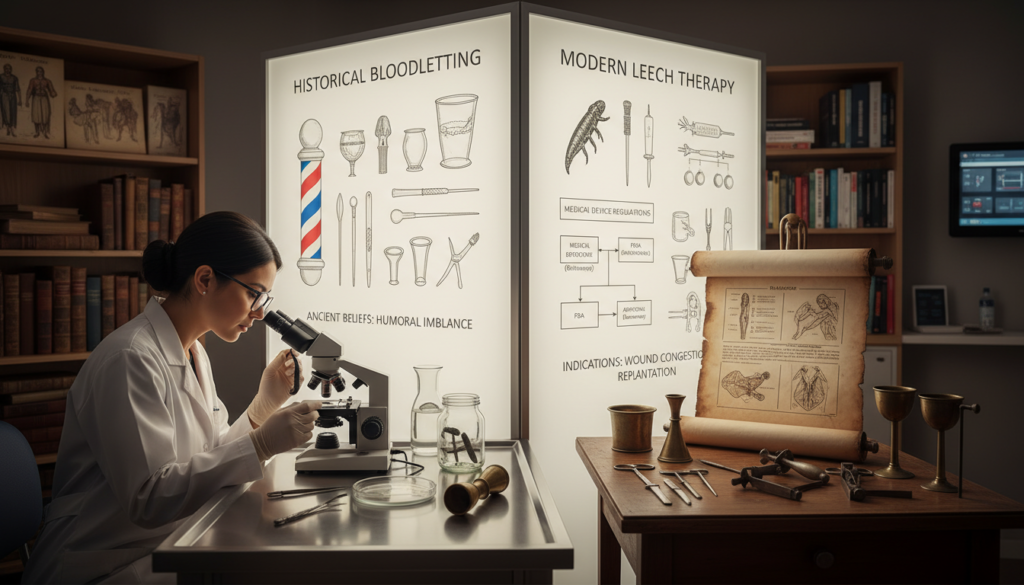
Regulatory Bodies Overseeing Practices
In the U.S., the FDA treats medicinal leeches like a medical device. They have strict quality standards. It’s quite surprising.
In Europe, the EMA handles leech therapy. India’s Ministry of AYUSH oversees Ayurvedic leech therapy. Back then, bloodletting was much less regulated.
| Country/Region | Regulatory Body | Classification |
|---|---|---|
| United States | FDA | 510(k) Medical Device |
| European Union | EMA | Therapeutic Medicinal Product |
| India | Ministry of AYUSH | Ayurvedic Practice |
Ethical Concerns in Medical Applications
Getting consent can be hard. Patients must accept a live animal treatment. This can upset some people.
There’s also an environmental issue. Hirudo medicinalis is protected by CITES. Most leeches are now raised on farms. Each leech is used once and then killed to avoid disease spread. This raises big animal welfare questions.
As Vincent Lam showed in Bloodletting & Miraculous Cures, medicine always faces tough choices. Bloodletting history teaches us that ethics have always been complex.
Future of Leech Therapy in Medicine
So, where are we headed? The history of bloodletting shows us that old ideas can come back better. Leech therapy is evolving fast. Researchers and engineers are making it even more advanced.
Innovations and New Discoveries
Something exciting is happening. Scientists at the University of Wisconsin-Madison and Brigham and Women’s Hospital are working on mechanical leech devices. These devices suck out blood and add heparin, just like leeches do, but without the squirm.
On the drug side, scientists have made a lab version of hirudin, found in leech spit. This drug, called Angiomax, is used in heart surgeries. It shows how old ideas can lead to new medicines.
Researchers are also looking at a bacterium in leech guts. It might have special powers against germs. This could lead to new treatments.
Patient Perspectives and Acceptance
Most people are scared when they hear about leeches. It’s a normal reaction. Studies show that people are often hesitant at first.
But, when they see their wounds healing, they get really happy. Talking openly and explaining things helps a lot. Doctors can make patients understand and accept leech therapy.
The story of bloodletting is a humbling one. It shows us that science is always evolving. Sometimes, the best solution has been waiting for us for millions of years. We just need to be open to using it.
FAQ
What are the origins of bloodletting, and how far back does leech therapy actually go?
Why did barber-surgeons perform bloodletting in medieval Europe, and what does the barber pole actually represent?
How did leeches become a status symbol among royalty and the wealthy?
Who was François-Joseph-Victor Broussais, and why did France import 42 million leeches a year?
Was George Washington really killed by bloodletting?
How did germ theory and antibiotics lead to the decline of leech therapy?
When did the FDA approve leeches as a medical device, and why?
Are “leech facials” and cosmetic leech treatments actually effective?
What is hirudin, and why is it so important in medicine?
Are scientists developing synthetic alternatives to live leeches?
Do leeches transmit diseases to patients?
How has leech therapy been portrayed in popular culture and literature?
How does leech therapy differ between Eastern and Western medical traditions?
Which countries are the biggest producers and users of medicinal leeches today?
How are medicinal leeches regulated, and what legal standards apply?
What are the ethical concerns surrounding modern leech therapy?
What does the future of leech therapy look like?
Get More Medical History
Join our newsletter for fascinating stories from medical history delivered to your inbox weekly.