The History of Healing
 Harvey Cushing: Father of Modern Brain Surgery
Discover the life and legacy of Harvey Cushing, the pioneering neurosurgeon who revolutionized brain surgery and endocrinology.

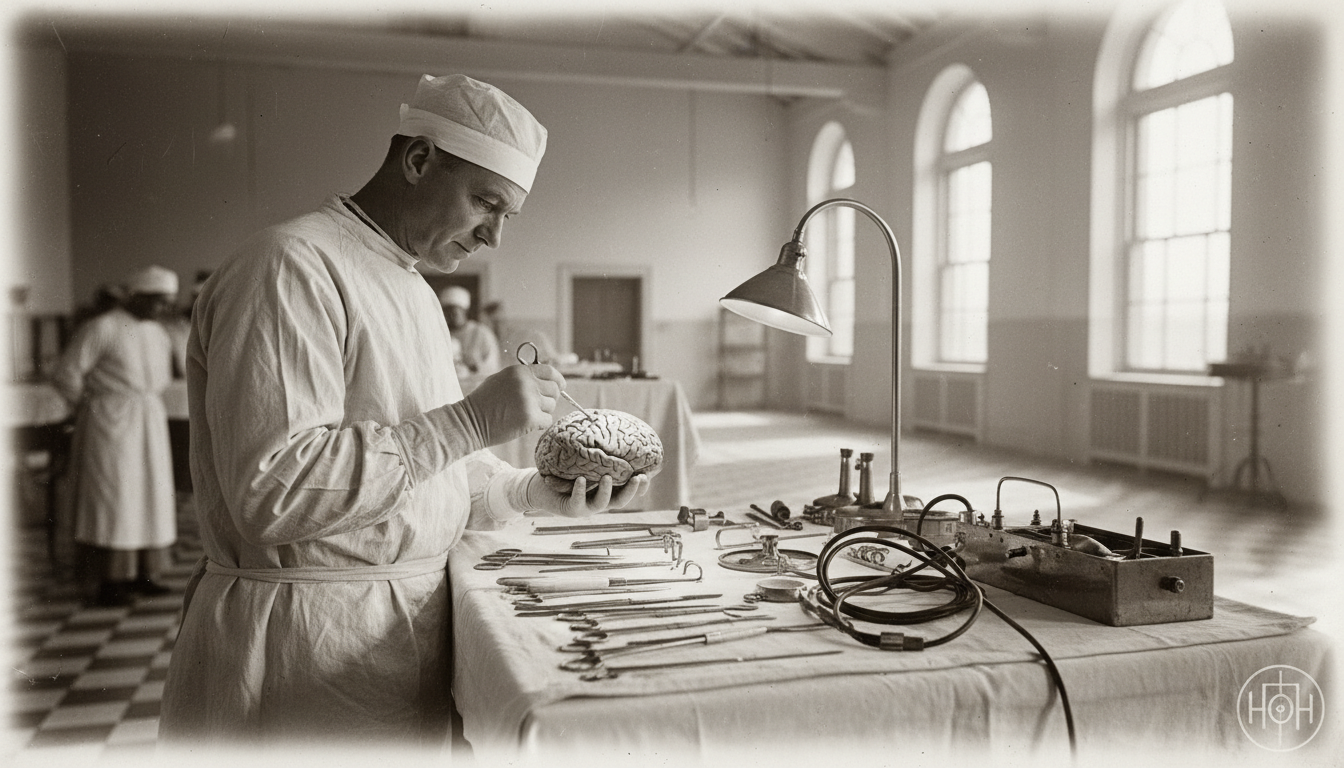
More than 2,000 brain tumor operations. Harvey Cushing did this in a time when brain surgery was very risky.
Ever wonder how neurosurgery became a real field? Meet Harvey Cushing, the man who made it happen. He was more than a surgeon. He was a clinician, pathologist, writer, and even a skilled draftsman.
In medical history, Harvey Cushing is a key figure. The American Association of Neurological Surgeons even uses his portrait. They see him as a foundation of the field.
What’s amazing is that we know a lot about his work. He saved notes, letters, and case records with great detail. This lets us see his choices, risks, and small victories over the years.
As a medical pioneer, Harvey Cushing also linked brain surgery with hormones and glands. His work led to Cushing’s reflex and Cushing syndrome in 1932. Join us as we explore how one person transformed neurosurgery.
Key Takeaways
- Harvey Cushing helped turn early brain surgery into modern neurosurgery.
- He operated on more than 2,000 brain tumor cases across a 40+ year career.
- His detailed records make his work unusually clear in medical history.
- He worked as a surgeon, pathologist, writer, and skilled medical illustrator.
- His influence is seen today, including by the American Association of Neurological Surgeons.
- His ideas helped link brain surgery and hormones, shaping later diagnoses and treatment.
Early Life and Education of Harvey Cushing
Harvey Cushing’s story is one of real stakes. He was the youngest of ten kids in Cleveland, Ohio. His home was always buzzing with noise and activity.
This early environment taught him to focus. It’s a skill that would later mark his place in medical history.
Family Background
Medicine was a family affair for Harvey. His father, Henry Kirke Cushing, was a doctor. The family’s medical roots went back generations.
His mother, Elizabeth Maria “Betsey M.” Williams, kept the household running smoothly. This mix of structure and ambition shaped Harvey’s determination.
Academic Pursuits
Harvey started at the Cleveland Manual Training School. It focused on hands-on learning, not just books. This training was like learning a language with your hands.
He then went to Yale University (B.A., 1891) and joined several clubs. Later, he attended Harvard Medical School (M.D., 1895). His education was steady and intense.
| Stage | Place | What he gained | Why it matters in medical history |
|---|---|---|---|
| Manual training | Cleveland Manual Training School | Hands-on precision, comfort with instruments, physics-based thinking | Built the practical “do it clean, do it right” mindset tied to a medical pioneer |
| Undergraduate study | Yale University | Broad learning, discipline, campus networks and mentorship | Helped Harvey Cushing move easily between ideas, people, and emerging fields |
| Medical degree | Harvard Medical School | Clinical fundamentals, anatomy, early research habits | Set the groundwork for later links between brain disorders and endocrinology |
| Early clinical training | Massachusetts General Hospital | Hospital pace, case volume, real-world decision-making | Turned classroom knowledge into judgment under pressure |
Influences on His Career
After Harvard, Harvey’s training was fast-paced. He interned at Massachusetts General Hospital. Then, he worked under William Stewart Halsted at Johns Hopkins Hospital in Baltimore.
Halsted’s strict style matched Harvey’s need for precision. Harvey didn’t stop there. He also trained abroad, learning from Emil Theodor Kocher in Bern and Charles Scott Sherrington in Liverpool.
These experiences broadened his understanding of the nervous system. They fueled his curiosity, reshaping neurosurgery and endocrinology in medical history.
Contributions to Neurosurgery
Harvey Cushing is a name you hear in neurosurgery today. He was a young doctor with a big impact. He wanted to use new tools in patient care right away.
His drive to improve made him a medical pioneer. He didn’t just treat cases. He changed how surgeries were planned and done.
Development of Surgical Techniques
Cushing saw surgery as a skill to hone, not a risk to take. He used detailed notes and steady hands. These habits made his techniques spread widely.
He focused on small details like clean fields and tight teamwork. In neurosurgery, these details are key.
| What Cushing pushed for | Why it mattered in the OR | What it changed long-term |
|---|---|---|
| Meticulous operative notes and sketches | Made each case easier to review and learn from | Helped standardize surgical techniques for future surgeons |
| Relentless bleeding control | Kept the field visible and reduced shock | Lowered risk during brain tumor work and other delicate cases |
| Consistent pre-op planning | Reduced surprises once the skull was open | Set a pattern for modern neurosurgery workflows |
| Team rhythm in the operating room | Fewer delays, fewer mistakes under pressure | Made complex procedures more repeatable across hospitals |
Introduction of Local Anesthesia
He also made local anesthesia common in brain surgery. This led to calmer, more controlled operations. It was about precision, not speed.
Local anesthesia wasn’t about being brave. It was about control and careful work.
Pioneering Tumor Removal Procedures
When a brain tumor was suspected, Cushing pushed for sharp diagnosis and bold surgery. He treated each case like an investigation. He looked at symptoms, location, and what was possible without harming function.
He wasn’t after drama. He was building a method. His method of careful exposure, controlled bleeding, and step-by-step removal defined neurosurgery.
Cushing’s Brain Surgery Innovations
Early brain surgery was often seen as fast and messy. But Harvey Cushing changed that. He brought calm focus, clear sight, and reliable numbers to neurosurgery.
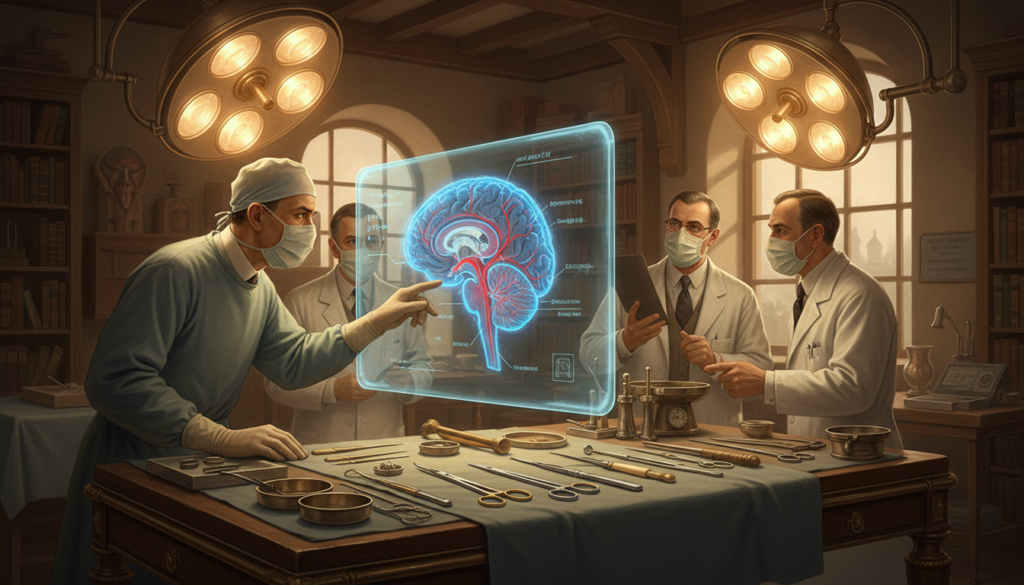
He made the operating room a place of careful watching and adjusting. This approach helped in delicate surgeries, like those near the pituitary gland. Even small mistakes could change a life.
Importance of Visualization
Cushing wanted you to see what you were doing, not guess. He believed in better light, steady exposure, and a clean field. These were key to safe neurosurgery.
Tools got better over time, but the real change was attention. Harvey Cushing trained teams to slow down. This way, every move had a clear purpose.
Emphasis on Precision
He also made control during surgery tighter. Around 1900, he supported the Riva-Rocci sphygmomanometer. This blood pressure cuff helped track pressure during operations.
With blood pressure as a steady signal, surgeries could be timed and adjusted calmly. This was vital, as complex cases needed careful handling.
Introduction of the Cushing Reflex
The Cushing reflex is another example of his careful approach. It shows when the brain is under strain. This pattern warns of trouble during neurosurgery.
For Harvey Cushing, this was more than trivia. It was a clue to watch during surgery, right next to your tools and techniques.
| Innovation focus | What you do differently | Why it matters in neurosurgery | Where it shows up (including pituitary gland work) |
|---|---|---|---|
| Visualization | Keep a clean field, strong lighting, and steady exposure | Reduces guesswork and rushed moves | Helps you protect small vessels and nerves during deep approaches |
| Precision habits | Plan steps, limit unnecessary motion, and coordinate the team | Lowers risk in tight spaces where millimeters count | Supports careful dissection near the pituitary gland and nearby structures |
| Blood pressure monitoring | Track peri-operative blood pressure with the Riva-Rocci sphygmomanometer | Gives early warnings during stress, bleeding, or rising pressure | Makes longer, complex surgical techniques easier to manage safely |
| Cushing reflex awareness | Watch for the pattern tied to increased intracranial pressure | Signals trouble when the brain is being compressed | Guides pacing and decision-making during demanding neurosurgery cases |
The Cushing Triad
Imagine a tense moment in the ER. A patient’s skull pressure is rising, and the body is sending out warnings. Harvey Cushing noticed this pattern early in neurosurgery. It’s a key warning sign today.
Definition and Significance
The Cushing triad is a set of warning signs for high skull pressure. It includes high blood pressure, a slow heart rate, and odd breathing. It’s the body’s way of trying to keep blood flowing to the brainstem.
This mix of signs is memorable. It shows up when the brain might be swelling, bleeding, or have a tumor. This old observation is important in today’s care.
Clinical Applications
The triad is like a quick snapshot at the bedside. It helps doctors ask, “Is the brain getting squeezed?” In neurosurgery, it can lead to quick imaging and urgent action.
It helps doctors sort out what’s happening. A single odd sign can have many causes. But the triad means something serious is happening, like the brain is in trouble.
| Triad clue | What you might notice | Why it matters at the bedside | Common next steps teams consider |
|---|---|---|---|
| Rising blood pressure with widened pulse pressure | Higher systolic number; “bounding” pulse | Can reflect the body trying to maintain blood flow as pressure builds in the skull | Frequent vital checks, rapid neuro exam, imaging planning, tighter blood pressure targets |
| Bradycardia | Heart rate dropping compared with earlier readings | May signal brainstem stress and a worsening pressure problem | Continuous monitoring, escalation to critical care, review meds and oxygenation |
| Irregular respirations | Uneven rate, pauses, or abnormal breathing pattern | Breathing control centers can be affected when compression advances | Airway readiness, ventilation support if needed, urgent reassessment for deterioration |
Impact on Brain Injury Management
The triad is key in managing brain injuries. It shows up late, when pressure is high. Teams treat it as a “don’t wait” signal. This leads to fast checks and quick action.
Cushing’s work linked careful observation to lifesaving steps. This is seen in neurosurgery and critical care today. Cushing’s disease is in endocrinology, but his focus on body patterns is shared across fields.
Cushing’s Role in World War I
War didn’t ease up for anyone in Europe, and it didn’t spare medicine either. Harvey Cushing showed up with habits that shaped neurosurgery. He had steady hands, sharp notes, and a refusal to rush the hard parts.
His World War I timeline almost reads like a travel log that takes a sudden turn. One month you’re thinking “break,” the next you’re staring at a new kind of emergency medicine. This will reshape medical history.
Contributions as a Surgeon
In March 1915, he led the first Harvard Unit. It had 13 surgeons and 4 nurses. They sailed from the United States on March 22. They went to Gibraltar, then Paris, and worked at the American Ambulance before returning in June.
What made him stand out wasn’t drama. It was the grind. He made triage decisions, kept meticulous records, and used surgical techniques built for speed without cutting corners. Even in wartime, he pushed for cleaner fields and better control of bleeding, because those basics save lives.
Innovations in Trauma Care
Battle injuries forced fast learning. Head wounds, shock, and infection came in waves. Every case demanded practical neurosurgery thinking.
His approach leaned on observation and repeatable steps. Not fancy. Just reliable. That mindset—measure, adjust, document—helped turn messy experience into usable medical history.
- Discipline under pressure: calm setups, clear roles, and fewer wasted motions
- Better surgical flow: steady hemostasis, careful tissue handling, and strict wound care
- Sharper records: notes that could be taught, tested, and improved
Influence on Military Medicine
He returned for later stints in base hospitals. Eventually, he became the senior consultant in neurological surgery for the American Expeditionary Forces in Europe. That position mattered because it linked front-line reality to training and standards.
You can see the ripple effect in how military medicine began to talk about head trauma: more system, less guesswork. Harvey Cushing didn’t just treat patients; he helped shape how teams thought, moved, and learned across a brutal theater of war.
| World War I role | What it looked like day to day | Why it mattered for neurosurgery and medical history |
|---|---|---|
| Leader, first Harvard Unit (March–June 1915) | Managed surgeons and nurses, ran cases in Paris at the American Ambulance, kept tight case notes | Spread disciplined surgical techniques under combat pressure; preserved lessons that later shaped training |
| Surgeon in later base-hospital stints | Handled high-volume trauma, prioritized infection control and bleeding control, refined operating routines | Turned repeated battlefield patterns into practical, teachable care for head injuries |
| Senior consultant in neurological surgery, American Expeditionary Forces | Advised teams across sites, pushed consistent standards, reviewed outcomes and complications | Helped military medicine move toward coordinated neurosurgery practice instead of isolated “one-off” solutions |
Recognition and Awards
Harvey Cushing’s journey through medical history is filled with honors. He received many medals, fellowships, and invitations. This shows his work was groundbreaking and changed what doctors thought was possible.
Honorary Degrees and Titles
After World War I, Harvey Cushing was honored by both the British and U.S. governments. He was made a Companion of the Order of the Bath by the British. The U.S. Army gave him the Distinguished Service Medal in 1923.
These honors were not just thank-yous. They showed his skill and leadership were recognized worldwide.
He also received honorary degrees. Being named an honorary F.R.C.S. (London) in 1913 was a big deal. It showed his reputation in neurosurgery was respected globally.
Memberships in Professional Societies
Harvey Cushing was elected to many prestigious groups. He became a Fellow of the American Academy of Arts and Sciences in 1914. He also joined the U.S. National Academy of Sciences in 1917.
Later, he was elected to the American Philosophical Society (1930) and the Royal Swedish Academy of Sciences (1934). He was even a Fellow of the Royal Society of London, a huge honor.
In 1934, he became president of the History of Science Society. This role fit his interest in the history behind science.
| Type of Recognition | Honor or Organization | Year | Why It Stood Out |
|---|---|---|---|
| Military honor | Companion of the Order of the Bath (United Kingdom) | After World War I | Marked wartime surgical service as internationally valued |
| Military honor | Distinguished Service Medal (U.S. Army) | Often cited as 1923 | Recognized leadership and impact in military medicine |
| Professional title | Honorary F.R.C.S. (London) | 1913 | Signaled rare cross-Atlantic respect for an American surgeon |
| Scholarly fellowship | American Academy of Arts and Sciences | 1914 | Placed his medical work in a broader scientific and cultural circle |
| Scientific academy | U.S. National Academy of Sciences | 1917 | Confirmed his research influence beyond the operating room |
| Learned society | American Philosophical Society | 1930 | Highlighted his reach into ideas, evidence, and public knowledge |
| Scientific academy | Royal Swedish Academy of Sciences | 1934 | Reflected global attention to his lasting scientific impact |
| Scientific fellowship | Royal Society of London | 20th century | One of the strongest signals of international scientific esteem |
| Leadership role | President, History of Science Society | 1934 | Showed his active interest in how discoveries get remembered |
Cushing’s Legacy in Medicine
Harvey Cushing was nominated for the Nobel Prize in Physiology or Medicine 38 times. This shows his peers highly valued his work. They saw his contributions to neurosurgery as groundbreaking.
Looking at medical history, Harvey Cushing’s honors tell a story. He didn’t just collect awards. He set new standards that others followed and debated for years.
Harvey Cushing’s Writings and Publications
Ever wish medical history came with receipts? You’re in luck. Harvey Cushing left behind case notes, letters, and drafts that feel alive. His work shows how neurosurgery grew, one careful observation at a time.
Even outside the operating room, he watched patterns and symptoms. He noticed how hormones and the brain interact. This connection touched on endocrinology too.
Key Texts in Neurosurgery
Harvey Cushing left behind language, not just tools. His writing guides you through hard cases. It makes neurosurgery seem like a craft, not myth.
His Life of Sir William Osler (Oxford University Press, 1925) won a Pulitzer Prize. It’s a biography that shows Cushing’s curious and stubborn nature. He was obsessed with getting things right.
| Work | What you’ll notice | Why it matters |
|---|---|---|
| Life of Sir William Osler (Oxford University Press, 1925) | Clean storytelling mixed with sharp clinical memory | Shows how medical history teaches judgment, not just dates |
| Published surgical case reports and series | Step-by-step records: symptoms, approach, outcome, and follow-up | Explains how neurosurgery standards formed from evidence, not vibes |
| Writings on the pituitary and related disorders | Links between brain findings and body-wide changes | Connects neurosurgery to endocrinology in a practical, patient-first way |
Contributions to Medical Literature
His medical literature stands out because of his discipline. He wrote about successes and failures. He shared what surprised him and what needed a new plan.
This honesty is invaluable for medical history. It keeps endocrinology relevant, as pituitary problems affect the whole body.
- Relentless documentation that tracks patients beyond the operation
- Clear surgical descriptions that other teams could repeat and test
- Clinical curiosity that ties symptoms to anatomy and function
Impact on Future Generations of Surgeons
Reading his work, you feel the handoff to the next generation. Harvey Cushing’s writing lets you picture the room and the stakes. This made neurosurgery teachable at scale, not just passed down as legend.
He treated the pituitary as part of the story. This brought endocrinology into the main text. For today’s readers, it shows that the best medical history is practical and human.
Personal Life and Character of Harvey Cushing
Harvey Cushing was more than just a doctor. He had a personal life that adds color to his story. He balanced his work and family, making medical history feel real.
Family and Relationships
Harvey Cushing married Katharine Stone Crowell in 1902. They had five children together. Their son, William Harvey Cushing, died in a car accident at Yale.
Their daughters, Mary Benedict “Minnie” Cushing, Betsey Cushing, and Barbara “Babe” Cushing, were known as the “Cushing sisters.” Minnie married Vincent Astor and later James Whitney Fosburgh. Betsey married James Roosevelt and later John Hay Whitney. Babe married Stanley Grafton Mortimer and later William S. Paley.
Henry Kirke Cushing, their son, married Marjorie Estabrook in 1936. Understanding Harvey Cushing means knowing his family. Family shapes what we fear, protect, and push through.
| Family member | Key detail | Connections that drew public attention |
|---|---|---|
| Katharine Stone Crowell | Married Harvey Cushing in 1902 | Steady partner during years of intense hospital work |
| William Harvey Cushing | 1903–1926; died in an auto accident while at Yale | A private tragedy that shadowed an already public career |
| Mary Benedict “Minnie” Cushing | One of the “Cushing sisters” | Married Vincent Astor; later James Whitney Fosburgh |
| Betsey Cushing | One of the “Cushing sisters” | Married James Roosevelt; later John Hay Whitney |
| Barbara “Babe” Cushing | One of the “Cushing sisters” | Married Stanley Grafton Mortimer; later William S. Paley |
| Henry Kirke Cushing | Married Marjorie Estabrook in 1936 | Kept the family name alive beyond the headlines |
Work Ethic and Dedication
Harvey Cushing didn’t clock out early. He was known for strict routines and focus. His discipline helped his teams and led to better results.
His long hours were driven by curiosity. He was patient and detailed, which mattered a lot. If you’ve ever worked hard, you’ll understand him.
Insights into His Personality
Harvey Cushing was intense and exacting. Yet, he had a warm side, documenting people’s lives. This made him more than just a technician.
He had a collector’s eye and a writer’s patience. This helped him see medicine as a story, not just rules. His dedication to the pituitary gland shows his drive to get it right.
Cushing’s Legacy in Neuroscience
Looking back at neurosurgery, Harvey Cushing’s name keeps popping up. He didn’t just improve results; he made the field its own world. This change affects how teams tackle brain tumors and discuss risks before surgery.
Schools of Thought Inspired by Cushing
Cushing’s students took his ideas to new places. They taught others, spreading his way of thinking. People like Walter Dandy, Wilder Penfield, and Norman Dott carried on his legacy.
They turned careful watching into a common language. This helped surgical methods stay sharp and spread widely.
This culture also welcomed working with endocrinology. Cushing’s work on pituitary disease led to teamwork, not competition. This simple idea changed what caring for the whole patient meant.
Modern Applications of His Techniques
Today’s surgery follows Cushing’s key principles: control bleeding, protect tissue, and don’t rush. Modern neurosurgery uses careful positioning and clean fields. Even with new tools, the core values remain the same.
Brain tumor care is a prime example. Surgeons use advanced imaging but aim to remove what’s harmful while preserving what’s needed. This balance is in line with Cushing’s approach.
Ongoing Research in Neurosurgery
Research is always pushing forward, focusing on brain tumor mapping and safer surgeries. Labs study how pressure and blood flow change during long operations. The goal is better outcomes, not just bigger surgeries.
Endocrinology is also involved, as hormone changes can affect recovery. Teams now track hormone shifts alongside neurological signs. This cross-talk is the kind of progress Cushing would have wanted to see.
| What Cushing pushed | How it shows up today | Why it matters in practice |
|---|---|---|
| Detailed operative notes and case tracking | Standardized documentation, registries, and outcome dashboards | Lets teams compare results across hospitals and refine neurosurgery workflows |
| Relentless focus on hemostasis and gentle handling | Microsurgical tools, refined coagulation methods, and staged surgical techniques | Reduces complications and protects function during brain tumor surgery |
| Team-based care for pituitary disorders | Joint clinics with endocrinology, coordinated imaging, and shared follow-up plans | Catches hormone-related problems early and supports smoother recovery |
| Teaching by example in the operating room | Fellowships, simulation training, and structured mentoring | Turns hard-won judgment into habits younger surgeons can actually use |
Conclusion: The Lasting Impact of Harvey Cushing
Take a moment to feel the change he brought. From 1895 to 1935, Harvey Cushing changed brain surgery. It went from a risky gamble to a skillful craft.
Reflection on His Achievements
Cushing didn’t just operate; he made it a science. He did over 2,000 brain tumor surgeries, raising survival rates. He also used new tools like blood pressure checks and X-rays for better diagnosis.
Importance in Medical History
His work is remembered for a reason. Cushing’s reflex, discovered in 1901–1902, helps doctors understand brain pressure. He also found Cushing’s disease in the early 1930s, linking it to pituitary tumors.
Future Directions in Neuro-Surgery
Today, neurosurgery uses advanced imaging and careful techniques. Cushing’s work laid the foundation for these advancements. His focus on precision and patient safety is timeless.
FAQ
Who was Harvey Williams Cushing, and why do people call him the father of modern brain surgery?
Where did Harvey Cushing grow up, and what was his family like?
How did Cushing’s education push him toward surgery?
Who trained Harvey Cushing during his early medical career?
How did Cushing use new technology like X-rays in real clinical practice?
What made Cushing’s surgical approach different from earlier brain surgery?
Why is peri-operative blood pressure monitoring linked to Harvey Cushing?
What is Cushing’s reflex, and what did it teach surgeons?
What is the Cushing triad, and why does it matter in brain injury care?
How many brain tumor operations did Harvey Cushing perform?
How did Cushing connect neurosurgery with endocrinology and the pituitary gland?
What’s the difference between Cushing’s disease and Cushing syndrome?
What did Harvey Cushing do during World War I?
What major honors and professional recognition did Cushing receive?
Why do historians know so much about Cushing’s daily work and personality?
What did Harvey Cushing write that is important today?
Who were some of the notable surgeons and collaborators trained by Cushing?
What do we know about Cushing’s personal life?
Why is Harvey Cushing relevant to modern neurosurgery?
Get More Medical History
Join our newsletter for fascinating stories from medical history delivered to your inbox weekly.