The Complete History of Anesthesia: From Ancient Herbs to Modern Surgery

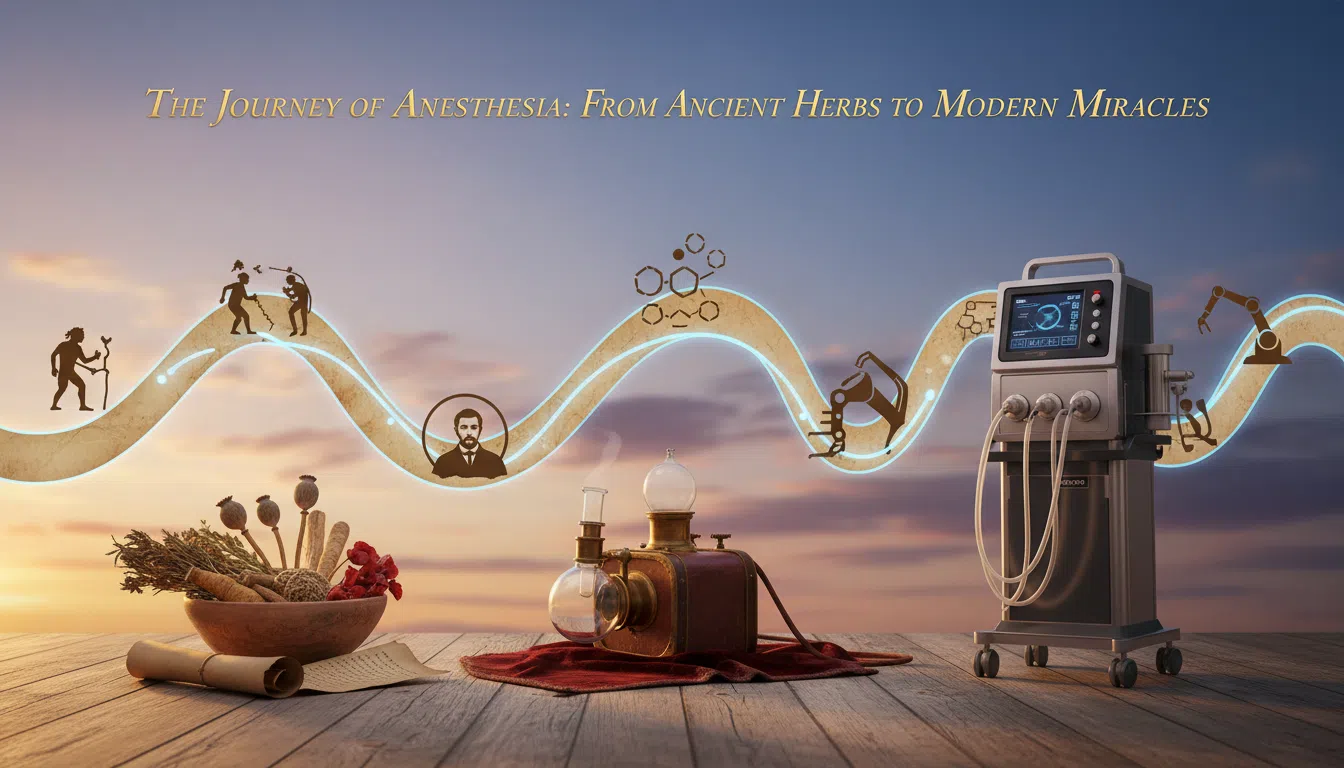
Every year, over 300 million surgeries worldwide use anesthesia to make procedures painless. Just 180 years ago, patients had nothing but alcohol or wood to bite on during surgery. The history of anesthesia shows our endless fight against surgical pain, dating back over 6,000 years.
The journey of anesthesia started with ancient Sumerians harvesting opium poppies around 4000 BC. They knew that certain plants could reduce pain and induce unconsciousness. People crushed poppy seeds in Mesopotamia and made herbal potions in medieval Europe, trying many natural remedies.
The turning point in anesthesia history was October 16, 1846. William Morton and John Warren used diethyl ether at Massachusetts General Hospital. They performed surgery on Gilbert Abbott without pain. This moment marked the start of modern surgery and sparked a rapid growth in anesthesia development.
Before this breakthrough, surgeons focused on speed over skill. Operations were quick, with patients screaming in pain. Doctors used ice to numb areas or pressed the carotid artery to make patients unconscious. Many patients preferred death to the agony of surgery.
This history shows how anesthesia evolved from crude herbs to precise chemicals. Ancient Chinese physicians made their own surgical mixtures. Islamic scholars kept Greek medical knowledge alive during Europe’s Dark Ages. Each culture contributed to the puzzle of modern anesthesia.
Key Takeaways
- Ancient Sumerians used opium poppies for pain relief as early as 4000 BC
- The first public demonstration of surgical anesthesia occurred at Massachusetts General Hospital in 1846
- Before modern anesthesia, surgical patients endured extreme pain with only alcohol or physical restraints
- Multiple civilizations contributed to anesthetic knowledge, from ancient China to medieval Islamic scholars
- The transition from herbal remedies to chemical compounds took over 6,000 years of human experimentation
- William Morton and John Warren pioneered the use of diethyl ether for painless surgery
Ancient Origins of Pain Relief in Surgery
Long before we had anesthesia, ancient people looked for ways to ease surgical pain. They used plants and natural substances to help patients through medical procedures. These early efforts helped create the advanced pain management we see today.
Early Medicinal Plants and Herbal Concoctions
Old-time doctors used plants to find ways to numb or knock people out. They found that opium, mandrake root, henbane, and coca leaves could do this. They mixed these into potions or burned them to make vapors for patients to breathe.
Sumerian Artifacts and the Opium Poppy (4000 BC)
Studies show Sumerians knew about pain relief around 4000 BC. They had clay tablets and artifacts showing opium poppies, called the “joy plant.” This was one of the first times people tried to control pain during surgery.
Medieval Soporific Sponges and Sleep-Inducing Mixtures
In medieval times, doctors like Ibn Sina used special sponges to give patients sedatives. The Salerno School of Medicine, led by Ugo Borgognoni and his son Theodoric, made these sponges work. They soaked them in opium, mandragora, and hemlock juice. Patients would breathe in the vapors until they fell asleep.
French surgeon Ambroise Paré kept using these methods until the late 1500s. Then, the practice stopped because of witchcraft fears and the Roman Inquisition’s rules.
Revolutionary Anesthesia Techniques in Ancient China
Ancient China made big steps in the history of anesthesia. They created early methods for pain relief during surgery. Their work laid the groundwork for medical practices in Asia for centuries.
Hua Tuo and the Discovery of Mafeisan (140-208 CE)
Hua Tuo was a key figure in anesthesia history. He lived from 140 to 208 CE and used a special formula called Mafeisan for surgery. This herbal mix helped patients feel no pain during operations, a major breakthrough.
The Role of Aconitum in Chinese Surgical Practice
The main ingredient in Mafeisan was aconitum, also known as monkshood or wolfsbane. This plant has strong effects that can be dangerous. The Masters of Huainan, written in the second century CE, warned about its dangers.
Yet, skilled doctors found a safe way to use it for surgery.
Cultural Revolution and the Revival of Herbal Anesthetics
During China’s Cultural Revolution, Yan Tau Wang at Xu Zhou Medical University brought back these old methods. He used Mafeisan-based formula, first on himself, then with Thorazine. This mix worked well in over 46,000 surgeries, showing the value of ancient discoveries in anesthesia today.
Japanese Innovations in Surgical Anesthesia
Japan made big steps in the anesthesia invention story before the West did. The Edo period’s isolation led to unique medical innovations. These mixed traditional Eastern medicine with some European knowledge.
Seishu Hanaoka was a key figure in anesthesia history. He studied under both European and Japanese surgeons. He worked hard to make a safe anesthetic for surgery.
On October 13, 1804, Hanaoka made a huge anesthesia breakthrough. He did a partial mastectomy on a 60-year-old woman with Mafutsusan. This was 42 years before the famous Ether Day in Massachusetts and 38 years before Crawford Long’s work in Georgia.
| Achievement | Date | Significance |
|---|---|---|
| First general anesthesia surgery (Hanaoka) | October 13, 1804 | Partial mastectomy under Mafutsusan |
| First anesthesia textbook (Gendai Kamada) | 1840 | Documented Mafutsusan applications |
| Crawford Long’s ether use | 1842 | First Western documented case |
| Massachusetts General Ether Day | 1846 | Public demonstration in America |
The evolution of anesthesia practices in Japan kept going with Hanaoka’s student, Gendai Kamada. In 1840, Kamada wrote the first anesthesia textbook. It talked about Mafutsusan’s use in many surgeries.
Kamada also had a system for figuring out who was at risk. This showed he understood patient safety well. But, Western anesthetics like diethyl ether and chloroform soon came. They were safer than Mafutsusan, and the Japanese method faded away.
Medieval European Approaches to Surgical Pain Management
The medieval period was a time of great change in how people managed pain during surgery. Doctors from different cultures shared their knowledge of pain relief. This shared knowledge helped lay the groundwork for anesthesia as we know it today.
The Canon of Medicine and Islamic Contributions
Ibn Sina’s The Canon of Medicine was a key text in the history of anesthesia. It detailed how to use opium-based preparations for anesthesia. Islamic doctors had already discovered sleep-inducing mixtures, which were later translated into Latin and taught in European schools.
The Salerno School and “The Great Rest” Formula
The Salerno School’s Antidotarium Nicolai included a famous anesthetic formula called “The Great Rest.” It combined three powerful plants. Later, English texts mentioned a similar formula called “Dwale,” showing how these ideas spread.
Mandrake, Henbane, and Tropane Alkaloids
Doctors in the Middle Ages used plants with tropane alkaloids for their sedative effects. These plants were key in the early development of anesthesia:
| Plant | Active Compound | Medical Effect |
|---|---|---|
| Mandrake | Hyoscyamine | Sedation and pain relief |
| Henbane | Scopolamine | Memory suppression |
| Belladonna | Atropine | Muscle relaxation |
In the 1500s, Paracelsus experimented with opium-based treatments. Thomas Sydenham simplified these in 1676 to just opium and alcohol. The London Pharmacopeia of 1618 listed laudanum pills with opium and other ingredients. Despite many formulas, evidence of their use in surgery was scarce during the medieval period.
The Dark Ages of Surgery Without Anesthesia
The 17th and 18th centuries were a dark time in the anesthesia historical timeline. Surgeons worked on patients who were fully awake and in great pain. The goal was to finish operations quickly to lessen suffering and shock.
Before the invention of anesthesia, doctors used simple ways to manage pain:
- Strong alcohol to make patients less aware
- Leather straps and wooden blocks for patients to bite
- Multiple assistants to hold down patients
- Ice and snow mixtures to numb areas
- Nerve compression to reduce feeling
In 1766, Franz Anton Mesmer started using hypnosis to help patients feel no pain. He called it “mesmerism.” It showed promise but wasn’t reliable for big surgeries. Chinese doctors had used acupuncture for pain relief for over 1,600 years.
The anesthetic agents evolution began with early experiments. In 1656, Christopher Wren and Robert Boyle injected opium into a dog’s vein. This was a big step towards intravenous therapy. But, a fatal blood transfusion in France in 1667 stopped these tests for nearly two hundred years.
The history of anesthesia timeline was quiet until Alexander Wood made a good syringe and needle in 1853. This made it possible to give pain-relieving drugs directly into the blood. It was a big step towards today’s anesthetic methods.
Early Chemical Discoveries Leading to Modern Anesthetics
The path to pain-free surgery started long before operating rooms. Between the 13th and 18th centuries, scientists found compounds that changed medicine. These early finds, from accidents and experiments, paved the way for painless surgery.
Synthesis of Diethyl Ether (1275-1540)
In 1275, Spanish philosopher Raymundus Lullus found ether. By 1540, German doctor Valerius Cordus made a better version. He called it “oleum vitrioli dulce” or “sweet oil of vitriol.” Paracelsus, a famous doctor, saw ether’s pain-reducing power, a key moment in anesthesia history.
Discovery of Nitrous Oxide by Joseph Priestley (1772)
In 1772, English chemist Joseph Priestley found nitrous oxide gas. This colorless gas was a major breakthrough, though its medical use was slow to come.
Humphrey Davy’s Experiments with Laughing Gas
In 1799, British chemist Humphrey Davy studied nitrous oxide. He noted its ability to make people feel euphoric. He even used it to ease his own pain from a wisdom tooth.
But, people didn’t listen to Davy’s idea to use it in surgery. Instead, they used it for fun at “laughing gas parties” and “ether frolics.” This delayed its use in medicine for nearly 50 years.
History of Anesthesia
Anesthesia has changed medicine a lot. It moved from harsh surgeries to painless ones. Ancient herbs to modern chemicals have helped us fight surgical pain. These changes have made surgeries safer and saved many lives.
Timeline of Major Breakthroughs and Discoveries
In December 1844, a big moment happened. Gardner Quincy Colton showed nitrous oxide in Hartford, Connecticut. Dentist Horace Wells saw Samuel Cooley get hurt without feeling it. The next day, Wells had a tooth pulled while Colton gave him the gas. Wells didn’t feel a thing.
But, there were also setbacks. Wells’s big show at Harvard Medical School didn’t go well. Professors thought he was a fake. But, his partner William Morton learned from this. He worked with chemistry teacher Charles Jackson to test ether on animals and then on people.
Key Figures Who Shaped Anesthetic Practice
John Snow was a big name in anesthesia in London. He used chloroform on Queen Victoria for her babies’ births. Joseph Clover kept Snow’s work going, making it better. Benjamin Ward Richardson spread Snow’s ideas in Britain and found new ways to numb areas.
Evolution from Herbal Remedies to Chemical Compounds
The move from plants to chemicals changed surgery a lot. At first, doctors used opium, mandrake, and alcohol. Then, they found gases like nitrous oxide and liquids like ether and chloroform. Each new discovery made pain control better and safer.
The Revolutionary Ether Day at Massachusetts General Hospital
October 16, 1846, was a day that changed medicine forever. It was called “Ether Day.” On this day, a dentist named William Morton gave ether vapor to a patient named Gilbert Abbott. Surgeon John Warren then removed a tumor from Abbott’s neck while he was asleep and pain-free.
The story of anesthesia’s invention was filled with disputes over who should get the credit. Morton wanted to keep his ether formula secret for a patent. But, medical ethics won out. A big argument started between Morton, Charles Jackson, and Horace Wells over who should be recognized.
This fight led to the creation of the “Ether Monument” in Boston. It has no names on it. People started calling it the “Either Monument” because of the ongoing debate.
Records show ether was used in surgery in Georgia as early as 1842. But, those who used it never shared their findings. Soon, ether was used across the Atlantic. By December 1846, British surgeons were trying it out.
Francis Boott used ether for the first time in Britain on December 19, 1846. He was a dentist who removed a tooth. Two days later, Robert Liston did a public leg amputation using ether at University College Hospital.
This event made surgical anesthesia a real medical practice. Within months, ether was used in hospitals all over Europe and America. It ended centuries of painful surgeries.
Chloroform and the Competition of Early Anesthetic Agents

The search for better pain relief during surgery was a key time in anesthetic advancements history. Ether was a success, but doctors wanted something safer and easier to use. This time brought both great discoveries and important lessons about keeping patients safe.
Introduction of Chloroform in 1831
In 1831, Samuel Guthrie in America and Eugène Soubeiran in France made chloroform. It was first used by James Young Simpson in 1847. Simpson was looking for a better option than ether, which was harsh and irritating.
Royal Endorsement by Queen Victoria
Chloroform’s use became more accepted when John Snow used it on Queen Victoria. This was during the births of Prince Leopold in 1853 and Princess Beatrice in 1857. The queen’s support made anesthesia more accepted in British society.
Safety Concerns and Sudden Death Reports
Chloroform’s popularity was threatened by reports of sudden deaths. The history of nurse anesthetists shows these tragic events. Doctors had different views on the risks:
- François Magendie thought pain was good for health
- Charles Delucena Meigs believed labor pains were vital
- John Porter thought ether poisoned the blood
These issues led to chloroform’s decline in American hospitals. But, European doctors kept using it until the 1920s.
Development of Local and Regional Anesthesia Techniques
Doctors first noticed that patients could stay awake while certain parts of their body felt numb. This idea started in 1847 with James Young Simpson. He thought local numbing agents might be better than total sleep for surgery.
Benjamin Ward Richardson made an ether spray to numb skin through cooling. In 1860, scientists found cocaine numbs parts of the body. The big leap was in 1884 when Carl Koller, an eye doctor in Vienna, found cocaine numbs the eye for surgery.
Koller shared his findings at a conference in Heidelberg on September 15, 1884. News spread fast, thanks to electric telegraph systems. Soon, doctors all over were trying new methods, speeding up the evolution of anesthesia.
| Year | Breakthrough | Pioneer | Impact |
|---|---|---|---|
| 1884 | Cocaine for eye surgery | Carl Koller | First successful local anesthetic |
| 1898 | First spinal block | August Bier | Surgery without general anesthesia |
| 1921 | Epidural technique | Fidel Pages | Safer childbirth pain relief |
| 1948 | Lidocaine synthesis | Nils Löfgren | Safer alternative to cocaine |
Spinal anesthesia started in 1898, and epidural blocks came in 1921. These needed deep knowledge of anatomy. By 1948, lidocaine, a safer modern local anesthetic, replaced cocaine.
The Rise of Professional Anesthesiology
Anesthesia evolved from a hobby to a medical specialty in the early 20th century. Doctors started focusing on pain management during surgery full-time. This change led to the modern anesthetic practices and safety standards we have today.
John Snow as the First Anesthesia Specialist
John Snow changed anesthesia in Victorian London by focusing on it alone. He created special equipment and techniques, unlike general doctors. Snow wrote early texts that shaped the nurse anesthesia profession.
His careful dosing and monitoring set the stage for today’s anesthetic practices.
Formation of Academic Departments and Training Programs
Formal education programs made anesthesia a true medical specialty. In 1937, Oxford University’s first anesthesia department was funded by Lord Nuffield. Professor Robert Macintosh led it.
This was a big step in the history of CRNA. It created a path for doctors to specialize in anesthetics. The department’s training methods soon spread to schools all over.
Establishment of Safety Standards and Protocols
The 1920s saw growing worries about anesthetic risks. This led to the creation of professional groups and safety rules. The 1948 start of Britain’s National Health Service gave anesthesiologists their own status.
This made them independent, not just assistants. The Royal College of Anaesthetists later added special areas like Intensive Care and Pain Medicine. This expanded anesthetic skills beyond surgery.
Twentieth Century Breakthroughs in Anesthesia Technology

The twentieth century was a time of great change in anesthesia innovations. Gardner Quincy Colton started a company in 1862 for tooth extractions under nitrous oxide. This idea spread fast when nitrous oxide arrived in London in 1868.
Joseph Clover then mixed it with ether to make induction faster. This method became a key part of modern anesthesia.
Metal cylinders made a big difference by storing and transporting nitrous oxide. This made anesthetics more available in hospitals across America and Europe. In 1934, thiopental was introduced as the first fast-acting intravenous anesthetic.
But it required more skill from those using it. Harold Griffith and Enid Johnson of Montreal introduced curare for muscle relaxation in 1942. Jack Halton later improved this in Liverpool, allowing for smaller doses and better surgery conditions.
In 1948, Griffiths and Gillies in Edinburgh used induced hypotension to reduce bleeding. By 1950, all parts of today’s anesthetic practice were in place. Sterile syringes and electronic monitors were used, making surgeries safer.
These changes laid the groundwork for today’s advanced operating rooms. Anyone looking into the history of anesthesia will see this period as a key transition from experimental to standardized care.
Modern Anesthesia Innovations and Future Directions
Anesthesia has changed a lot from its start in 1846. Today’s operating rooms have advanced tools that would amaze the first users of anesthesia. These modern methods show a lot of progress in a short time.
Computer-Controlled Delivery Systems
We no longer use silk handkerchiefs with ether. Now, anesthetic workstations use computers to give exact doses of drugs. These systems watch drug levels and adjust doses on their own. This change started in the 1980s with the use of microprocessors in operating rooms.
Advanced Monitoring Equipment and Patient Safety
Today, we have electronic monitors that watch patient health during surgery. They track heart rate, blood pressure, oxygen levels, and brain activity. These tools have made surgery safer than ever.
Ever sense 1948, when Britain’s NHS made anesthetists independent, safety has gotten much better.
| Monitoring Device | Function | Introduction Year |
|---|---|---|
| Pulse Oximeter | Oxygen Saturation | 1974 |
| Capnograph | CO2 Levels | 1978 |
| BIS Monitor | Brain Activity | 1994 |
Integration of AI and Precision Medicine
Artificial intelligence helps predict how patients will react to drugs. This lets doctors tailor treatments based on genetics and medical history. Machine learning looks at many cases to suggest the best drug doses.
This precise method cuts down on complications and speeds up recovery.
Conclusion
The history of anesthesia is a major achievement in medicine. It started with ancient civilizations using opium poppies and herbal mixtures. Now, we have advanced computer systems for pain management.
This change has made surgery much safer. Each era added new discoveries to the field. This built the base for today’s surgery.
The evolution of anesthesia shows how science improves our lives. Pioneers like William Morton and John Snow risked their careers to show surgery could be painless. Their work led to many innovations.
Today, anesthesiologists use advanced techniques and technology. They keep patients safe during complex surgeries. This was impossible without effective pain control.
These milestones in anesthesia show the importance of courage and curiosity in medicine. The journey from ancient methods to modern nerve blocks shows our drive to reduce pain. As we move forward, new technologies will make pain management even better.
The history of anesthesia is ongoing. Each breakthrough brings us closer to surgery without risks or complications.
FAQ
When was anesthesia invented and who invented it?
What did surgeons use before the invention of anesthesia?
What was the first year anaesthetics were used in surgery?
What is the timeline of anesthesia development?
Why is ether anesthesia history significant?
What is the history of spinal anesthesia and regional blocks?
Who were the anesthesia pioneers and key figures in anesthesia history?
What is the history of nurse anesthesia and CRNAs?
How did the history of anaesthesiology develop as a medical specialty?
What were the most significant anesthesia breakthroughs and innovations?
Get More Medical History
Join our newsletter for fascinating stories from medical history delivered to your inbox weekly.