The History of Healing
 The Invention of the Stethoscope
Explore the origins of cardiac diagnostics with the tale of how René Laennec invented the stethoscope, revolutionizing medical assessments.

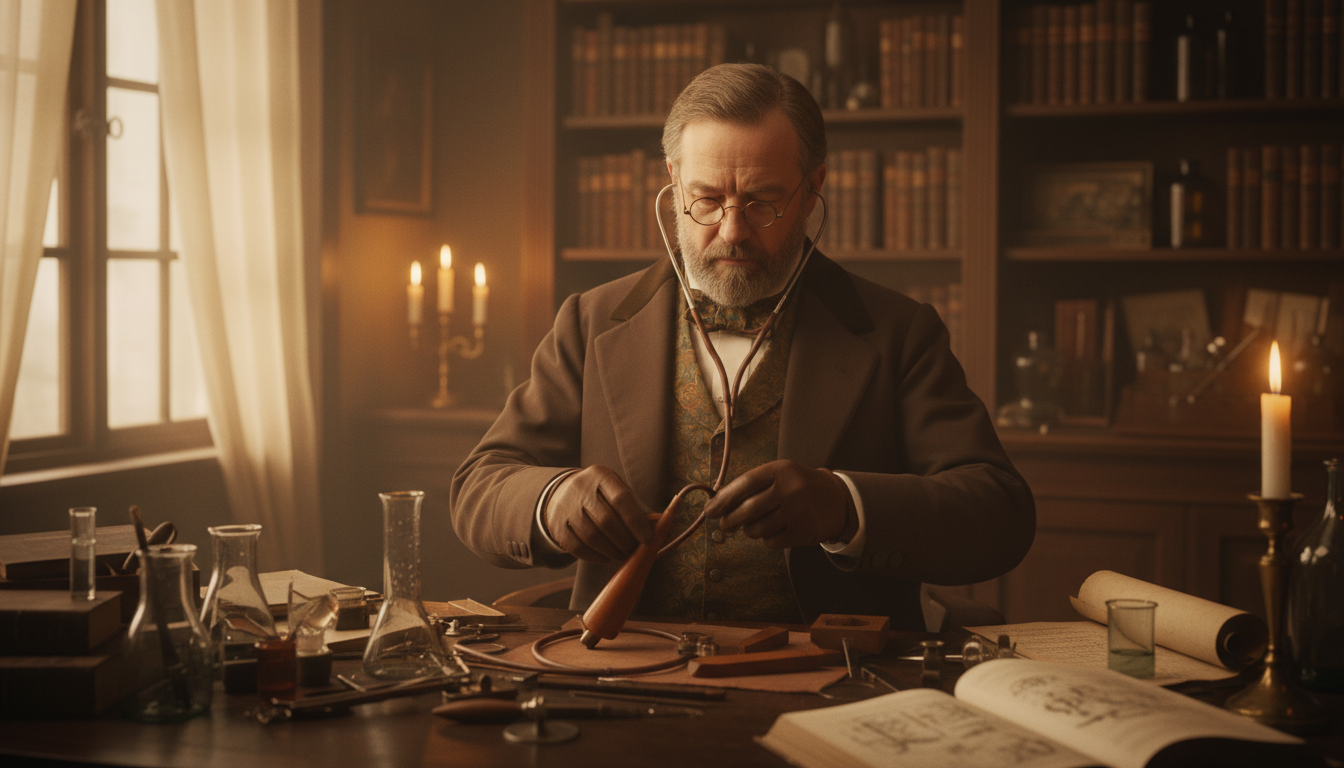
More than 200 years ago, the stethoscope became a key tool in medicine. It started as a simple idea in 1816. This idea changed how doctors listen and make decisions.
René Laennec was working in Paris at Necker–Enfants Malades Hospital. He needed a better way to check a patient’s chest. He used rolled paper to create the first stethoscope.
A stethoscope lets you hear sounds inside the body. It can pick up heartbeats, lung sounds, and blood flow. Today’s stethoscopes have a disc, flexible tubing, and earpieces for clear sounds.
The word “stethoscope” comes from Greek. It means “chest” and “to explore.” This tool lets you explore what’s inside the body.
This tool was a big change in medicine. It made it easier for doctors to diagnose. Medical historian Jacalyn Duffin says it helped doctors understand diseases better.
Key Takeaways
- René Laennec invented the stethoscope in 1816 while working at Necker–Enfants Malades Hospital in Paris.
- Stethoscope history begins with a simple tube that made chest exams clearer and more practical.
- A stethoscope helps you listen to internal body sounds like heartbeats, lung airflow, and blood movement.
- Modern stethoscopes use a chestpiece, tubing, and earpieces designed to amplify subtle sounds.
- The word “stethoscope” comes from Greek roots meaning “chest” and “to explore.”
- This medical innovation helped shift diagnosis toward what doctors could actually hear and connect to anatomy.
The Historical Context of Medical Diagnosis
Before the famous tubes and chest pieces, doctors had to guess what was happening inside a body. They used what they could see and touch, like skin color and breathing rate. They listened carefully, long before the auscultation device was invented.
Early medical devices were often just techniques. Doctors used their hands and ears to check patients. This was a practice from ancient Greece, known as immediate auscultation.
Overview of Pre-Stethoscope Practices
Doctors mixed observation with hands-on exams when they suspected chest illness. They felt for vibrations and counted breaths. They also watched how a patient sat or spoke.
Leopold Auenbrugger, a Viennese physician, used percussion in the 1700s. He noticed how tapping barrels revealed what was inside. Jean-Nicolas Corvisart later popularized this method, helping shape the stethoscope’s history.
| Practice | How it worked at the bedside | What it could hint at | Where it often fell short |
|---|---|---|---|
| Observation | Watching breathing effort, posture, skin tone, and cough | Severe distress, fever patterns, advanced chest disease | Subtle lung and heart changes could look the same from the outside |
| Palpation (touch) | Hand on chest to feel movement and vibrations | Uneven expansion, strong or weak chest vibrations | Extra body tissue could blur what the hand could detect |
| Percussion | Tapping the chest and judging the sound quality | Areas that seemed “hollow” versus “dull” | Results depended on skill, room noise, and the patient’s build |
| Immediate auscultation | Placing an ear directly on the chest wall to listen | Rough breathing, fluid-like sounds, obvious irregular rhythms | Awkward, inconsistent, and hard to repeat the same way twice |
The Limitations of Early Diagnostic Tools
These methods were important but had their limits. Immediate auscultation raised modesty issues and hygiene was often poor. In crowded wards, sounds could be muffled, even with a skilled ear.
Without a non-lethal way to “explore” the inside, doctors had to wait for symptoms to get loud. The stethoscope was a game-changer, providing a clearer way to listen.
The push for a better auscultation device was about making signs easier to hear and trust. It was about helping one patient at a time.
René Laennec: The Innovator Behind the Stethoscope
Imagine the stethoscope inventor in a cold lab, having a big “aha” moment. But Rene Laennec’s story is more personal. It’s about travel, illness, mentors, and a deep desire to listen closely. His journey makes you wonder who created the stethoscope.
Background and Early Life
René Théophile Hyacinthe Laënnec was born on February 17, 1781, in Quimper, Brittany. His mother died of tuberculosis when he was five. His father, a lawyer, couldn’t raise him, so he grew up with his grand-uncle, Abbé Laënnec.
Rene Laennec had fragile health. He suffered from long fatigue, fevers, and breathing trouble. He loved music and poetry, and sought cleaner air in the countryside.
At 12, he moved to Nantes to live with his uncle, Dr. Guillaume François Laënnec. By 14, in 1795, he was helping care for the sick and wounded at the Hôtel Dieu in Nantes. At 18, he served at the Military Hospital in Nantes as a “third class surgeon,” then worked at the Hospice de la Fraternité.
In 1800, he went to Paris and dove into dissection in Guillaume Dupuytren’s lab. He learned from leading minds like Gaspard Laurent Bayle, Marie François Xavier Bichat, Jean-Jacques Leroux de Tillets, and Corvisart. He graduated in 1804 with a thesis on Hippocratic doctrine, joined the Société de l’École de Médecine, and edited the Journal de Médecine.
His career kept climbing: he helped found the Athénée Médical in 1808, became physician to Cardinal Joseph Fesch, and treated wounded Breton soldiers at the Salpêtrière from 1812 to 1813. In 1816, he was appointed physician at Necker Hospital—an important setting for the work that made people ask, again and again, who created the stethoscope.
Later honors followed. He held a chair at the Collège de France in 1822, became a full member of the French Academy of Medicine in 1823, and taught at the Charité. In 1824, he was made chevalier of the Legion of Honor.
There’s a quiet irony at the end. His health worsened from tuberculosis, and he died on August 13, 1826, at Kerlouanec, only 45 years old. In his final months, he asked his nephew Mériadec to listen to his chest, and in his will he left him “above all, my stethoscope.”
Contributions to Medicine
Rene Laennec is often called the father of clinical auscultation, and it’s not just because of the device. He listened to heart and lung sounds, then checked his ideas against autopsy findings. That tight loop—sound, symptom, anatomy—turned bedside listening into a sharper tool.
In 1819, he published De l’auscultation médiate ou Traité du Diagnostic des Maladies des Poumon et du Coeur in Paris, with a revised edition appearing in 1826. An English translation by John Forbes came out in 1821, helping spread his method beyond France. It also helped cement his reputation as the stethoscope inventor in everyday medical talk.
His impact went well past the question of who created the stethoscope. He wrote early descriptions of bronchiectasis and cirrhosis, and he named “cirrhosis” from the Greek kirrhos, for tawny yellow nodules. He’s also linked to Laënnec’s cirrhosis (micronodular), a reminder that he watched patterns closely, not just single cases.
He also built disease categories from sound—pneumonia, pleurisy, emphysema, pneumothorax, phthisis, and more. That’s where clinical auscultation starts to feel less like a trick and more like a language you can learn.
And then there’s melanoma. He lectured on it in 1804 and published in 1806, coining “melanose.” He recognized melanotic lesions as metastatic melanoma, not soot-like deposits or “black tubercles,” which was a big shift in how doctors talked about dark tumors.
Even his heart notes show his listening-first mindset. He described two heart sounds, tying the first to ventricular systole and the second to atrial systole (an idea shaped by the limits of his era). The drive was clear: use the ear, test the guess, and keep refining the map.
| Milestone | What Happened | Why It Mattered for Listening-Based Diagnosis |
|---|---|---|
| 1795, Hôtel Dieu in Nantes | As a teenager, he helped care for the sick and wounded. | Early hands-on exposure to symptoms, breathing distress, and bedside observation. |
| 1800–1804, Paris training | Worked with dissection and learned from Dupuytren, Bayle, Bichat, Leroux de Tillets, and Corvisart. | Linked what you hear and see in a patient to what anatomy shows after death. |
| 1816, Necker Hospital appointment | Held a key clinical post where careful examination was part of daily work. | Supported the practical spread of clinical auscultation in real hospital routines. |
| 1819, landmark book published | Released De l’auscultation médiate, later revised in 1826; translated by John Forbes in 1821. | Standardized methods and vocabulary so more physicians could use the approach consistently. |
| Beyond the device | Described bronchiectasis and cirrhosis; coined “cirrhosis”; advanced early melanoma understanding. | Showed that the stethoscope inventor also built broader diagnostic thinking, not a one-off gadget. |
The First Stethoscope: Design and Functionality
Imagine being a doctor in Paris in 1816. You need to hear a patient’s heart but pressing your ear to their chest is awkward. That’s when René Laennec changed medicine with the first stethoscope.
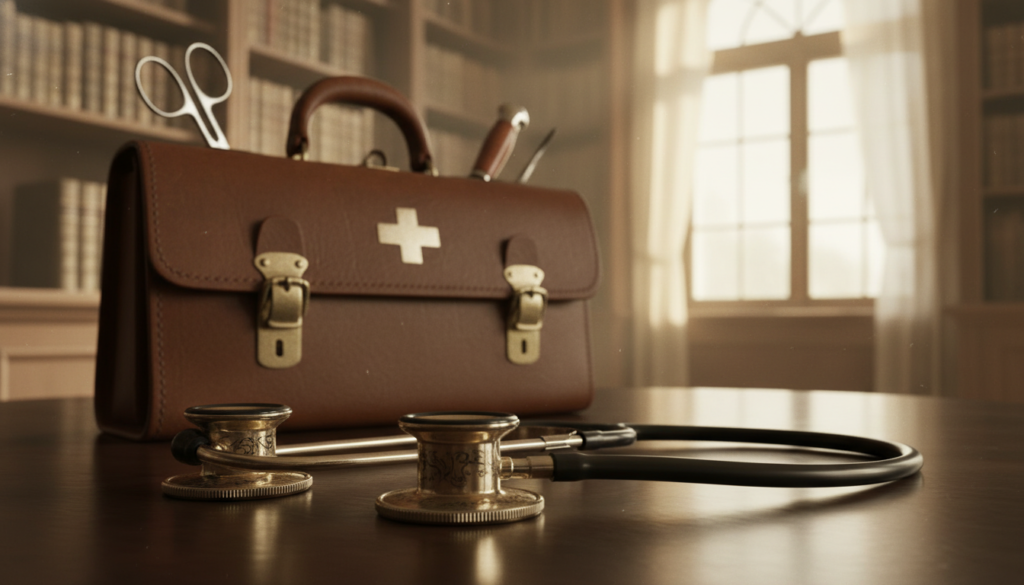
Description of the Original Model
Laennec didn’t want to touch a young woman’s chest. He used a tube to carry sound, inspired by kids playing with wood. This was his first idea.
He made a cone from paper and listened to the heartbeat. He was amazed by how clear it sounded. This was the start of the stethoscope.
After testing, he made a wooden tube 25 cm long and 3.5 cm wide. It was monaural and could be taken apart. It looked like an ear trumpet, making it feel familiar.
| Prototype or Feature | What It Was Made Of | How You Used It | Why It Mattered |
|---|---|---|---|
| First prototype | Rolled paper cone/tube | One end on the chest, the other to your ear | Proved sound could be carried and clarified without direct contact |
| Original stethoscope design | Hollow wood, built in detachable parts | Single-ear listening with a focused chest contact point | Portable, repeatable exams and more consistent listening positions |
| Heart plug attachment | Wooden insert | Adjusted the instrument for heart-focused listening | Helped direct attention to specific chest sounds during exams |
| Look-alike comparison | Similar form to an ear trumpet | Held like a listening tube | Made the new device feel usable and recognizable |
How It Revolutionized Patient Examination
Mediate auscultation changed exams. You could listen with distance. This made exams less awkward and sounds clearer.
Laennec found it wasn’t just for heartbeats. You could listen to all chest sounds. This was a big discovery.
He shared his findings in Paris in 1818. Soon, doctors across Europe wanted to learn. They came to Paris to use the wooden stethoscope.
Evolution of the Stethoscope Through the Decades
Once you know who created the stethoscope, you might wonder how it evolved. It went from a simple listening tube to a key tool for doctors. Small changes added up to big improvements in sound quality.
Stethoscope development is a timeline of changes over the years. Some updates made it more comfortable. Others improved sound quality. Some ideas didn’t stick, but they all contributed to the tool’s evolution.
Major Design Enhancements
Early changes focused on better sound and comfort. In 1828, Pierre Adolphe Piorry made the chest end more like a funnel. He also made the stem lighter and the earpiece thinner.
Then, in 1843, Williams created an early binaural stethoscope. It used lead pipes, which were clunky but showed the direction of future designs.
By 1851, Arthur Leared made a better binaural stethoscope. Marsh added a flexible membrane to the chest piece. A few years later, George Philip Cammann made a version that was easier to produce.
Not every idea worked out. In 1858, Alison created the “stethophone” with two separate bells. Later, a 1873 design aimed for a stereo effect, but it didn’t catch on.
In 1894, Bianchi introduced the “phonendoscope” with a rigid diaphragm. In the early 20th century, Rappaport and Sprague made a two-sided chestpiece popular. Their design was sturdy and had twin tubes.
In the 1960s, David Littmann made stethoscopes lighter and better at picking up sounds. In the late 1970s, 3M-Littmann added a tunable diaphragm. This let you adjust what you hear by changing pressure.
And in 1999, Richard Deslauriers created the DRG Puretone. It used special materials to block out background noise. This shows that stethoscope history is about finding the right balance between sound quality, comfort, and practical use.
| Year | Person or brand | Design change | What it changed for you |
|---|---|---|---|
| 1828 | Pierre Adolphe Piorry | Funnel-shaped bell; lighter stem; thinner earpiece | Better seal and easier handling during long exams |
| 1843 | Williams | Early binaural stethoscope using lead pipes | Introduced two-ear listening, even if uncomfortable and stiff |
| 1851 | Arthur Leared; Marsh | Leared’s binaural design; Marsh’s flexible membrane on chest piece | More practical two-ear use and improved sound shaping at the chest end |
| 1855 | George Philip Cammann | Commercial-ready binaural format with separate ear plugs | A durable layout that became the familiar baseline for decades |
| 1894 | Bianchi | Rigid diaphragm “phonendoscope” | Sharper pickup of higher-frequency sounds in some settings |
| Early 20th century | Rappaport and Sprague | Two-sided chestpiece (bell + diaphragm), heavier twin-tube build | Quick switching between sound types, with a sturdy feel in hand |
| 1960s | David Littmann | Lighter stethoscope with improved acoustics | Less neck strain and clearer everyday auscultation |
| Late 1970s | 3M-Littmann | Tunable diaphragm (G-10 resin + silicone surround) | Pressure-based control of frequency emphasis without flipping sides |
| 1999 | Richard Deslauriers (DRG Puretone) | Noise-reducing parallel lumens with steel coils | Less interference from ambient noise, with noticeable added weight |
Introduction of New Materials
Materials played a big role in stethoscope development. Wood was the first material, but rubber tubing came later. It made sound travel better from chest to ear.
As designs improved, you saw latex rubber and chrome-plated brass. These changes made the stethoscope stronger, easier to clean, and more consistent.
Modern diaphragms got more advanced. The 3M-Littmann tunable diaphragm used G-10 resin and silicone. The DRG Puretone used steel coils to block out noise.
The Glia project’s 3D-printed stethoscope was a big step. It was made during equipment shortages in 2012. It showed that stethoscopes keep getting better for both sound quality and availability.
The Stethoscope’s Role in Medical Training
Medicine changed a lot with one small tool. The stethoscope made listening a key part of learning at the bedside. It became a common language for teachers and students.
Even today, with lots of screens, it encourages us to slow down and listen. This mix of old and new is why it’s always in training rooms.
Adoption in Medical Education
After René Laennec published De l’auscultation médiate in 1819, doctors quickly learned his method. They traveled to Paris to learn from him. He was a big lecturer at the Charité, with many doctors waiting to learn from him.
Soon, the stethoscope became a key tool in teaching. Students learned the same steps—position, pressure, patience—until they could understand sounds. This training made learning consistent and personal.
As designs improved, teaching got better. “Teaching stethoscopes” let two people listen to the same heartbeat. Today’s electronic stethoscopes can record and play back sounds, helping in group discussions.
Impact on Clinical Skills Development
Auscultation is a skill that takes practice. It’s not just about hearing sounds; it’s about understanding them. This is where clinical skills grow.
For years, the stethoscope linked what you heard at the bedside to what you learned. It helped build a habit of thinking critically. You listened, made a guess, and then checked it against what your body showed you.
But there’s a challenge today. Studies show fewer doctors are listening at the bedside. Educators are working to improve this with more practice and feedback. The stethoscope is at the heart of this effort, blending history and innovation.
| Training Moment | What You Do With the Stethoscope | What It Builds | Where Medical Innovation Helps |
|---|---|---|---|
| First bedside practice | Find landmarks, place the chest piece, and listen through full breaths | Basic auscultation training and attention to subtle changes | Clearer tubing and better diaphragms reduce distracting noise |
| Preceptor-led rounds | Compare what you hear with what your instructor describes in the moment | Shared vocabulary and faster pattern recognition for clinical skills | Teaching stethoscopes let two listeners hear the same sound together |
| Case-based learning | Match lung or heart sounds to symptoms and exam findings | Clinical reasoning tied to stethoscope history and physical exam habits | Differential models support side-by-side comparison across chest points |
| Skills refreshers | Replay recorded sounds and practice identifying key features | More consistent interpretation, even for rare findings | Electronic versions can record, store, and replay audio for review |
The Stethoscope in Modern Medicine
Today, clinics are filled with the same stethoscope you see everywhere. But now, it’s not just one tool. It’s a family of options, each for a different task. The first stethoscope was a simple wood tube. Now, it’s a high-tech device for better sound and comfort.
Current Types and Variations
The classic stethoscope works on basic physics. Sound goes from the chestpiece, through tubing, to your ears. It’s simple, yet effective, because our bodies are loud enough.
Most stethoscopes have two sides. The diaphragm picks up high sounds, like breathing. The bell catches low sounds, like heart murmurs.
Some stethoscopes let you switch sides easily. This is thanks to the Rappaport and Sprague design. It’s a small change, but it makes a big difference in what you hear.
There are stethoscopes for special moments. The Pinard horn is for hearing a baby’s heart. Doppler stethoscopes use ultrasound to track moving things.
In operating rooms, esophageal stethoscopes are used for close monitoring. The phonendoscope is for catching subtle sounds. And in everyday practice, stethoscopes often come with blood pressure cuffs.
| Type | How it captures sound | Where it shines | What you trade off |
|---|---|---|---|
| Acoustic stethoscope | Body sound travels through chestpiece and tubing to your ears | Fast checks of heart and lung sounds at the bedside | No built-in amplification; noisy rooms can interfere |
| Pinard horn (fetal stethoscope) | Direct conduction through a trumpet-shaped cone | Hearing fetal heart tones without batteries or screens | Needs careful positioning and a quiet environment |
| Doppler stethoscope | Ultrasound plus Doppler effect converts motion into audible signal | Finding pulses and tracking moving blood flow | Different sound “feel” than the original stethoscope method |
| Esophageal stethoscope | Sensor positioned in the esophagus for close internal pickup | Intraoperative monitoring when access to the chest is limited | Invasive placement; used in specific settings |
| Phonendoscope | Design aims to intensify auscultatory sounds | Picking up faint details during careful listening | Can emphasize some noise along with the signal |
Technological Advances in Stethoscopes
Now, let’s talk about the electronic stethoscope. It turns sound waves into electrical signals. This lets it amplify, filter noise, record, and even stream audio wirelessly.
Brands like Welch Allyn and 3M use different methods. Welch Allyn uses a piezoelectric crystal. 3M uses a piezo-electric crystal in foam behind a rubber diaphragm.
Thinklabs Rhythm 32 uses an electromagnetic diaphragm. Eko’s lineup includes devices that send heart sounds to phones or tablets. Eko Duo adds ECGs and echocardiograms for more screening.
Software has changed listening too. Stethographics introduced tools in 2001 for phonocardiograms and interpretation. Smartphone apps can also enhance and visualize sound. A stethoscope app-compatible with smartphones was introduced in 2015.
This shows how stethoscope development has improved. It’s all about making better decisions at the bedside. The journey of stethoscope development has added new ways to hear, save, share, and learn from our bodies.
Cultural Significance of the Stethoscope
When you enter a clinic, you’ll see it right away. A stethoscope around someone’s neck is like a badge. It’s a sign of help, comfort, and practicality all at once.
A 2012 study in the Journal of Medical Internet Research found something interesting. The stethoscope makes a doctor seem more trustworthy than other medical tools. So, when you see it, you’re not just imagining things.
Symbolism in Healthcare
The stethoscope is more than just a tool. It comes from Greek words meaning “chest” and “explore.” This fits the moment when a doctor leans in to listen to you. It shows respect and care.
Knowing who invented the stethoscope adds to its story. René Laennec’s invention made listening a teachable skill. It shows how medical innovation has grown.
| Where you see it | What it signals fast | How it connects to the stethoscope history |
|---|---|---|
| Around the neck in hospitals and urgent care | Availability and readiness to examine you | A modern “uniform accessory” that grew out of bedside listening |
| In patient-facing photos and staff profile cards | Trust and competence at a glance | Echoes the 2012 Journal of Medical Internet Research finding on perceived trustworthiness |
| In training spaces like med schools and simulations | Learning to hear what machines might miss | Links Laennec’s early methods to today’s clinical routines |
Recognition in Popular Media
In movies, TV, and health graphics, the stethoscope is a key symbol. It’s often seen as more important than the caduceus. One look, and you know it’s about health.
Art has also played a big role. Paintings like Théobald Chartran’s and Robert A. Thom’s show Laennec’s breakthrough. These images make us remember the stethoscope’s importance without words.
Challenges and Criticism of the Stethoscope
The stethoscope is seen as a symbol of care. Yet, it faces criticism. The main issue isn’t tradition. It’s the variation in results from one listener to another.
Limitations in Diagnostic Accuracy
How well a stethoscope works depends on many things. This includes your hearing, training, and the environment. In noisy places or with faint sounds, it can be hard to get accurate readings.
Many educators say skills in using the stethoscope are declining. This is why training programs are working to improve these skills.
Electronic stethoscopes seem like a solution. They can make sounds louder. But, they can also pick up unwanted noises. This can change what you think you hear.
Studies show that other tools can be better. For example, Doppler auscultation can find things that a stethoscope might miss. It’s better at detecting certain heart problems.
Alternative Diagnostic Technologies
In clinics, there’s a shift away from manual blood pressure checks. Automated monitors are taking over. This change is quiet but shows how new technologies can reduce differences in results.
Medical innovation is also changing how we listen. ECG-enabled stethoscopes with AI can screen for heart problems. This is a big change from just listening at the bedside.
Telemedicine brings another twist. Electronic stethoscopes can record and send sounds. This lets doctors review and share sounds, making diagnosis easier.
| Approach | What you get | Where diagnostic accuracy can slip | Practical upside in real care |
|---|---|---|---|
| Classic stethoscope auscultation device | Live sound at the bedside (heart, lungs, bowel) | Strongly depends on training, hearing, noise, and positioning | Fast, cheap, and works anywhere without batteries or setup |
| Electronic stethoscope | Amplified sound with filtering options | May amplify contact artifacts; frequency cutoffs can reshape what stands out | Helpful in loud settings and for teaching groups what “normal” sounds like |
| Continuous-wave Doppler auscultation | Flow-based signal that can reveal valve and filling problems | Different learning curve; not a direct replacement for standard listening | Reported higher sensitivity for some findings (for example, aortic regurgitation 84% vs. 58%) |
| Automated office blood pressure monitors | Standardized readings without manual listening | Cuff size and patient movement are important; devices need validation | Reduces observer bias and supports more consistent workflows |
| ECG-enabled exams with AI (studied for screening) | Electrical signals plus algorithm-based flags | Quality depends on signal capture; models can vary by population and setting | Scales screening and supports earlier triage as medical innovation moves forward |
| Recorded auscultation + phonocardiographs | Shareable audio and visual traces over time | Bad placement gives bad data; interpretation can drift without standards | Makes remote review possible and builds a track record, not a one-time listen |
The Future of the Stethoscope
Looking ahead, stethoscope development is speeding up. It’s moving into new health tech that fits today’s fast-paced clinics. The old tube-and-chestpiece is not going away, but it’s getting some new friends.

Emerging Trends in Health Technology
AI is making its way to the bedside. Now, an electronic stethoscope can match heart sounds with ECG data. This is not just science fiction anymore. Researchers are even using AI to spot heart problems during exams.
Noisy clinics are a big problem. New stethoscopes are being made to cut through the noise. Designs like Deslauriers’ DRG Puretone use special coils to block out background sounds. Even military stethoscopes are being made to work in super loud places.
Getting stethoscopes to patients is getting easier. Open designs can be made and shared quickly. This means that even when supplies are low, stethoscopes can be made locally and shared widely.
Remote care is becoming more common. Digital stethoscopes are now used to record and share sounds. This lets doctors review and discuss sounds over distance. It’s a big change in how we listen to our patients.
| Trend | What you can do with it | Why it matters in day-to-day care |
|---|---|---|
| ECG + AI screening | Combine heart sounds with ECG signals to support point-of-care flags | Faster triage when symptoms are vague and time is tight |
| Noise reduction engineering | Reduce ambient interference using mechanical or Doppler-based approaches | More usable sound in busy clinics, ambulances, and crowded wards |
| Open-source 3D printing | Manufacture locally from shared designs when supply is limited | More resilience during disruptions and better access in low-resource settings |
| Recording and sharing audio | Save, replay, visualize, and transmit heart/lung sounds | Supports telemedicine consults and helps track changes over time |
Predictions for the Stethoscope’s Evolution
The debate about the stethoscope’s future will keep going. But, the need for a quiet, human touch in exams won’t change. That moment of listening and understanding is priceless.
The future will mix old and new. Acoustic stethoscopes will stay because they’re easy and don’t need batteries. At the same time, electronic stethoscopes will get better at detecting and sharing sounds. This will make listening to patients more precise and teachable.
Expect exams to blend old and new methods. You’ll listen first, then use algorithms to help. Tools like ultrasound will be used when you need a clearer look. It’s not about replacing the stethoscope, but about making exams better for everyone.
Conclusion: The Lasting Legacy of the Stethoscope
A simple rolled sheet of paper changed medicine in 1816. René Laennec invented the stethoscope at Necker Hospital in Paris. This tool let doctors hear chest sounds without touching skin.
Recap of Its Importance in Healthcare
The stethoscope wasn’t just a tool. It made listening to heart and lung sounds easier. It also made exams more respectful.
Laennec used what he heard to learn about anatomy. This linked symptoms to diseases. The design improved over time, but the core idea stayed the same.
Continuing Relevance in Medical Practice
So, why is it important today? Laennec created a tool, not a museum piece. Doctors use it to check on patients quickly.
New tech is available, but the stethoscope remains valuable. It’s fast, easy to carry, and shows care is personal. Seeing a stethoscope on a doctor means care is happening right then.
FAQ
Who invented the stethoscope, and when did it happen?
What is a stethoscope in plain terms?
What did diagnosis look like before the stethoscope was created?
Why was percussion such a big deal before Laennec’s medical innovation?
What were the biggest limitations of early diagnostic tools like immediate auscultation?
Why did René Laennec invent the stethoscope in the first place?
What was the original stethoscope made of?
How did the original stethoscope actually work?
Is it true the early stethoscope looked like other early medical devices?
What does “mediate auscultation” mean, and why was it a big payoff?
Where does the word “stethoscope” come from?
Who was René Théophile Hyacinthe Laënnec beyond being the stethoscope inventor?
What was Laennec like as a person?
How did Laennec train as a doctor before he created the stethoscope?
Which major medical figures influenced Laennec in Paris?
What were Laennec’s key career milestones after the stethoscope was invented?
What did Laennec publish that cemented his place in medical innovation?
What else did Laennec contribute to medicine beyond the stethoscope?
Did Laennec do early work on melanoma?
How did the stethoscope revolutionize patient examination?
When did the stethoscope spread beyond France?
What are the biggest milestones in stethoscope development after Laennec?
Who perfected the modern binaural stethoscope design most people recognize?
How did David Littmann change the stethoscope?
How did stethoscope materials evolve over time?
What is the Glia 3D-printed stethoscope, and why does it matter?
How did the stethoscope become central in medical education?
Is auscultation a skill you have to train, or is it just “listen and know”?
Are clinicians losing stethoscope listening skills today?
What are the main types of stethoscopes used in modern medicine?
What specialty stethoscopes might you run into?
Do people use stethoscopes for blood pressure checks?
How do electronic stethoscopes work compared with acoustic ones?
What are real examples of modern electronic stethoscope technology?
What is a phonocardiograph, and how does software fit into stethoscopes?
Why is the stethoscope such a strong healthcare symbol?
How has popular media shaped the way we remember who created the stethoscope?
What are the limitations of the stethoscope in diagnostic accuracy?
Is Doppler better than classic auscultation for some findings?
What technologies are challenging the stethoscope’s role today?
What emerging trends are shaping the future of the stethoscope?
Is the traditional stethoscope becoming obsolete?
How did Laennec’s story end, and what’s the irony people remember?
Get More Medical History
Join our newsletter for fascinating stories from medical history delivered to your inbox weekly.