The History of Healing
 The History of Medical Illustration
Explore the evolution of Medical Illustration from ancient art to modern healthcare visualization, shaping our understanding of the human body.

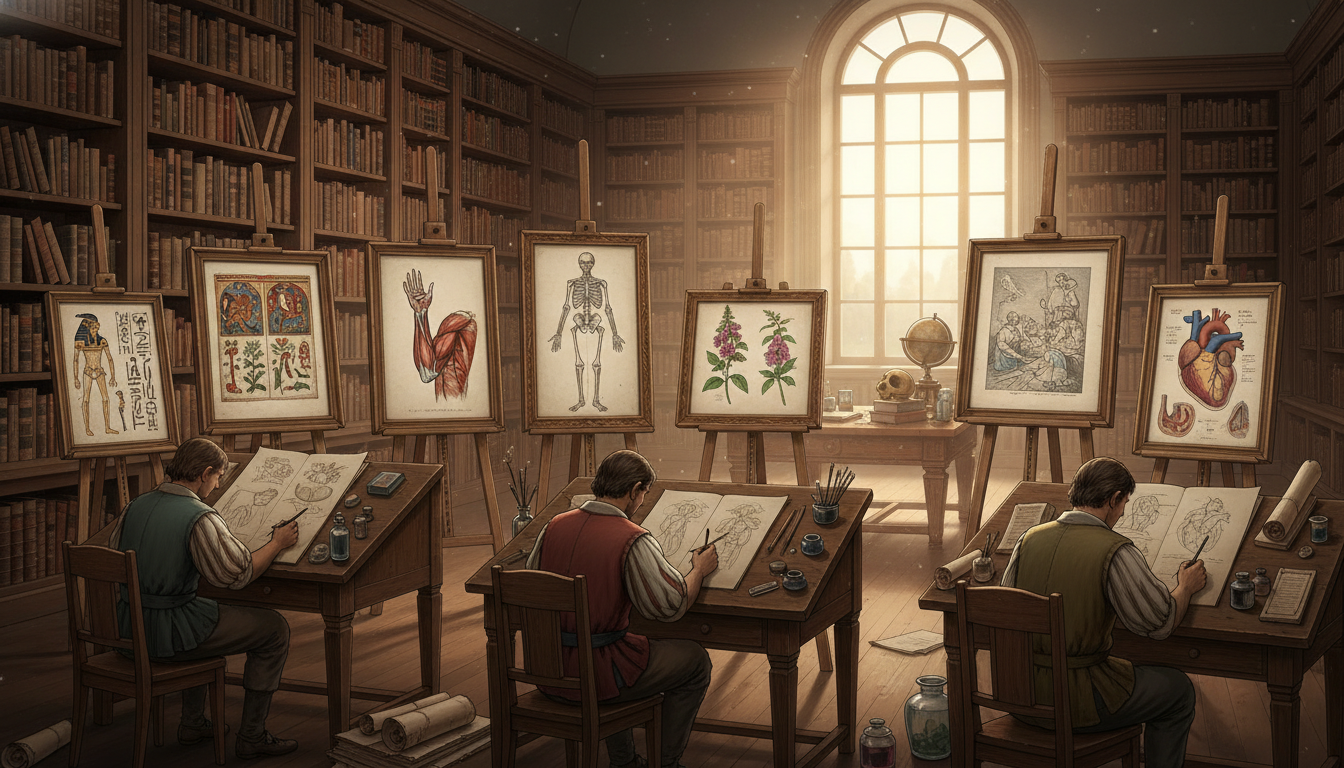
Here’s a wild fact: people can follow directions over three times better with clear pictures than with text alone. This is the power of Medical Illustration. It has been helping us understand the human body for centuries.
Imagine trying to explain a nerve bundle, a heart valve, or a surgery with just words. It’s slow and messy. But, good healthcare visuals make it clear and fast. This is true for diagrams, handouts, or animations.
In the United States, Medical Illustration has been a real job for about 130 years. Yet, many people are surprised to learn it’s a job. It’s where art meets anatomy, blending creativity with facts.
We’ll explore the history of Medical Illustration. From early sketches to digital tools, we’ll see how it evolved. Once you understand its history, today’s medical visuals will make more sense.
Key Takeaways
-
Medical Illustration exists because some medical ideas are too complex for words alone.
-
Healthcare visualization helps you understand anatomy, disease, and procedures faster and with fewer mistakes.
-
Biomedical visualization blends art and science, which can be both helpful and occasionally awkward.
-
The profession has been established in the United States for roughly 130 years, but it surprises many people.
-
This history moves from hand-drawn manuscripts to printing, then into digital illustration, animation, and 3D.
-
Knowing the past explains why modern medical images look the way they do today.
Origins of Medical Illustration in Antiquity
Before textbooks, people needed a way to share what they saw. Early medical artwork was practical, memorable, and followed the rules of the time.
Ancient scientific illustrations focused on strong shapes and simple labels. They aimed for clarity and meaning, even when the body was a mystery.
Early Civilizations and Their Practices
In Egypt and Mesopotamia, healing mixed with religion and ritual. Early medical diagrams focused on what healers could see: bones, skin, and swelling.
In Greece and Rome, medical traditions grew through teaching and debate. But dissection was rare, so drawings followed respected texts more than new evidence. This made some anatomy look odd today.
Across the medieval bridge, illuminated manuscripts and Arabic treatises carried older ideas forward. They organized them in new ways. You see system-based layouts, like circulatory hints and nerve paths, in these illustrations.
Notable Artists and Contributions
Some names stand out because their work traveled far. Galen shaped medical thinking for centuries. His model of the body guided what got drawn and what got skipped.
Later, scholars like Avicenna helped preserve and expand medical learning. In many copies, medical artwork acts like a visual index. It helps readers track symptoms and treatments quickly, even if the pictures weren’t drawn from direct viewing.
| Tradition | Typical focus in images | What shaped accuracy | How it helped readers |
|---|---|---|---|
| Egyptian papyri | Injuries, bones, surface anatomy, bandaging | Hands-on care and visible trauma | Quick recognition for treatment steps |
| Greek and Roman teaching | Body “maps” based on learned theory | Reliance on classical scholarship, specially Galen | Shared a common model across schools |
| Arabic treatises and medieval manuscripts | Organ systems, pathologies, and remedies | Careful copying plus commentary and organization | Made complex notes easier to review and teach |
The Role of Symbolism in Ancient Illustrations
Symbolism played a big role. When cultures had taboos about opening the body, artists used icons and color cues. They showed what couldn’t be shown directly.
So, you’ll find medical diagrams that feel like maps. They have clean routes, boxed organs, and repeated shapes. This kind of illustration wasn’t about winning an art contest; it was about making knowledge stick.
That’s the vibe of antiquity: medical artwork that’s bold, simplified, and sometimes strangely beautiful. It’s built from belief, limited access, and the best teaching tools available at the time.
The Renaissance and Advances in Anatomy
The Renaissance was a time of great change. Artists and doctors worked together to understand the body better. Anatomy illustrations became more realistic, showing the body as a living being.
Influential Figures: Vesalius and da Vinci
Leonardo da Vinci was a true pioneer. He did many dissections and drew what he saw with great detail. His drawings showed the body in action, not just as a static form.
Da Vinci made over 800 drawings of the body. But, his work was hidden for a long time. It wasn’t published until the 19th century, due to the taboo of dissections.
Andreas Vesalius made a big impact with his book, De Humani Corporis Fabrica. Published in 1543, it had over 600 woodcut images. He corrected many mistakes in Galen’s work, based on human dissections.
Vesalius found over 200 errors in Galen’s work. This led to controversy. Despite this, he became a respected figure in medicine, known as the Father of Modern Anatomy.
Anatomical Studies and Illustrative Techniques
During this time, artists and doctors used new methods. They used perspective and measured proportions to create detailed diagrams. This made it easier for students to understand the body.
Woodcuts played a big role in this change. They allowed for consistent and detailed illustrations to be shared widely. This helped spread knowledge across different places.
| Renaissance approach | What you see on the page | Why it changed learning |
|---|---|---|
| Dissection-based observation | Specific structures drawn from real bodies, including variation | Medical diagrams shift from “accepted truth” to checkable evidence |
| Perspective and cutaway views | Layered organs, cross-sections, and depth cues | Anatomy becomes easier to picture in 3D, not just flat labels |
| Print-ready line art (woodcuts) | Clean outlines, repeated plates, readable details | Medical artwork becomes shareable across classrooms and borders |
| Studio collaboration (often uncredited) | High-skill carving and shading that looks “alive” | The visuals feel authoritative, even when the illustrator stays anonymous |
The Shift Towards Realism in Art
Realism was a big change in art. Bodies were shown in motion, making illustrations more believable. This made learning anatomy more engaging.
Many artists worked behind the scenes. The creators of the Fabrica were not always credited. Yet, their work played a key role in advancing medical knowledge.
The Evolution of Medical Texts
Imagine mass-producing images. Suddenly, one sharp drawing doesn’t stay in one room—it travels. This shift changed how scientific illustration showed up on the page and in the classroom.
With reliable printing, medical diagrams became common. They were no longer rare, hand-copied oddities. The same figure could be taught in different cities, using the same labels, in the same order. This consistency gave early healthcare visualization a shared “look” people could recognize fast.

Printers and physicians started thinking like partners. Better presses meant finer lines. Cleaner lines meant clearer anatomy. And clearer anatomy meant fewer “wait, which part is that?” moments.
The Impact of Printing Technology
Printing didn’t just speed things up—it tightened the rules. When an image is printed again and again, any mistake gets copied too. So artists and doctors had to agree on shapes, scales, and labels before the ink hit the page.
This push toward standard forms made medical diagrams easier to teach from. It nudged scientific illustration away from decorative flourishes and toward crisp visual proof. You can feel the early roots of modern healthcare visualization right there, in those repeated plates.
Key Publications and Their Authors
In 1522, Jacopo Berengario da Carpi published Anatomia Carpi. Isagoge breves perlucide ac uberime, in Anatomiam humani corporis, often described as the first known medical textbook to include illustrations. He wasn’t guessing how print worked, either—he studied printing under Aldus Manutius of the Aldine Press.
Berengario’s illustrated poses look less like stiff figure series and more like real bodies taking up space. He also challenged Galen’s anatomical notions and described values of the heart, giving the images extra weight. The page wasn’t just showing anatomy; it was arguing for it.
Jump ahead, and you get another giant print milestone: Gray’s Anatomy, first published in 1858. By then, the language of scientific illustration had matured, and medical diagrams could be both precise and readable at speed—ideal for generations of students learning under pressure.
| Print-era shift | What changed on the page | Why it mattered for learners |
|---|---|---|
| Repeatable plates | More consistent medical diagrams across copies | Students could share a common visual reference, even across cities |
| Cleaner line work | Finer detail in organs, vessels, and labels | Less confusion during study and quicker identification in labs |
| Author-printer collaboration | Tighter agreement between text claims and scientific illustration | Images could support (or challenge) accepted anatomy in a direct way |
| Standard layouts | More predictable sequencing and caption styles | Helped early healthcare visualization feel “teachable” and repeatable |
Integrating Art and Science
Medical texts became the place where art and science had to cooperate. Sometimes it was uneasy: artists wanted clarity, physicians wanted accuracy, and printers wanted something that wouldn’t blur or clog with ink.
But that tension produced better pages. Scientific illustration grew more disciplined, medical diagrams grew more legible, and healthcare visualization started to feel like a practical language you could learn—one printed image at a time.
The 18th and 19th Century: A Growing Profession
By the 1700s, science got louder. Art didn’t vanish, but it often got treated like an “extra.” This put Medical Illustration in a strange spot: more pressure, more rules, and way more demand.
So if you’re picturing quiet studios, think again. This era pushed medical artwork into classrooms, labs, and publishing houses. Accuracy wasn’t a nice-to-have. It was the point.
Medical Schools and Educational Necessities
Medical schools were growing fast, and they needed clear visuals for lectures and exams. Cadavers were limited. Specimens decayed. Prints could travel.
That’s where medical illustration services started to feel essential, even if people didn’t call them that yet. A good plate could teach hundreds of students the same lesson, with the same landmarks, every time.
Pioneers of Medical Illustration
Bernhard Siegfried Albinus at Leiden University wanted anatomy that looked undeniable. Jan Wandelaar (1690–1759) could engrave that level of truth into copper. They first crossed paths in 1723 while working with Herman Boerhaave on a new edition of Vesalius.
Then they went all in: a 28-year effort that produced 40 engraved copper plates for Tabulae Sceleti et Musculorum Corporis Humani, published in Leyden in 1747. Their method was almost obsessive. A grid sat between the body and the artist, matched by a grid on paper.
Big squares helped block in the form. Smaller squares locked down tiny structures. They even drew at 90 degrees to cut down on single-view distortion. If you’ve ever wondered why some medical artwork feels like it’s “measured,” this is why.
And then comes the weird, unforgettable twist. Wandelaar filled backgrounds with lush hills, tropical plants, and even a rhinoceros named Clara. Critics didn’t love the whimsy, but the contrast made the images stick in your head.
In the 1800s, the mix of surgeon and illustrator became more visible. French surgeon Jules Germain Cloquet (1790–1883) didn’t just write about the body; he illustrated most figures in Anatomie de l’homme. His name also lives on in surgery, tied to hernia repair and “Cloquet’s septum.”
Later in the century, Ernst Haeckel (1834–1919) shaped how people pictured nature itself. Kunstformen der Natur turned biology into collectible imagery, admired by both researchers and art lovers. It’s a reminder that Medical Illustration wasn’t only about the operating room; it also fed public curiosity.
| Figure | Where the work landed | What made it stand out | Lasting impact on medical artwork |
|---|---|---|---|
| Bernhard Siegfried Albinus | Leiden University; anatomical publishing | Drove extreme accuracy standards and repeatable methods | Helped set expectations for precise Medical Illustration in education |
| Jan Wandelaar | Engraving workshops; scientific plates | 40 copper plates; grid-based drafting; bold, whimsical backgrounds | Showed how a strict visual record could carry style and narrative |
| Jules Germain Cloquet | Surgery and anatomy textbooks | Illustrated most figures in Anatomie de l’homme while practicing surgery | Modeled a tight link between clinical practice and medical illustration services |
| Ernst Haeckel | Biology, museums, private collections | Kunstformen der Natur presented organisms with striking symmetry and detail | Expanded the audience for Medical Illustration beyond medical schools |
The Role of Female Illustrators
There was also a credit problem. Many artists worked long hours, but authors and publishers didn’t always name them. Their lines taught generations, yet their signatures disappeared.
Even so, the ground was shifting. By the early 20th century, women were playing a major role in the field in the era associated with Max Brödel, when photographs and program culture began to capture who was actually doing the work. That push toward formal training and named departments was already gathering speed.
Technological Innovations in Illustration
Tools keep changing, but your need for clear anatomy never goes away. As images got easier to capture, the goal stayed the same: show what matters fast. That’s where healthcare visualization shines—clean, focused, and built for real decisions.
The Advent of Photography and Its Effects
In 1895, German physicist Konrad Röntgen revealed the X-ray, and suddenly the inside of the body wasn’t a mystery. Later, ultrasound, CT, and MRI added more layers, like a stack of see-through pages. Photography also grew into a solid reference tool, showing surfaces and clinical details well.
But cameras don’t “edit” reality for teaching. A skilled illustrator can simplify a messy field, combine angles, and make a hard idea readable. That’s why biomedical visualization didn’t fade—it leveled up.
Max Brödel proved it. His surgical plates could mix a cross-section into a natural scene so you understood depth and context at once. He also pushed technique, like carbon dust, which printed with crisp tone and detail in his era’s presses.
Digital Illustration: The New Era
Fast-forward to the digital age and the workflow flips. Instead of relying only on carbon dust studies or cadaver sketches, you might start with scans, endoscopic video, and high-res photo reference. Digital tools let you revise quickly, keep color consistent, and build versions for print, slide decks, and patient handouts.
This is also where medical animation starts to feel normal, not exotic. Once time gets added to the picture, processes like blood flow, nerve signaling, or device placement click in a different way.
The Use of 3D Modeling in Medicine
3D modeling brought a new kind of “hands-on” understanding. You can rotate a structure, peel layers, and line up a model with a CT slice. Tom S. Jones helped push that mindset early—treating motion as the fourth dimension and drawing inspiration from early Disney cartoons.
Jones and his students also explored plastics for physical models and museum-style displays. That same spirit shows up today in 3D renders used for surgical planning, device demos, and classroom visuals. It’s modern biomedical visualization with a practical backbone, and it pairs naturally with healthcare visualization and medical animation when a static image can’t tell the whole story.
| Innovation | What it added to the illustrator’s toolkit | Where it shows up in healthcare visualization | Why a human interpreter is key |
|---|---|---|---|
| X-ray (Konrad Röntgen, 1895) | First routine internal reference; bone structure and foreign objects | Fracture education, device positioning, basic anatomy teaching | You need to highlight what’s important |
| Ultrasound, CT, MRI | Soft tissue detail, cross-sections, and multi-plane views | Scan-based diagrams, patient-friendly explainers, radiology teaching sets | Illustration can unify slices into one clean mental map |
| Photography | Surface realism and quick capture of clinical detail | Dermatology references, operative documentation, education libraries | Photos can be cluttered; drawings clarify and remove distractions |
| Carbon dust (Max Brödel) | Controlled tone and depth that reproduced well in print | Classic surgical plates used for training and textbooks | Technique supports storytelling, not just “recording” what’s there |
| 3D modeling and rendering | Rotate, layer, and simulate spatial relationships | Pre-op planning visuals, device demos, interactive learning modules | Someone must choose the viewpoint and simplify without losing truth |
| medical animation | Adds time, motion, and cause-and-effect | Procedure walk-throughs, mechanism-of-action explainers, public education | Pacing and focus decide whether viewers understand or get lost |
Specializations Within Medical Illustration
Medical illustration is not just one thing. It’s like a big neighborhood with many streets. Each street has its own job, like teaching or guiding surgeons. This is why medical illustration services have many specialties.
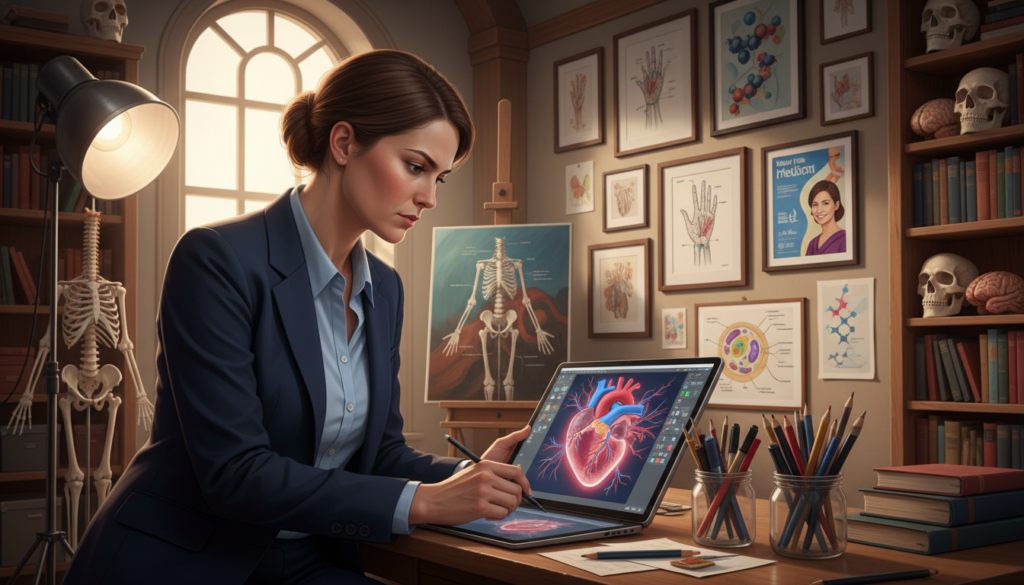
Surgical Illustration: Precision and Detail
In surgery, the goal is simple yet hard: show the right thing at the right time. A good drawing can make important anatomy stand out quickly. This is healthcare visualization at its most useful.
Max Brödel worked at Johns Hopkins with famous doctors. His work was in Operative Gynecology (1898) and The Journal of the American Medical Association. His 1914 piece on transsphenoidal hypophysectomy is famous.
Russell L. Drake worked at the Mayo Clinic for 44 years. His work is highly admired for its clarity, even in complex procedures.
Forensic Illustration: Intersection of Law and Medicine
Forensic illustration is for the courtroom. It needs to be clear and easy to follow. Drawings can help juries understand injuries without guessing.
This field combines law and medicine. You need to be accurate but also clear. The audience is regular people, not just medical teams.
Illustrating Pathology: Understanding Diseases
Pathology illustration documents diseases for learning. It shows changes in tissues and cells. The best images make patterns clear without being too busy.
Brödel’s work shows how important this has always been. Today, pathology visuals are in journals, textbooks, and clinic handouts. Medicine keeps getting more specialized, and so does healthcare visualization.
| Specialty | Main Purpose | Typical Setting | What the Visual Must Do |
|---|---|---|---|
| Surgical illustration | Guide technique and explain procedures | Operating rooms, surgical education, journals | Highlight critical anatomy, remove distractions, sequence steps |
| Forensic illustration | Explain injuries and events for legal review | Courtrooms, depositions, legal exhibits | Stay neutral, clarify scale and location, support testimony |
| Pathology illustration | Document disease processes for learning | Labs, textbooks, professional publications, patient materials | Show abnormal vs. normal, emphasize patterns, keep labels clear |
Education and Training for Medical Illustrators
Max Brödel was a key figure in Medical Illustration’s history. Born in 1870 in Leipzig, he trained at the Leipzig Academy of Fine Arts. He even worked in Carl Ludwig’s lab, so he knew what he was drawing.
He met William H. Welch and Franklin P. Mall at Johns Hopkins. In 1894, Mall convinced Brödel to join Johns Hopkins Hospital. This move changed the field of scientific illustration.
Degree Programs and Institutions
In 1911, Johns Hopkins started the Department of Art as Applied to Medicine. It was the first place to teach medical illustration. It focused on hands-on biomedical visualization, not just pretty pictures.
Henry Walters funded the department with $5,000 a year for three years. He matched an offer from Dr. William J. Mayo to recruit Brödel. Walters also gave a $110,000 endowment in 1921, worth about $1.8 million today. This money helped train many talented artists.
Johns Hopkins introduced a two-year Master of Arts in Medical and Biological Illustration in 1959. The program has been fully accredited by CAAHEP, a big deal for career prospects.
| Program (U.S./Canada) | Origin story | Degree + format | What the training is known for | Accreditation / status |
|---|---|---|---|---|
| Johns Hopkins University (Baltimore) | Art as Applied to Medicine established in 1911; shaped by Max Brödel’s Hopkins work starting in 1894 | Two-year Master of Arts in Medical and Biological Illustration (approved 1959) | Classic draftsmanship paired with deep anatomy; roots of modern scientific illustration standards | CAAHEP-accredited, 1970 |
| University of Illinois Chicago (UIC) | Biomedical Visualization Program founded in 1921 by Thomas Smith Jones; based on the UIC Medical Center campus | Two-year MS | Rigorous animation curriculum; Virtual Reality Medical Laboratory; strong biomedical visualization workflow | CAAHEP-accredited |
| Augusta University (formerly Medical College of Georgia) | First MS degree awarded in 1951 | MS in Medical Illustration | Anatomical and surgical illustration focus; traditional methods early, then vector/raster digital techniques | CAAHEP-accredited |
| University of Toronto | Biomedical Communications begun in 1945 by Maria Wishart (a Brödel student); contributors created drawings for Grant’s Atlas of Anatomy | Two-year professional Master’s | Research-based creation and evaluation for medical education and health promotion; strong scientific illustration culture | Active program (Canada) |
| University of Texas Southwestern Medical Center at Dallas | Started in 1945 by Lewis Boyd Waters (a Brödel student); first school to offer a graduate degree in medical illustration | Graduate program (historical) | Helped set early expectations for professional training in Medical Illustration | Closed in 2012 |
Skills Required for Success
While schools teach tools, the key skill is visualizing subject matter. You need to see structures in your mind, rotate them, and draw them clearly.
Being original in drawing style is also important. Copycat work doesn’t impress. And knowing how to use colors is critical, as small changes can make big differences in biomedical visualization.
But your training doesn’t end with graduation. Medical Illustration is a lifelong journey of learning medicine, science, and art. The more you learn, the sharper your skills become.
Professional Organizations and Certifications
The Association of Medical Illustrators (AMI) is the heart of the profession. Founded in 1945, it focuses on advancing Medical Illustration and working with medicine and health science.
AMI also sponsors CAAHEP accreditation through ARC-MI. This ensures programs are consistent and career-ready. And for job seekers, AMI publishes the Medical Illustration Source Book and a database of hundreds of artists’ portfolios. This shows what top-level scientific illustration looks like today.
Medical Illustration in the 21st Century
The 21st century has brought big changes. What was once drawn on paper now appears on screens and in patient portals. Medical illustration services use anatomy and observation, but now they’re faster and sharper.
Today, medical illustrations are everywhere. You’ll find them in textbooks, journals, ads, and patient handouts. Medical animation makes complex diagrams easy to follow.
Current Trends and Techniques
Today’s tools mix art and technology. You’ll see vector drawings, 3D models, and interactive web modules. These tools use real data from scans to ensure accuracy.
Workflows have changed a lot. Studios now use 3D models and cameras instead of traditional methods. This makes updates quicker and easier.
3D models are not just for looks. They help teach anatomy, create simulators, and even make prosthetics. This hands-on approach is carried over into digital work.
| What you need to show | Common 21st-century approach | Where you’ll see it |
|---|---|---|
| How a procedure unfolds | medical animation with labeled steps and timed pacing | Instructional videos, training modules, patient education |
| Complex anatomy in one glance | Layered healthcare visualization using 3D renders plus callouts | Textbooks, journal figures, conference presentations |
| A device’s function and fit | Photoreal or stylized 3D with cutaways and scale cues | Medical ads, sales training, regulatory support graphics |
| Patient-specific teaching | Custom medical illustration services built from imaging and clinical notes | Clinics, hospitals, consent conversations |
Case Studies of Modern Medical Illustrators
Today’s style didn’t come out of nowhere. Frank H. Netter set the standard for clear medical images. He studied at the National Academy of Design and later in medical school.
During the Great Depression, he entered pharmaceutical marketing. His work for CIBA, like the 1936 Digitalis ad, made medical images common in marketing. His work for CIBA (now Novartis) became a staple in medical education.
Training centers like Johns Hopkins and the University of Illinois Chicago keep the field growing. They train artists who can switch between medical and creative work seamlessly.
The Global Impact of Medical Illustration
Medical illustration has always been global. Max Brödel’s students helped start programs worldwide. Today, it supports global trials and education thanks to fast file sharing.
Now, we can see the long history of medical illustration. The Stuttgart Database of Scientific Illustrators lists thousands of artists. This shows that today’s animation is just the latest tool in a long tradition of drawing to understand.
Ethical Considerations in Medical Illustration
Ethics is like an invisible rulebook. You might not even notice it until something goes wrong. In scientific illustration, accuracy is key because people trust what they see.
Today, images spread fast. They show up in clinics, on phones, and in news. So, the choices made in creating these images are very important.
Accuracy vs. Artistic License
This debate isn’t new. Early drawings often followed Galen’s ideas, even if they were wrong. The truth was based on texts, not real bodies.
The Renaissance and Enlightenment changed this. Andreas Vesalius based his work on real dissections. Later, Bernhard Siegfried Albinus and Jan Wandelaar used grids to reduce errors. This set the standard for today: you can simplify for clarity, but not lie.
In practice, this means your diagrams should be clear but not misleading. A simpler image is good. But if it changes the meaning, it’s a problem.
Patient Privacy and Representation
Today, healthcare images are for more than just doctors. They’re used for patient education and even in courtrooms. This wider use makes privacy very important.
Good practices are simple but strict. Remove identifying marks when needed and handle rare conditions carefully. Avoid angles or clues that could identify someone.
- Consent should match the actual use (training, public education, marketing, legal).
- Minimization helps: show what’s necessary, hide what isn’t.
- Respect shows up in posture, cropping, labels, and tone.
Cultural Sensitivity in Medical Art
Who is this for? Scientific illustrations can teach, sell, warn, or reassure. When images go online, they lose their context fast.
So, choices about skin tones, body types, and age are important. The goal is to inform, not to stereotype or erase.
| Ethical pressure point | What can go wrong | What works better |
|---|---|---|
| Styling for clarity in medical diagrams | Simplification shifts anatomy, scale, or risk and leaves the viewer with the wrong takeaway | Keep proportions honest, label uncertainty, and separate “schematic” from “realistic” looks |
| Privacy in healthcare visualization | Identifiers slip in through marks, angles, backgrounds, or a too-specific case story | De-identify aggressively, limit context, and match consent to where the image will appear |
| Representation in scientific illustration | One body type becomes “normal,” while others look like exceptions or problems | Use inclusive references, vary models across projects, and choose neutral, respectful framing |
| Cultural symbolism and metaphors | Icons, colors, or analogies read as insulting or misleading across communities | Pick plain language visuals, test with diverse viewers, and avoid shock-value shortcuts |
The Future of Medical Illustration
New tools arrive, and you learn to use them fast. The goal is the same: make biology easy to understand. This is done through biomedical visualization.
It’s a fun twist of history. Tom S. Jones used time and motion in teaching. He worked with 3D models long before they were common.
Innovations on the Horizon
Now, 3D renders start projects, not just add to them. Tools like endoscopic cameras and CT scans are used. They help make complex visuals clear and easy to learn.
Motion is key. It shows when things happen, not just where. This is what Jones meant by his fourth-dimension idea.
Expanding Roles in Health Communication
You won’t just draw anymore. You’ll help plan how information is shared. This makes biomedical visualization a strategic tool, not just a style.
This role fits the Association of Medical Illustrators’ vision. It involves advising teams and keeping projects on track. Medical illustration services play a key role here.
Collaborations with Other Disciplines
Medical illustration is a team effort. Think of Max Brödel working with Johns Hopkins clinicians. Or Frank H. Netter working with CIBA (now Novartis).
Today’s teams are bigger and work faster. You might team up with surgeons, researchers, and educators. Marketing and legal teams also join in. This requires tight collaboration, just like in the past.
| What’s changing | What you work with | Where it shows up | Why teams rely on it |
|---|---|---|---|
| 3D-first workflows | CT/MRI data, 3D meshes, lighting and shaders | Surgical training, device demos, anatomy lessons | One accurate model can feed many outputs through medical illustration services |
| More real-world viewpoints | Endoscopic footage, operative photos, instrument reference | OR education, residency prep, skills labs | Bridges the gap between what surgeons see and what students need to learn |
| Motion as a default | Storyboards, keyframes, timing, annotations | Procedure walkthroughs, patient education, continuing medical education | Medical animation explains sequence and cause-and-effect in seconds |
| Cross-platform planning | Style guides, accessibility needs, review workflows | Apps, social video, print, LMS modules, presentations | Biomedical visualization stays consistent across every channel |
| More stakeholders per project | Surgeons, researchers, publishers, legal teams, educators | Journals, courtroom exhibits, curricula, public-facing health content | Clear visuals reduce risk and confusion while keeping details intact |
The Cultural Impact of Medical Illustration
Medical Illustration isn’t just for lectures. It’s everywhere, shaping how we see medicine. You see it in ads, magazines, and online. It makes complex health topics seem simple.
Shaping Public Perception of Medicine
Healthcare visualization plays a big role. Classic art and modern diagrams help us understand health. The CDC uses clear images to teach us about diseases.
Contributions to Medical History and Heritage
Medical Illustration is like a visual history book. Andreas Vesalius’ work in 1543 and Leonardo da Vinci’s drawings are key. They show what was known before modern tools.
The Role in Patient Education and Advocacy
Good visuals make health topics clear. They help patients understand diagnoses and treatments. This clarity empowers us to ask better questions and feel more in control.
FAQ
What is medical illustration, and why do visuals matter so much in healthcare?
How long has medical illustration existed in the United States?
Did medical illustration exist before modern textbooks?
What did medieval and Islamic-era medical artwork look like?
Why does some early anatomy look odd to modern eyes?
Why is Leonardo da Vinci considered a turning point in anatomy illustration?
What made Andreas Vesalius and the 1543 Fabrica so revolutionary?
Were the artists behind early anatomy books credited?
How did printing technology change medical illustration?
What was Jacopo Berengario da Carpi’s role in early illustrated medical texts?
Where does Gray’s Anatomy fit into the story?
How did the Enlightenment affect medical illustration?
What’s the story behind Albinus and Jan Wandelaar’s famous anatomy engravings?
Who were key medical illustrators and image-makers in the 18th and 19th centuries?
When did women begin to play major roles in medical illustration?
Did X-rays and medical imaging replace medical illustrators?
Why is Max Brödel so important to American medical illustration history?
How did medical illustration shift into digital tools, 3D, and animation?
What’s the difference between surgical, forensic, and pathology illustration?
Which Johns Hopkins clinicians did Brödel work with?
Who was Russell L. Drake, and why does the Mayo Clinic matter here?
How did formal training for medical illustrators begin in the U.S.?
What was the first training department for medical illustrators in the world?
When did Johns Hopkins begin offerings a graduate degree in medical illustration?
What accredited medical illustration and biomedical visualization programs should you know?
What does the Association of Medical Illustrators (AMI) do?
What skills do you need to succeed in medical illustration?
What kinds of projects do medical illustrators create today?
Who was Frank H. Netter, and why are his images everywhere?
How global is medical illustration, really?
What are the main ethics rules in medical illustration?
How does patient privacy and representation affect medical artwork?
What does cultural sensitivity mean in healthcare visualization?
What innovations are shaping the future of medical illustration?
Are medical illustrators only artists, or do they do more than that?
Who do medical illustrators collaborate with?
How do medical illustrations shape public perception of medicine?
Why do historical medical images and illustrations matter today?
How does medical illustration support patient education and advocacy?
Get More Medical History
Join our newsletter for fascinating stories from medical history delivered to your inbox weekly.