The History of Healing
 Paracelsus and the Shift Toward Chemical Medicine
Explore how Paracelsus revolutionized medicine with his groundbreaking chemical approaches and reshaped Renaissance healing practices.

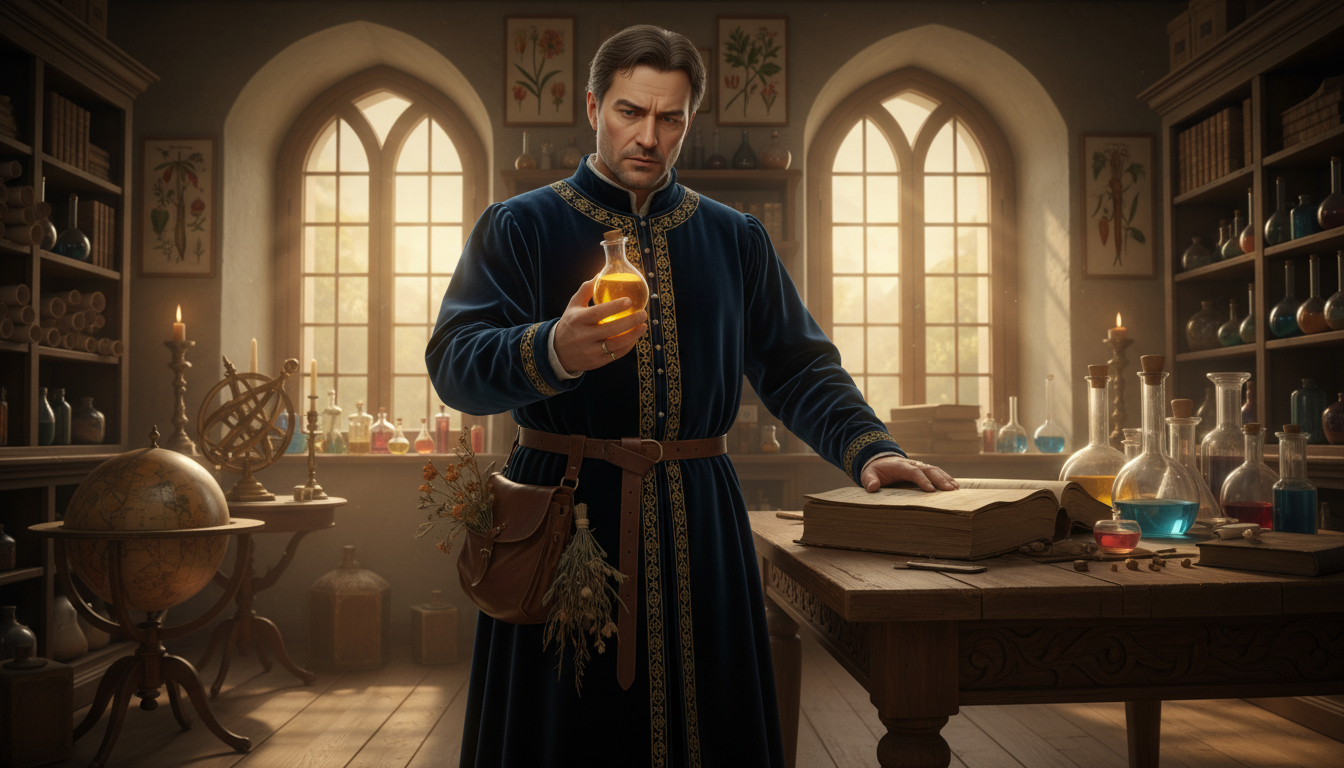
Here’s a wild fact: for roughly 1,500 years, most European doctors followed Galen and Avicenna like they were the only truth.
Then Paracelsus came along and said that was wrong.
He wasn’t shy about it. This loud, restless Renaissance physician—born Theophrastus Bombastus von Hohenheim—asked why trust old books over what you can see and test?
His curiosity is key. As a Swiss alchemist, he treated nature like a lab, not a museum. He wanted medicine to move from tradition to chemical medicine, using minerals and compounds on purpose.
Paracelsus pushed doctors to watch real patients, learn from miners, and try new remedies. He even suggested using mercury, despite its dangers. There was drama in Basel, including a book-burning.
And there’s a famous saying from him: “Solely the dose determines that a thing is not a poison.” Stick with us. We’re about to explore how one Swiss alchemist changed medicine into a new era—messy, chemical, and surprisingly familiar.
Key Takeaways
- Paracelsus challenged the long reign of Galen and Avicenna in everyday medical practice.
- As a Renaissance physician, he argued that observation should beat blind loyalty to old texts.
- The Swiss alchemist promoted chemical medicine, including treatments made from minerals.
- Paracelsus contributions include ideas that shaped early toxicology and drug dosing.
- His career mixed hands-on healing with public conflict, including the famous Basel book-burning.
- The next sections connect his theories to mercury, mining illnesses, and the rise of testing remedies in the real world.
Introduction to Paracelsus and His Influence
Ever wondered when medicine became more hands-on? This story is for you. A Paracelsus biography is like a travel journal. It’s about a healer who loved to question the status quo.
He roamed the world like a Swiss alchemist, always asking: what really helps when someone is sick? His curiosity changed medicine, making him a true Renaissance physician.
Early Life and Background
Paracelsus was born in Einsiedeln, Switzerland, in late 1493. His name was Theophrastus Philippus Aureolus Bombastus von Hohenheim. That’s a mouthful.
His dad, Wilhelm Bombast von Hohenheim, was a chemist and doctor. His mom, Elsa Ochsner, worked at a local hospital. She passed away soon after he was born.
In 1502, he and his dad moved to Villach in Carinthia (Austria). Those walks were lessons in plants and care.
Key Philosophical Ideas
Paracelsus didn’t believe in blindly following old authorities. He wanted you to look and trust what you see and feel.
As a Swiss alchemist, he used alchemy to understand matter. He talked about sulphur, salt, and mercury to explain how things work. Then, he applied these ideas to healing.
| What he leaned on | How it showed up in practice | Why it got attention |
|---|---|---|
| Direct observation over tradition | Watched symptoms closely and adjusted methods based on outcomes | It challenged the book-first habit of many schools |
| Travel and field learning | Pulled knowledge from miners, herbal workers, and everyday routines | It treated “street-level” experience as real evidence |
| Tria prima: sulphur, salt, mercury | Used a chemical lens to think about bodies, reactions, and remedies | It nudged medicine toward materials and processes, not just theory |
Legacy of Paracelsus in Medicine
Even back then, people argued about him. Some saw him as a troublemaker. Others saw a visionary who changed medicine.
He was a major figure in Western Europe during the Renaissance. His nickname, “Luther of Medicine,” shows his impact. Paracelsus died on September 24, 1541, in Salzburg, Austria. But his work was published later, spreading his ideas.
So, when you hear Swiss alchemist today, it’s not just about old legends. It’s about a fresh idea: learning by watching the world, not just reading.
The Transition from Traditional to Chemical Medicine
Imagine the Renaissance as a bustling workshop. Old rules and new ideas were both present. This is where chemical medicine started to gain ground.
Paracelsianism emerged, asking a simple question: what if healing is more effective when it’s specific?
The pace of change was fast. Johannes Gutenberg’s printing press (around 1440) spread medical ideas quickly. Christopher Columbus’s 1492 voyage made Europe eager for new discoveries.
Historical Context of Medicine
Traditional medicine relied on old rules and broad thinking. But the era was all about change. Leonardo da Vinci drew bodies with precision, while Michelangelo and Raffaello made anatomy look real.
At the same time, Martin Luther challenged power, and Erasmus of Rotterdam changed how people read. Galileo Galilei made observation a new kind of honesty. Paracelsian philosophy emerged as a bold challenge.
The Role of Alchemy in Medicine
When Paracelsus called himself an alchemist, it wasn’t just for fun. He believed alchemy could turn metals into gold to cure diseases. It was a mix of hands-on work and big ideas.
This mix shaped Paracelsianism. It focused on process, not just mystery. You observe changes, keep what works, and discard the rest.
Paracelsus’s Innovations
Paracelsus made a big change: treating specific diseases with specific remedies. This was a key part of Paracelsian philosophy. It helped chemical medicine become more accepted.
His experience in Austrian mines was personal. He saw how metal fumes and dust affected lungs and skin. This experience gave Paracelsianism a practical edge.
| What you’re treating | Traditional focus | Paracelsus’s shift | Why it changed the game |
|---|---|---|---|
| Cause of illness | General imbalance across the body | Distinct diseases with distinct causes | Paracelsian philosophy made diagnosis feel more targeted and testable |
| Tools and materials | Mostly plant-based mixtures and inherited recipes | Inorganic salts, metals, and minerals | Chemical medicine expanded the toolkit beyond the herb shelf |
| How remedies were chosen | Tradition, authority, and broad rules | Match the remedy to the disease’s character | Paracelsianism encouraged selection with a clearer “why this, for that” logic |
| Everyday proof | Slow change, hard to separate from luck | Workplace exposure showed fast, visible effects | Chemical medicine leaned into what could be observed in real bodies |
Understanding Paracelsus’s Medical Theories
Paracelsus’s ideas aren’t just about finding balance. He believed disease has a real cause, so treatments should be precise. This idea is at the core of his philosophy, making his writings seem surprisingly modern.
The Concept of Disease and Treatment
In the Book of the Three Principles, Paracelsus introduced a bold rule. He said diseases should be named after their cure. For example, leprosy is called “gold disease” and treated with gold, and epilepsy is called “vitriol disease” and cured with vitriol.
This approach wasn’t just about names. It was about focusing on causes and specific remedies. In his works, treatment isn’t just more of the same. It’s about matching the illness with the right counter-force.
The Importance of Individualization
Paracelsus didn’t treat herbal drugs like magic. He believed herbs aren’t a universal fix. Instead, the illness dictates the treatment, not the other way around.
He also talked about arcana, or specialized knowledge of nature’s hidden properties. This idea is about building a toolbox through study and hands-on experience. In his works, this tailored approach is a recurring theme: the right substance, the right preparation, the right patient.
Influence on Medical Practices
Paracelsus’s ideas didn’t just stay in books. He challenged traditional medicine by teaching in German and promoting experimentation. This approach helped his theories spread, even when they faced opposition.
In works like De Mineralibus, De Natura Rerum, and Archidoxa, Paracelsus focused on chemistry. He believed medicine should be specific, testable, and based on what substances actually do.
| Idea in Paracelsus theories | What it changes for you in treatment | Where it shows up in Paracelsus works |
|---|---|---|
| Disease has a distinct cause and a distinct “thing-ness” | You look for a direct match: one illness, one targeted remedy | Book of the Three Principles |
| Name the disease after the cure | You focus on the remedy’s action (gold for “gold disease,” vitriol for “vitriol disease”) | Book of the Three Principles |
| Herbs aren’t a universal fix | You stop treating plant remedies like a one-size solution and tailor choices to the case | Archidoxa |
| Arcana as specialized knowledge of substances | You rely on learned preparation and careful selection, not tradition alone | De Natura Rerum |
| Chemistry belongs in everyday medical practice | You consider minerals and prepared compounds as tools, not curiosities | De Mineralibus |
Paracelsus and the Use of Minerals in Medicine
Wait—he treated people with what? A Swiss alchemist used powders and metals in the sickroom. This was a bold move, not just a simple treatment. Mineral medicine was a key part of his work, changing how people viewed drugs for a long time.
Paracelsus’ journey took him through mines and labs. His father worked with the Fuggers, and Paracelsus visited their mines in Austria. This experience made him see minerals as something to be tested, not just mysterious substances.
Introduction to Mineral-Based Treatments
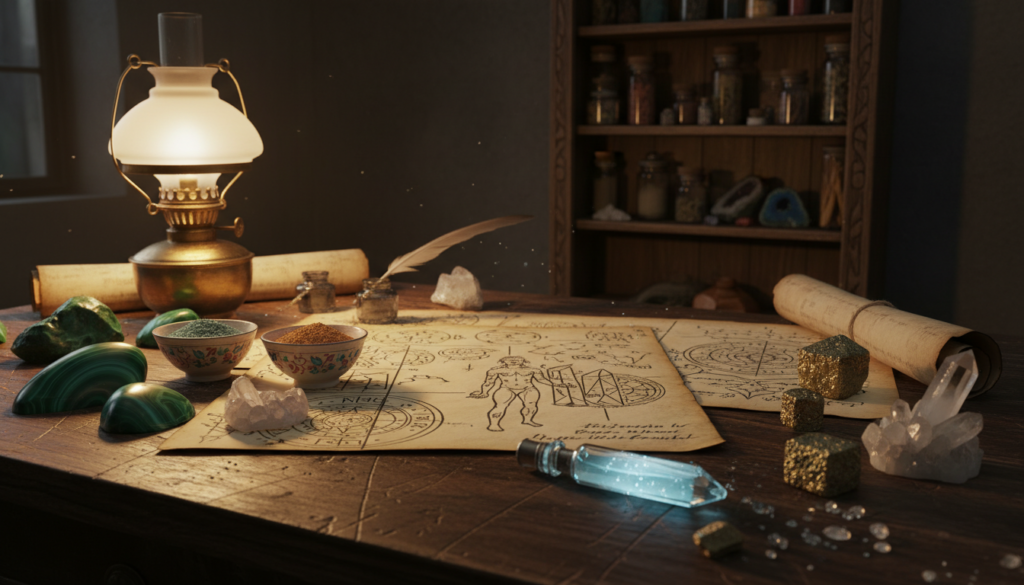
He didn’t just use herbs. Paracelsus also used mercury, lead, and other metals. He believed the body was like a chemical reaction, so he used chemical remedies.
Mineral medicine brought new words into medicine. Paracelsus is credited with naming the mineral “zinc”. This small step shows a big change: a move to describe substances clearly, not just as vague “purifying agents.”
Case Studies and Their Impacts
He made mercury a key treatment for syphilis. He used it in a special form, not just as a general cure. He also used mercury for dropsy, helping with its diuretic effects.
For digestive problems, he used iron antimony. For skin issues, he applied zinc-oxide ointment. These treatments were not just symbolic; they were real attempts to match a material to a specific symptom.
Laudanum, an opium tincture, is also linked to Paracelsus. He knew opium dissolved better in alcohol. Laudanum stayed in use for centuries, even as its misuse became known in the Victorian era.
| Mineral or preparation | How Paracelsus used it | Why it mattered in practice | What made people uneasy |
|---|---|---|---|
| Mercury (inorganic compounds) | Treatment for syphilis; also used for dropsy as a diuretic when ingested | Pushed drug therapy toward targeted chemical action, not just balancing “humors” | It looked like poison, and dosing could be risky |
| Iron antimony | Given for digestive complaints | Suggested that metals could be internal remedies, not only external salves | Antimony had a reputation for harsh effects |
| Zinc-oxide ointment | Applied for skin issues | Showed a move toward mineral-based topical care with clear, repeatable ingredients | People distrusted “chemical” pastes compared with familiar plant mixes |
| Laudanum (opium in alcohol) | Opium tincture made practical through alcohol solubility | Set a template for extraction and standardized dosing in later pharmacy | Dependence and abuse became a long-running worry |
Controversies Surrounding Mineral Use
His methods were bold, using inorganic substances that could harm quickly. This made many doctors uneasy, as they followed traditional methods. Paracelsus didn’t shy away from controversy, challenging the established views on healing.
In Basel, he made a big statement by burning Galen and Avicenna’s books. This act sparked outrage and cemented his reputation as a provocateur. His contributions were seen as bold and confrontational, sparking debate and criticism.
The Philosophy of Correspondences and Analogies
Paracelsian philosophy is all about patterns in the world. It says if you look closely, you’ll see connections between your body, the elements, and the sky. This idea makes Paracelsianism seem surprisingly modern.
Paracelsus believed illness is not just a local issue. It’s about being out of sync with your environment, habits, and even the stars. You don’t need to believe in astrology to see his point. He wanted medicine to look beyond just the body.
The Connection Between Microcosm and Macrocosm
You are like a small mirror of the universe. This means your body should reflect the order of the world. If nature has order, so should you.
The doctrine of signatures is a key part of this idea. It says nature gives clues about remedies through shapes, colors, and textures. For example, walnuts look like brains, yellow flowers hint at jaundice, and lungwort resembles lungs.
Paracelsus’s Influence on Future Philosophers
Paracelsus was hard to categorize because he mixed practical work with mysticism. His writings jump between chemistry, religion, and cosmic connections. This mix helped his ideas spread in many directions after he died.
Some readers focused on the chemistry, advancing it. Others saw the symbolic side and used it as a worldview. Either way, his style made it easy to debate and borrow from him.
Relevance in Contemporary Medicine
The doctrine of signatures doesn’t always hold up in today’s tests. Yet, it encouraged careful observation. This led to discoveries like willow bark for pain, which was later linked to aspirin.
Today, we look for patterns in nature with better tools and rules. We’re drawn to connect the dots, even when Paracelsian ideas and modern science don’t always match.
| Idea | How it works in Paracelsianism | What it can look like today | Everyday example |
|---|---|---|---|
| Microcosm and macrocosm | Your body reflects the wider world, so health ties to elemental and cosmic relationships | Focus on environment and timing, but tested through measurable risk and outcomes | Air quality affecting asthma symptoms |
| Doctrine of signatures | Plants and minerals “signal” their uses through color, shape, or texture | A starting hunch for observation, followed by chemistry and trials | Willow bark linked to pain relief compounds |
| Correspondences and analogies | Meaningful links connect organs, metals, planets, and remedies | Pattern-finding in data, with peer review and replication | Tracking symptom clusters to refine diagnosis |
| Chemical remedies with symbolic framing | Lab work matters, but it sits inside Paracelsian philosophy about hidden relationships | Drug discovery guided by mechanisms, dosing, and safety testing | Turning a natural compound into a standardized medication |
The Role of Observation in Paracelsus’s Work
If you follow this Renaissance physician, you’ll see a pattern. He observed first, then argued later. His work, “knowing,” is not just reading books. It’s about getting your hands dirty, observing the body, workshops, or the outdoors.
Importance of Empirical Evidence
Paracelsus believed in learning from experience. He traveled a lot across Europe, learning practical tricks and local cures. He didn’t just learn from famous doctors.
He learned from barber-surgeons, midwives, monks, executioners, the elderly, the homeless, and folk healers. He believed in learning from those who saw illness up close. His approach was like planting a seed and watching it grow.
Comparison with Other Medical Practices
His way of learning clashed with Galenic medicine. Galenic medicine relied on old rules and authority. Many doctors trusted what they were taught more than what they could test. Paracelsus was frustrated with this and seemed reckless to his critics.
He even taught in German instead of Latin. This made medical knowledge more accessible to apprentices and working people. His goal was to challenge the old order by making knowledge easier to get.
| What guided the work | Galenic tradition (typical university medicine) | Paracelsus’s approach |
|---|---|---|
| Main source of trust | Ancient authorities and established commentaries | Direct observation, trial, and hands-on judgment |
| How a student learns | Reading, disputation, and repeating accepted systems | Travel, apprenticeships, and watching real cases unfold |
| Who gets treated as a “teacher” | Credentialed scholars and licensed physicians | Physicians plus artisans and frontline healers |
| Language of instruction | Latin for elite circles | German for wider access |
Lasting Impact on Scientific Methodology
Paracelsus’s work nudged medicine toward seeking evidence. He believed that claims should be tested in the real world. This approach is important, even when his writing mixes experiments with mysticism.
For modern readers, Paracelsus’s contributions are clear. He advocated for a method that values observation, comparison, and change. Keep watching, comparing, and learning.
Paracelsus and Toxicology
Paracelsus is a key figure in toxicology’s history. He didn’t see “poison” as just a scary word. Instead, he saw it as something to study and understand.
His ideas were groundbreaking. He moved medicine towards chemistry and real-world dangers. He looked at things like workshops, mines, and smoke as dangers, not just ideas.
Foundations of Modern Toxicology
Paracelsus noticed miners and metalworkers getting sick. He saw dust in lungs and fumes in the air. He connected these to sickness patterns.
He believed certain substances affect certain organs more. This was an early hint at targeted organ toxicity. It was before the term existed.
His approach made mercury medicine seem less scary. He showed it was about the dose, not just the substance. It was about measuring and respecting it.
Case Examples from Paracelsus’s Writings
In his Third Defence, Paracelsus argued against critics. He said, “What is there that is not a poison? … Solely the dose determines that a thing is not a poison.”
He was hands-on, mixing metals with mercury and studying gases. His work is central to toxicology’s history.
He described his tria prima in a way that’s easy to picture. “For all that fumes and disappears in vapors is mercury; all that burns and is consumed is sulphur; all that is ashes is also salt.” His theories were practical, not just mystical.
| What Paracelsus paid attention to | What you notice in real life | How toxicology talks about it now |
|---|---|---|
| Mine dust and stone particles | Short breath, chronic cough, lungs that don’t “bounce back” | Inhalation exposure and long-term lung scarring (silicosis risk) |
| Mercury and arsenic fumes from metalwork | Headaches, tremors, weakness, confusion after repeated exposure | Metal fume toxicity and workplace exposure limits |
| Dose and timing of a substance | A small amount might pass, a larger amount overwhelms | Dose-response relationships and risk assessment |
| Where a substance “lands” in the body | Some exposures hit lungs, others hit nerves or kidneys | Target-organ effects and organ-specific toxicity |
Toxicology’s Role Today
Today, the idea of dose is key to safety. It guides us in work, home, and air quality.
Modern toxicology deals with complex issues. It looks at low doses over time and combined exposures. This is similar to old debates about mercury medicine.
Paracelsus’s ideas are timeless. He treated harmful substances as things to measure and learn from. He didn’t believe they were magic or harmless.
Critiques of Paracelsus’s Ideas
Paracelsus didn’t just challenge medicine; he sparked a big debate. His ideas, known as Paracelsianism, were loud and controversial. If you thought this story would be calm, think again.
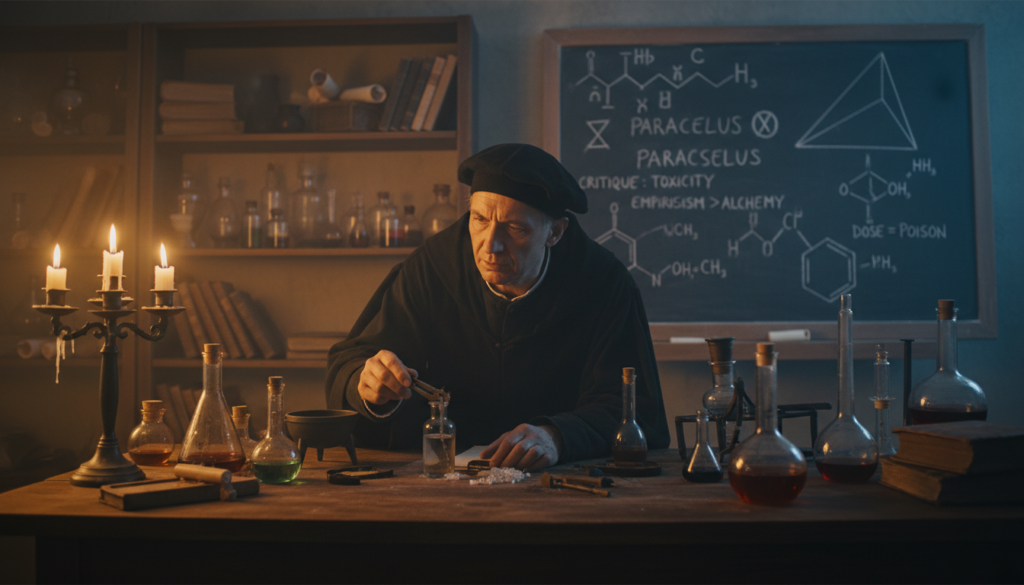
Looking at Paracelsus’s works, you feel his bold energy. He aimed for real cures, not just treating symptoms. But his boldness made him a target for criticism.
Skepticism from Contemporary Peers
In Basel, the backlash was quick and harsh. He criticized the medical field, religious beliefs, and even burned old texts. This bold move made many enemies.
His insults to other doctors didn’t help. After a short time in Basel (1527–1528), he had to leave in secret.
Limitations in His Theories
Some critics worried about safety. Paracelsus used minerals like mercury, which can be dangerous. Today, we see how risky some of his treatments were.
His writing was also a problem. It was dense, full of contradictions, and mixed with mysticism. His life story is also filled with debates and mysteries.
Impact on Future Medical Practices
Despite the drama, Paracelsianism kept growing. It was carried by many who saw its practical value. Over time, useful parts of his ideas influenced early drug-making and iatrochemical thinking.
| Flashpoint | What critics objected to | What later medicine took from it |
|---|---|---|
| Basel scandals and public attacks | Disrespect for university authority and inherited doctrine | Permission to question tradition when it blocks better treatment |
| Chemical remedies in Paracelsus works | Danger from metals and unstable dosing | Interest in targeted substances, preparation methods, and careful dosing |
| Mysticism inside Paracelsus theories | Astrology and spiritual language mixed into medicine | A push to connect body, environment, and lifestyle (later reframed in more testable terms) |
| Contradictory texts and disputed biography | Hard to verify claims and standardize guidance | Stronger demand for reproducible methods and shared standards |
Paracelsus’s Contribution to Homeopathy
Homeopathy talks about symptoms and remedies in a way that reminds us of old medical ideas. Paracelsus didn’t directly lead to today’s homeopathy. Yet, his ideas influenced many areas of thought.
Influences on Homeopathic Thought
Paracelsus believed that each disease needs a special treatment. He didn’t like treating everyone the same. This idea shows up in later systems that match remedies to specific symptoms.
He also explored the idea that “like affects like.” This isn’t exactly like homeopathy’s rules today. But it’s close. This idea led to looking for remedies that mirror symptoms, not just general tonics.
Key Principles Derived from His Work
One key idea is “dose makes the poison.” This shows that the same thing can be helpful or harmful based on how much you use. It’s about how much you take, not magic.
Paracelsus also focused on how remedies are made. He believed in using methods like distillation to get the active parts. He saw making remedies as key, not just a side step.
| Idea in practice | How Paracelsus framed it | Why it echoes in homeopathic talk |
|---|---|---|
| Dose control | “dose makes the poison” ties safety to quantity and context | It keeps attention on how small changes in amount can change effects |
| Preparation methods | Work the material through processes like distillation to refine what matters | It supports the belief that how a remedy is prepared changes what it does |
| Specific matching | Treat the named illness with a specific agent, not a general cure-all | It fits the instinct to match a remedy to a tight symptom picture |
The Legacy of Homeopathy Today
In the United States, homeopathy has a loyal following, mainly in wellness circles. But it’s also debated in medical circles, where evidence is key.
This debate makes Paracelsian ideas relevant today. People want care that’s personal, precise, and hands-on. The idea that “dose makes the poison” is a big part of this conversation.
The Interplay Between Medicine and Spirituality
Paracelsus didn’t see a clear line between what we can measure and what we feel. As a Renaissance doctor, he treated the body as a working system. Yet, he also looked for meaning in illness. This mix makes Paracelsian philosophy seem surprisingly modern today.
Paracelsus’s Natural Philosophy
In his time, nature was full of signs—colors, tastes, smells, and patterns. These hints showed what remedies could do. This idea comes from Hermetic philosophy, which says the small world in us reflects the big world outside.
He believed nature heals itself, and doctors just help. He talked about an inner force called the Archeus. It’s like an “inner alchemist” that manages digestion and starts repairs.
Medicine as a Spiritual Practice
Paracelsian philosophy says treating a person is more than fixing a tool. Healing must involve body, soul, and spirit together. Even with chemical medicines, he saw recovery as more than just technique.
He also saw alchemy as a journey of inner change. Prayer, faith, and divine grace were part of his care. He linked the “philosopher’s stone” to divine wisdom and Christ. For a Renaissance doctor, this was bold and comforting.
Modern Interpretations of This Relationship
Today, many don’t turn to astrology for fever explanations. But Hermetic philosophy and Paracelsus’s way of thinking remind us illness isn’t always mechanical. Pain can be chemical, social, emotional, and full of questions we can’t test.
This story keeps being rediscovered. You can be lab-minded and value the human side he emphasized. You can also seek meaning and respect his focus on real substances and reactions.
| Theme | How Paracelsus framed it | How it’s often read today | What you can take from it |
|---|---|---|---|
| Nature as healer | The physician supports nature’s work and removes blocks | Healing as recovery support: rest, environment, timing | A push to notice basics that affect outcomes |
| Archeus | An inner “alchemist” that regulates digestion and separation | A rough match to self-regulation and repair processes | A language for why the body isn’t passive |
| Body and meaning | Symptoms can carry signals, not just errors | Patients want explanations that fit their lived experience | A cue to listen for the story behind the symptom |
| Hermetic philosophy | Links between microcosm and macrocosm shape diagnosis and care | Often seen as symbolic, not literal science | A way to think in patterns without ditching evidence |
| Alchemy and spirituality | Inner transformation sits beside chemical remedies | Sometimes viewed as metaphor, sometimes as faith practice | Room for values and hope without replacing treatment |
The Continued Relevance of Paracelsus in Modern Medicine
It’s amazing how a doctor from the 16th century can seem so modern. Paracelsus’ ideas are seen in today’s treatment: a specific substance, effect, and dose.
Even though some of Paracelsus’ recipes are outdated, his main idea is timeless. Chemistry is key in healing, not just extra. This view made chemical medicine seem normal, not strange.
Influence on Current Medical Practices
Everyday drugs follow a similar logic. Modern medicine focuses on active agents that target a condition. It tests how the dose affects the outcome.
This focus on dose is a lasting part of Paracelsus’ legacy. Today, it’s seen in side-effect warnings and dosing schedules. It’s about finding the right amount, even with today’s advanced tools.
| Modern habit in care | What it looks like for you | How it echoes Paracelsus works |
|---|---|---|
| Dose discipline | Starting low, adjusting based on response, and watching for toxicity | Pushes the idea that the amount can shift a substance from help to harm |
| Targeted agents | Choosing a drug because it has a known action, not just a tradition | Supports a chemistry-first view that helped shape chemical medicine |
| Risk thinking | Reading labels, checking interactions, and factoring in liver or kidney limits | Builds on Paracelsus contributions to early toxicology thinking |
Paracelsus in Integrative Medicine
If you’ve heard a doctor say, “We’re treating the whole person,” you’re hearing Paracelsus. He believed in treating the whole person, not just symptoms.
He also thought doctors should care about patients, not just follow rules. This idea fits with today’s integrative care, which looks at lifestyle and stress too.
Paracelsus taught in German and learned from everyday people. He believed medicine should be easy to understand. This idea is why his work is talked about today.
- Whole-person attention alongside tests and prescriptions
- Respect for practical experience, not just elite theory
- Clear communication so you can follow the plan and stick with it
Current Research Inspired by Paracelsus
Researchers keep looking at dose-response, even with complex exposures. Real life is full of mixtures and different reactions. It’s not just one chemical and one dose.
Paracelsus’ ideas are key in toxicology and pharmacology history. The question remains: what dose changes risk, and when does a useful agent become harmful? His curiosity is alive in today’s medicine.
Conclusion: Paracelsus’s Enduring Legacy
Paracelsus seems surprisingly modern when you look back. His life was marked by constant questioning and a desire to change the way medicine was done. He believed in treating patients as individuals, not just following old rules.
Lessons for Modern Healthcare
His main lesson is to observe before acting. Paracelsus knew that too much of a good thing can be bad. He showed that medicine is about people, not just theories.
Future Directions in Chemical Medicine
Today, we’re building on Paracelsus’s ideas. We’re working on better treatments and safer doses. But we’re also facing the same questions he did about risk and safety.
Celebrating the Contributions of Paracelsus
Paracelsus’s impact is clear, despite the challenges he faced. He introduced new ideas in medicine and sparked debates. His work influenced teaching and even the treatment of famous people like Louis XIV.
FAQ
Who was Paracelsus, and why does he matter in medical history?
When and where was Paracelsus born?
What do we know about Paracelsus’s family and early upbringing?
Why did Paracelsus move to Villach, and how did that shape him?
What was Paracelsus rebelling against—Galen and Avicenna?
What are Paracelsus contributions to the shift toward chemical medicine?
What did Paracelsus believe about learning medicine from nature?
What is the “tria prima” in Paracelsus theories?
What was the Renaissance medical world like when Paracelsus showed up?
How did Paracelsus define alchemy’s role in medicine?
What did Paracelsus change about how doctors treated disease?
Why did Paracelsus think diseases should be named after their cures?
What did Paracelsus mean by “arcana” and individualized treatment?
Which Paracelsus works show his chemical approach?
Why is Paracelsus linked to mineral-based treatments?
How did mining shape Paracelsus’s medical thinking?
What are key examples of Paracelsus using chemicals as medicine?
Did Paracelsus really invent laudanum, and why did it matter?
What’s the story behind Paracelsus and the word “zinc”?
Why did Paracelsus spark outrage in Basel?
Why did Paracelsus lecture in German, and why was that a big deal?
What is the microcosm and macrocosm idea in Paracelsian philosophy?
What is the doctrine of signatures, and did Paracelsus use it?
How is Paracelsus relevant to modern medicine if some ideas were mystical?
Who did Paracelsus claim to learn from beside university physicians?
How did Paracelsus compare to Galenic medicine?
Why is Paracelsus called the “Luther of Medicine”?
When did Paracelsus die, and why did his influence grow afterward?
Why do people call Paracelsus a pioneer of toxicology?
What did Paracelsus mean by “Solely the dose determines that a thing is not a poison”?
Did Paracelsus actually experiment with chemicals in a hands-on way?
Why did Paracelsus’s peers consider him dangerous or reckless?
What are the main limitations or problems in Paracelsus theories?
How did Paracelsianism influence later medicine if Paracelsus was so controversial?
Did Paracelsus influence homeopathy?
What ongoing research themes are most “Paracelsian” today?
Who helped spread Paracelsus’s legacy after his death?
What’s the famous “antimony” comeback story tied to Paracelsus’s chemical medicine?
Get More Medical History
Join our newsletter for fascinating stories from medical history delivered to your inbox weekly.