The History of Healing
 Paul Ehrlich and the Dawn of Immunology
Explore the legacy of Paul Ehrlich, Nobel Prize winner and pioneer whose work laid the foundation for modern immunology and chemotherapy.

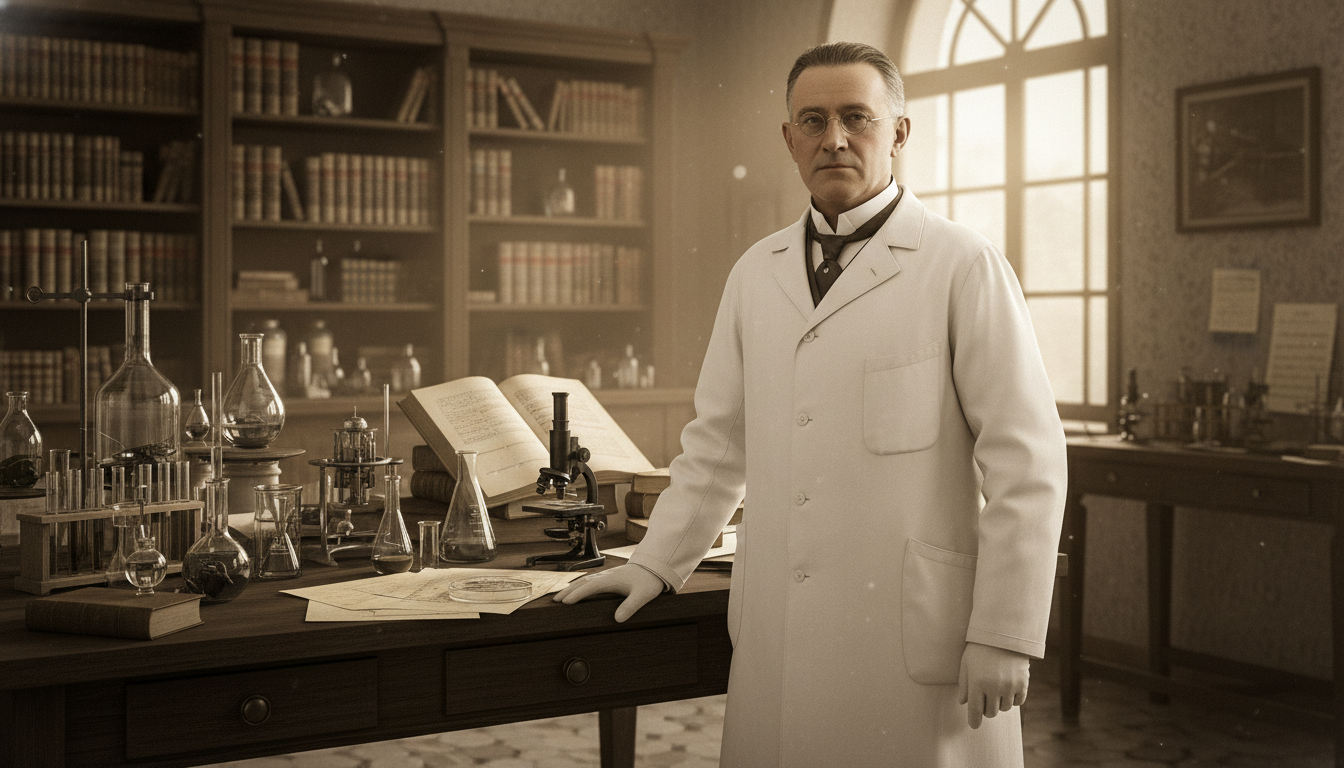
In 1908, Paul Ehrlich, a German doctor, made a big change. He got a Nobel Prize for it. This change is why we have vaccines, antibodies, and targeted drugs today.
Paul Ehrlich was born March 14, 1854. He’s a big name in medical history. He asked tough questions like, “Why does the body react to some germs but not others?”
We’re going to explore his big ideas. From how the immune system works to using chemistry to heal. You’ll see how his ideas shaped immunology and chemotherapy.
We’re not just telling stories. We’re using real sources from back then. Henry Dale wrote about Ehrlich in Br Med J (1954). And there are collections edited by Henry Dale and Felix Himmelweit in the Pergamon volumes (1957/1960). So, you’ll hear what Ehrlich’s world was like.
Key Takeaways
- Paul Ehrlich helped launch modern immunology by asking how the body targets specific threats.
- He wasn’t just a lab thinker; his medical research pushed toward real treatments.
- As a German physician, he connected staining, microscopy, and chemistry to disease fighting.
- This story follows the bridge from immune theory to early drug development.
- The article draws from published historical sources, including Henry Dale and Felix Himmelweit’s edited collections.
- Ehrlich’s origin story is a key “dawn” moment for how we talk about immunity today.
Introduction to Paul Ehrlich
Imagine a person who loves to talk about their lab work. Paul Ehrlich was like that. He was a German doctor who loved to find proof of his ideas.
He was fascinated by how stains could make cells and microbes visible. This was important for understanding the tiny world we can’t see.
In the late 1800s, medicine was all about finding facts. This was a time when doctors needed solid evidence, not just guesses.
Years before, Rudolf Virchow had shown how bad outbreaks could be. He highlighted the need for better explanations in Europe.
By the time Paul Ehrlich worked, doctors were under a lot of pressure. They had to connect what they saw in the lab to real people’s health. For him, histology was key.
Early Life and Education
Ehrlich focused on the practical side of medicine. He spent hours studying and working with slides. He wanted to understand how cells worked together.
He saw bodies and diseases in a new way. Histology gave him a visual language to understand them.
Influences and Inspirations
He wasn’t alone in his work. Louis Pasteur had already shown that germs cause disease. Joseph Lister had also made surgery safer by using antiseptics.
Later, Élie Metchnikoff called Pasteur, Lister, and Koch the founders of a new era. This shows how Paul Ehrlich was part of a big movement. He believed in using histology and cellular theory to find evidence.
| Influence | What you’d notice in everyday terms | Why it mattered to Paul Ehrlich’s microscope-first mindset |
|---|---|---|
| Rudolf Virchow (1849) | Typhus wasn’t just “bad air”; it was a crisis that demanded documentation and action. | It reinforced cellular theory as a way to explain disease through observable changes, not rumor. |
| Louis Pasteur (1864) | He pushed back on the idea that life just “appears” out of nowhere. | It made germs and lab proof feel central, which fit a German physician committed to histology. |
| Joseph Lister (1867, 1868) | Cleaning tools and wounds could cut infections—simple, but huge. | It linked what happens on surfaces and tissues to outcomes, keeping attention on cells and mechanisms. |
| Élie Metchnikoff (1933) | He told the story like a big, connected movement with clear leaders. | It places Paul Ehrlich inside a broader push toward evidence, where histology and cellular theory felt like the shared language. |
Career Beginnings
Before he became famous, Paul Ehrlich worked in a lab. He used what he could see and test. This made medical research easier to follow.
He used histology to make the invisible visible. With dyes and slides, he made the microscope useful.
Initial Research Undertakings
Ehrlich’s early work was all about seeing things clearly. In 1877, he published Beiträge zur Kenntnis der Anilinfärbungen…. He studied aniline dyes and how they work under the microscope.
By 1882, he was writing about staining tubercle bacilli. This gave doctors a way to spot tuberculosis. It was useful, not glamorous.
He used color to measure things. In 1885, Das Sauerstoff-Bedürfnis des Organismus — eine farben-analytische Studie showed how tissues handle oxygen. Then, in 1887, he looked at the methylene blue reaction in living tissue.
| Year | Publication or Focus | What he worked on | Why it mattered to later immunology |
|---|---|---|---|
| 1877 | Beiträge zur Kenntnis der Anilinfärbungen… | Aniline dyes for microscopic technique and tissue contrast | Made cell details easier to compare, a key habit for careful medical research |
| 1882 | Staining tubercle bacilli | Practical staining method to see the organism tied to tuberculosis | Helped connect lab observation with disease detection, tightening the loop between histology and immunology |
| 1885 | Das Sauerstoff-Bedürfnis des Organismus — eine farben-analytische Studie | Color-based approach to how tissues relate to oxygen needs | Encouraged thinking about function inside cells, not just shape |
| 1887 | Methylene blue reaction in living nervous tissue | Staining reactions in active, living tissue | Opened doors to studying living systems, the kind immunology depends on |
Move to the Institute of Experimental Therapy
After years of lab work, Ehrlich’s goals grew bigger. The Institute of Experimental Therapy was a new challenge. It was where he could test his ideas and prove them.
This change was important for Ehrlich. His work in histology led to new questions in immunology. He wondered about the body’s reactions and how to treat diseases on purpose.
Contributions to Immunology
Paul Ehrlich’s work feels surprisingly modern. He didn’t just collect lab results. He looked for patterns and asked sharp questions.
He found that the body chooses what to attack. This idea connects antibodies, cellular theory, and testing.
The Concept of Immunological Specificity
Paul Ehrlich wondered how the body knows what to attack. In 1891, he used plant toxins like ricin and abrin to track immune reactions. He saw that resistance to one toxin didn’t mean resistance to another.
This led him to a more precise view of immunology. By 1897, he showed that antitoxins work like keys, setting the stage for understanding antibodies.
Cellular theory was also important. The body is not just one blob fighting back. It’s a coordinated effort of cells and signals. Later, discussions kept exploring why one threat triggers a specific defense.
| Milestone | What Ehrlich used | What it showed | Why it mattered for immunology |
|---|---|---|---|
| 1891 ricin work | Measured toxin effects and rising resistance | Protection could be tracked and compared over time | Made immune response feel testable, not mystical |
| 1891 abrin work | Another potent toxin with similar outward symptoms | Resistance to one toxin didn’t automatically cover the other | Helped define immunological specificity in practical terms |
| 1897 antitoxin theory | Reasoned model of how antitoxins act in the body | Effects depended on close matching, not broad “strength” | Fed into later thinking about antibodies and targeted binding |
Development of Atoxyl
Ehrlich also worked on treatments that acted on purpose. Atoxyl, an arsenic-based compound, was one of his efforts. It was an early attempt to make chemistry precise.
Atoxyl was rough and risky by today’s standards. Yet, it showed Ehrlich’s goal: to find direct, precise treatments. This mindset connected his work on antibodies and chemistry.
This approach nudged medicine toward more targeted treatments. If disease could be targeted with a designed chemical, then cellular theory was more than just a classroom idea. Atoxyl was an early step on this path.
The Magic Bullet Theory
Imagine you’re sick and a treatment helps, but it makes you very weak. Paul Ehrlich didn’t like this trade-off. He wanted a treatment that could target the problem without harming you too much.

Definition and Implications
Ehrlich’s “magic bullet” idea is simple. It aims to hit the bad guy without hurting the rest of you. This is like what we want from chemotherapy—hitting the target without causing too much damage.
He looked at cells in a new way. In Über Partialfunktionen der Zelle (1908), he saw cells as busy places with different jobs. If a cell has different jobs, a smart treatment could target one job and change the outcome.
This idea made immunology think about matching. It wanted one target, one fit, one effect. It also made medical research focus more on what a compound should do before it’s used on patients.
Impact on Modern Medicine
The magic bullet idea is seen in modern medicine. Instead of just throwing a remedy at a disease, we design treatments to be selective. This careful design is key in modern chemotherapy and drug making.
Ehrlich’s work is remembered in many ways. His papers on chemotherapy were collected in Chemotherapy, vol 3 (Pergamon, 1960), edited by Dale & Himmelweit. It shows how immunology, chemotherapy, and medical research grew together, one target at a time.
| Magic bullet focus | What it asks you to target | What it tries to avoid | Why it matters to immunology and medical research |
|---|---|---|---|
| Selective toxicity | The disease-causing organism or damaged cells | Broad harm to healthy tissue | Sets a clear goal for chemotherapy-like thinking: precision over brute force |
| Cell “partial functions” (1908) | Specific cell activities that can be interrupted or blocked | Shutting down every cell process at once | Encourages testable hypotheses in medical research about where a drug should bind |
| Compound design | Chemicals built to fit a biological target | Random trial-and-error dosing | Builds a bridge from Paul Ehrlich’s lab logic to today’s targeted medicine mindset |
The Discovery of Antibodies
Early immunology is not a mystery anymore. It’s a set of rules you can test. Paul Ehrlich made immune defense something you can measure and talk about clearly. This made antibodies seem like real parts, not just a vague “protective force.”
Understanding Antigen-Antibody Reactions
Antigen-antibody reactions are like a lock-and-key moment. But this “fit” can be timed, weakened, or boosted. In 1899, Paul Ehrlich and Julius Morgenroth explained how immune damage happens in “Zur Theorie der Lysinwirkung.”
This was a big deal. It treated binding and breakdown as steps in a process. It made immune events clearer.
Later, Svante Arrhenius’s 1907 “Immunchemie” helped frame these events with a chemistry mindset. The language got sharper. Now, we could talk about antibodies without hand-waving.
| Idea you can picture | How it shows up in antigen-antibody reactions | Why it mattered for immunology |
|---|---|---|
| Specific fit | Antibodies attach best to a particular antigen shape | Made immune action testable instead of just descriptive |
| Measurable change | Binding can lead to clumping, neutralizing, or lysis | Let researchers compare results across labs and samples |
| Conditions matter | Heat, dilution, and timing shift how strongly binding shows | Helped explain why the same serum could act “strong” one day and “weak” the next |
Practical Applications in Medicine
This is where theory meets reality. If antibodies can bind toxins or targets in predictable ways, then antitoxins and serum therapy make sense. In his 1899 writing “Mode of Action and Mechanism of Production of Antitoxins,” Paul Ehrlich asked: what’s happening in the body that makes protection possible?
For you today, the takeaway is simple and useful. Antigen-antibody reactions gave doctors and researchers a handle they could actually grab. It’s why careful dosing, potency testing, and consistent serum preparation became so important in immunology. Antibodies were no longer magic. They were working chemistry, with real consequences in clinics.
Ehrlich’s Work on Serum Therapy
In the late 1800s, hospitals were filled with kids with sore throats that could turn deadly fast. Then, serum therapy came along, giving doctors a real tool, not just hope. For Paul Ehrlich, a German physician, this was where hands-on care and immunology started talking.
Ehrlich was curious and disciplined. He didn’t just want a “maybe it works” remedy. He wanted a way to check, measure, and repeat it, so results could travel without falling apart.
Historical Context
In 1890, Emil von Behring and Shibasaburo Kitasato showed that diphtheria and tetanus immunity could be transferred through blood serum. This was a shock: protection could be passed through blood serum. It meant serum therapy could move from rumor to practice.
Ehrlich added structure. He pushed for careful dosing and reliable testing. This turned antitoxin use into something backed by numbers, not just stories. Ludwig Aschoff in 1902 discussed how Ehrlich’s ideas fit into artificial immunization, giving immunology a language to explain what clinicians were seeing.
| Problem doctors faced | What serum-based work offered | Where Ehrlich tightened the screws |
|---|---|---|
| Inconsistent antitoxin strength from one batch to another | A pathway for serum therapy to be produced and shared | Measurement habits that made potency more comparable |
| Toxin-driven infections that escalated fast, specially diphtheria | Antitoxin aimed at the toxin’s effects, not just symptoms | Clearer dose thinking so treatment wasn’t guesswork |
| Confusing explanations that didn’t match bedside outcomes | A growing framework for immunology that linked cause and effect | Theory that helped labs and wards describe the same process |
Advances in the Treatment of Diseases
Once antitoxin became a usable product, the change wasn’t subtle. Diphtheria, the classic toxin-driven threat, became the proving ground for how serum therapy could shift outcomes. The era’s push to translate immunity into treatment shows up in texts like v. Behring’s 1898 Allgemeine Therapie der Infektionskrankheiten, which treated immune tools as part of everyday medicine.
Ehrlich’s reputation later grew into that “Nobel Prize winner” glow, but the day-to-day work was gritty. It was about standards, repeatable doses, and making sure a doctor in one city could trust what another lab shipped. This steady approach helped immunology feel practical, not just theoretical, while Ehrlich kept asking: can we make this dependable for real patients?
Innovations in Chemotherapy
Chemotherapy might make you think of hospitals and long lines. But back then, it was more like a workshop. People were trying to make drugs that could hit diseases hard.
Medical research moved to the lab bench. Researchers started treating illness like a target. They aimed to hit it with real intent, even if not perfectly.
The Role of Chemical Compounds
Chemical compounds were key in this new approach. People learned to “see” molecules in a new way. This was thanks to Jacobus Henricus van ’t Hoff’s work on stereochemistry.
Emil Fischer showed how shape affects enzyme action. Otto Nikolaus Witt mapped dye compounds. This helped Ehrlich understand what sticks to what.
| Thinker and year | What it changed in the lab | Why it mattered for chemotherapy |
|---|---|---|
| Jacobus Henricus van ’t Hoff (1874, 1875) | Made molecular “shape” feel real, not abstract | Helped researchers picture selective binding as a physical fit |
| Otto Nikolaus Witt (1876) | Linked dye structures to predictable chemical behavior | Connected staining, tissue affinity, and chemical compounds as tools |
| Emil Fischer (1894) | Showed configuration can control enzyme action | Backed the idea that targeted effects depend on structure |
Breaking New Ground in Treatment Approaches
Once the “shape and fit” idea took hold, research got busier. Treatments became more precise. In 1910, Albert Neisser discussed syphilis therapy, showing the need for results.
By 1911, Paul Ehrlich was writing about Salvarsan. This marked the start of targeted chemotherapy. It was a trial-and-error process, documented in notebooks and debated in meetings.
This work was later collected in Chemotherapy (Pergamon, 1960). It shows bold ideas and constant tweaking. No magic, just the belief in the right molecule to change treatment.
Nobel Prize Recognition
When the news hit, it felt like the world was saying what lab people already knew. Immunology belongs at the center of modern medicine. Paul Ehrlich didn’t just win a shiny medal; he helped turn careful observation into a shared scientific language.
Later biographical writing kept basic facts in view. This included his 1854 birth date and his very public role in medicine (as described by Dale in 1954).
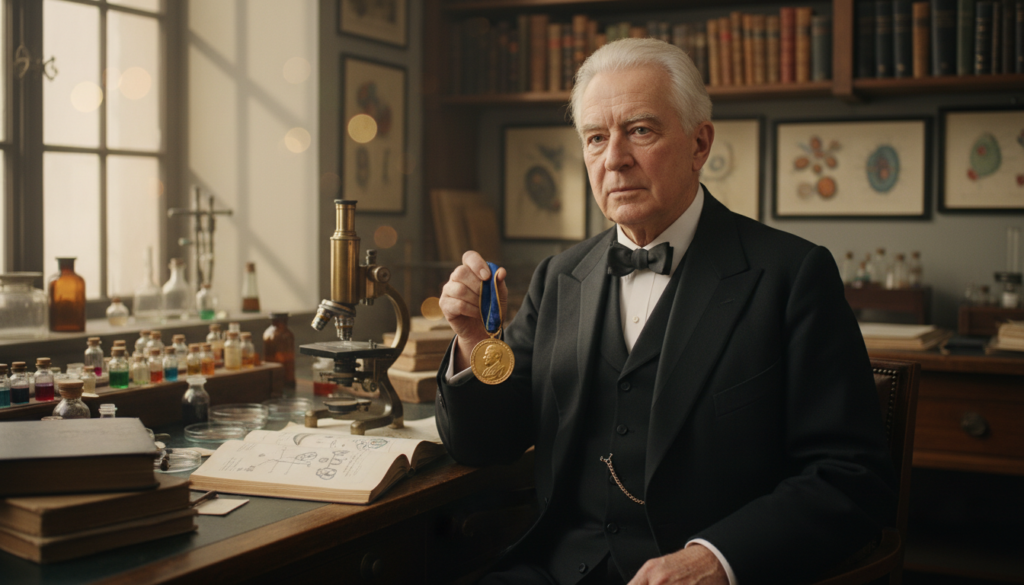
The Nobel Prize in Physiology or Medicine
In 1908, Paul Ehrlich became a Nobel Prize winner. His work made immunity feel measurable, testable, and real to a global audience. The award didn’t arrive out of nowhere.
It followed years of medical research. This research was built on staining methods, serum work, and a drive to explain why the body reacts the way it does.
What’s easy to miss is how “official” that moment made the field seem. The Nobel committee’s spotlight didn’t only honor one person. It helped pull immunology out of the rumor zone and into the “we can build on this” zone.
| What the recognition highlighted | What it nudged scientists to do next | How it showed up in medical research |
|---|---|---|
| Immunity as a system you can study, not a mystery | Design cleaner experiments and tighter definitions | More standardized lab work on sera, toxins, and protection |
| Methods that could be repeated across labs | Compare results across countries and institutions | Shared protocols and sharper debates over interpretation |
| Big theories tied to real lab observations | Test models against new diseases and new data | More papers that tried to confirm, revise, or challenge core ideas |
Reactions and Impacts on the Scientific Community
The response wasn’t just applause. Researchers wrote, argued, and tried to pin down what Ehrlich’s models meant in practice. Heymann’s 1928 historical look at the side-chain theory is a good example of how quickly people shifted into “let’s map this idea” mode.
Over time, his work also got preserved and organized in a way that shaped how later scientists read him. The collected papers of Paul Ehrlich, edited by Dale and Himmelweit (1957; 1960), helped “canonize” key threads in immunology, cancer research, and chemotherapy. For you as a reader, that’s a clue: this wasn’t a passing headline. It became a reference point that other medical research kept circling back to.
Legacy of Paul Ehrlich
Paul Ehrlich’s work is everywhere in today’s labs. He changed how we see the body’s fight against disease. Instead of guessing, the body chooses its battles.
His ideas also changed how we talk about treatments. Chemotherapy is now seen as precise, not just force. Antibodies are tracked, making research more accurate.
Influence on Future Generation of Scientists
Ehrlich’s ideas are in today’s science. Scientists now talk about immune reactions in detail. This is thanks to his focus on specific interactions.
Even today, scientists like Timothy A. Springer build on Ehrlich’s work. Springer’s 1990 paper on adhesion receptors shows how far we’ve come. We now understand how cells interact in great detail.
This understanding has led to better experiments and treatments. It’s not a single breakthrough. It’s a series of precise steps.
Establishment of the Ehrlich Institute
Ehrlich’s legacy is more than ideas. It’s a living part of research culture. The Ehrlich Institute shows his approach in action.
This approach is important. It keeps Ehrlich from being seen as a lone genius. His work helped set standards in immunology, from antibody measurement to chemotherapy screening.
| What carried forward | What you’d notice in practice | Why it’s important |
|---|---|---|
| Specific matching (immune targets and binding) | Researchers focus on receptors and how well they fit | This makes immunology more reliable and easier to study |
| Lab-to-therapy mindset | Drug candidates are tested and improved over time | This approach leads to better chemotherapy development |
| Institutional continuity under the Ehrlich Institute name | Teams and programs last long after scientists move on | This ensures consistent quality in immunology research |
Key Works and Publications
Paul Ehrlich’s publications are a clear path to understanding his work. His ideas started with dyes and slides, then moved to immunity. This led to medical research that changed lab work today.
Major Publications by Ehrlich
Ehrlich began with aniline dyes and their use in microscopy. In 1877, he published on staining methods using aniline. This helped standardize tissue and cell comparison in histology.
In 1882, he wrote about staining tubercle bacilli. This pushed lab visibility into the real world of infection. By 1885, he studied the oxygen needs of organisms in a color-analytical study. This blended chemistry with physiology.
In 1887, he explored the methylene blue reaction in living nervous substance. This showed staining could track living function. These papers are like a toolkit for careful observation.
| Year | Work (as published) | What it focused on | Why it mattered in the lab |
|---|---|---|---|
| 1877 | Aniline staining methods (Ehrlich P, 1877) | Microscopic staining technique | Made cell structures easier to separate and study in histology |
| 1882 | Staining tubercle bacilli (Ehrlich P, 1882) | Color methods for bacteria | Helped labs spot infection-related organisms more reliably |
| 1885 | Oxygen needs of the organism (Ehrlich P, 1885) | Color-analytical work tied to metabolism | Linked chemical behavior to how tissues function |
| 1887 | Methylene blue reaction in living nervous substance (Ehrlich P, 1887) | Staining in living nerve tissue | Suggested dyes could map function, not just anatomy |
| 1891 | Experimental immunity research on ricin and abrin (Ehrlich P, 1891) | Early immunity experiments | Built a bridge from lab models to immune response logic |
| 1899 | Antitoxin mechanism (Ehrlich P, 1899) | How antitoxins work | Gave immune protection a clearer, testable mechanism |
| 1899 | Lytic action theory (Ehrlich P, Morgenroth J, 1899) | Cell lysis and immune action | Added structure to debates about how serum effects happen |
| 1908 | Partial functions of the cell (Ehrlich P, 1908) | Cell function as distinct “parts” | Fed into cellular theory by treating the cell as a system with roles |
| 1909 | Status of carcinoma research (Ehrlich P, 1909) | Cancer questions and research direction | Showed his methods could travel beyond infection into tumor studies |
| 1911 | Writing on Salvarsan (Ehrlich P, 1911) | Chemical therapy and treatment framing | Made drug action feel measurable, targeted, and repeatable |
Summary of Findings and Their Importance
These works show a shift from better lab tools to sharper immune explanations. This shift is key to understanding Paul Ehrlich’s lasting impact. It keeps histology relevant, not just for pretty slides.
His work on cell “partial functions” is central to debates in cellular theory. It views the cell as a machine with jobs. Later, his work was organized in Immunology and cancer research, vol 2 (1957) and Chemotherapy, vol 3 (1960). This makes it easier for readers to follow his ideas today.
Modern Connection to Ehrlich’s Ideas
Today’s immunology is like a zoomed-in version of what Paul Ehrlich envisioned. We focus on specific targeting and how it works. This thinking is at the heart of much medical research, even with new tools.
How Ehrlich’s Work Influences Current Research
In labs, the immune system is mapped like a city. Scientists talk about docking and matching, echoing Ehrlich’s idea of precision. The language has evolved, but the core idea remains the same.
Springer’s 1990 piece in Nature on immune adhesion receptors is a key example. It shows how research describes immune targeting clearly. This clarity helped make antibodies a focus of study and design.
- Targets first: identify the exact receptor or marker you care about.
- Binding next: test how antibodies interact, block, or trigger signals.
- Design last: shape therapies around those interactions and their side effects.
Ongoing Relevance in Immunology
Immunology keeps focusing on finding targets and learning their rules. Antibodies remain central to many therapies and tests. The approach may change, but the logic stays the same.
Paul Ehrlich’s ideas continue to influence research. His work is kept alive through papers and historical accounts. These remind scientists of the importance of specific targeting in medical research.
| Ehrlich-era idea | What you’d recognize today | Why it’s important in medical research |
|---|---|---|
| Specific binding between a “target” and a “binder” | Receptor–ligand mapping and antibody profiling | Helps narrow down what to hit and what to avoid in therapy design |
| Immune reactions can be measured and compared | Standardized assays, titers, and functional immune tests | Makes results repeatable across labs and improves confidence in findings |
| Precision language for immune interactions | Adhesion receptor models (including the Springer 1990 framing) | Turns messy biology into testable steps, not just vague descriptions |
| Ideas preserved through careful documentation | Dale & Himmelweit collections and Waldeyer (1941) historical accounts | Keeps key concepts available for teaching, debate, and new angles in immunology |
Conclusion
By the time you reach the end of Paul Ehrlich’s story, it feels like watching medicine learn to *aim*. He was born on March 14, 1854. He kept chasing one simple question: what if we could see disease clearly enough to hit it on purpose?
That curiosity helped nudge immunology out of guesswork and into testable ideas.
Along the way, his lab work racked up a real set of “greatest hits.” Think of the staining breakthroughs in 1877, 1882, and 1887—small color changes that made cells easier to track and compare. Then came immunity experiments in 1891, antitoxin mechanism work in 1899, and bigger cell-function thinking by 1908, the year he became a Nobel Prize winner.
Summary of contributions
Here’s the thread that ties it together: he didn’t just describe what he saw; he tried to explain how it worked. That mindset shaped how people talked about immune reactions and specificity, and it set the stage for targeted treatment. By 1911, his writing around chemotherapy captured a new kind of confidence—risky compounds, careful dosing, and the hope of a “magic bullet” that could spare the rest of you.
Ehrlich’s lasting impact on medicine and immunology
Today, when you hear about drugs designed to bind to one target and leave others alone, you’re hearing an echo of Paul Ehrlich. His influence didn’t evaporate with the headlines; it got preserved and reused, down to multi-volume collected papers from Pergamon on Immunology and cancer research (1957) and Chemotherapy (1960). The big takeaway is simple: modern medicine tries to *target* disease, and immunology is built on the kind of bold, practical curiosity he made famous.
FAQ
Why is Paul Ehrlich (born March 14, 1854) considered a “dawn” moment for modern immunology?
What makes Ehrlich’s origin story so different from other medical pioneers?
What was medicine like in Europe before Ehrlich’s big breakthroughs?
Which “giants” shaped the world Ehrlich walked into?
What did Paul Ehrlich do with staining that made him famous?
How did Ehrlich contribute to spotting the tuberculosis germ?
What were Ehrlich’s other key early microscopy and dye studies?
Why was moving to the Institute of Experimental Therapy such a big deal for Ehrlich?
What question drove Ehrlich’s idea of immunological specificity?
What did Ehrlich learn from ricin and abrin experiments?
Where can you find Ehrlich’s core writing on antitoxins and immunity theory?
What is the “magic bullet” theory in plain English?
How does Ehrlich’s cellular theory connect to the magic bullet idea?
What was Atoxyl, and why does it matter in chemotherapy history?
How did Ehrlich help make antibodies feel like chemistry with rules?
What is “immunochemistry,” and why does Svante Arrhenius (1907) show up in this story?
How did Ehrlich’s antitoxin work change real-world medicine?
What was the breakthrough moment for serum therapy before Ehrlich’s refinements?
Where does Ehrlich fit into the Behring-Kitasato serum therapy era?
Which diseases most clearly showed the power of antitoxin therapy?
What chemistry ideas helped make targeted treatment feel possible?
How did Ehrlich’s work connect to syphilis treatment and Salvarsan?
How do we know these details are grounded in real sources and not legend?
Why did the Nobel Prize matter for Ehrlich and immunology?
Did scientists immediately agree with Ehrlich’s side-chain theory?
What is the “Ehrlich Institute,” and why does it matter for his legacy?
Which Ehrlich publications are the most important “receipts” to know?
Where were Ehrlich’s immunology and chemotherapy papers later compiled?
How does Ehrlich’s specificity mindset show up in modern immunology?
Was Ehrlich only an immunology figure, or did he reach into cancer research too?
What’s the simplest way to describe Ehrlich’s lasting impact?
Get More Medical History
Join our newsletter for fascinating stories from medical history delivered to your inbox weekly.