The History of Healing
 Early Prosthetics in Ancient Societies
Explore the origins of prosthetics and their transformative role in ancient societies, revealing a history of innovation and human resilience.

More than 2 million people in the United States live with limb loss. This number is expected to grow as the population ages. Diabetes-related problems also play a role.
But humans have been making prosthetics for thousands of years. This might surprise you.
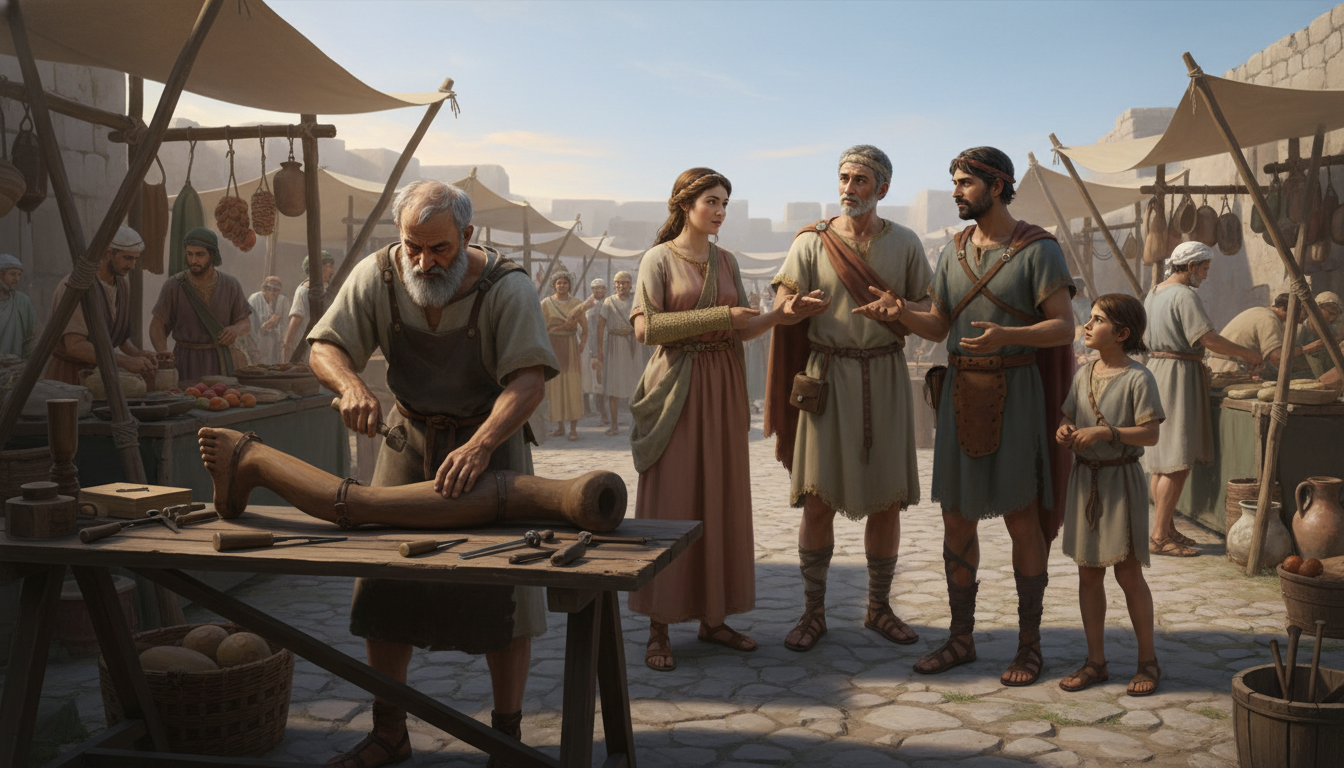
Many think prosthetics are a modern invention. But ancient people used wood, leather, metal, and natural glues to make them. They were not fancy, but they were practical.
Early prosthetics were not just for looks. They helped people walk, work, and feel proud in public. In a world where physical labor was key, a prosthetic could be life-changing.
Katherine Ott, Ph.D., from the Smithsonian Institution, points out a mystery. Historians don’t always know if early prosthetics were for function or appearance. Different cultures had different views on what it meant to be whole.
In this article, we’ll explore ancient Egyptian toes, Greek and Roman ideas, and the impact of war. We’ll see how these early efforts led to today’s prosthetics. The story of prosthetics is fascinating and older than you might think.
Key Takeaways
-
Millions of Americans live with limb loss, and the need for prosthetics is growing.
-
Artificial limbs aren’t new; people have tried to replace missing body parts for thousands of years.
-
Early prosthetic devices often used simple materials like wood, leather, and metal.
-
Even uncomfortable prosthetics could restore movement, work ability, and day-to-day independence.
-
Researchers are unsure if some early prosthetics were for function or appearance.
-
The next sections connect ancient experiments to the ideas behind modern prosthetics.
Historical Overview of Prosthetics
Prosthetics aren’t just a “modern invention.” They’ve been around for a long time. They help people work, walk, and live after injuries. Today, prosthetic care is more organized, but the goal remains the same: to help you live your daily life.
This is a story of problem-solving. Materials and skills have changed over time. But the need for function, comfort, and dignity has always been there. We’ll explore this need as we move through history.
Definition and Purpose
A prosthesis is an artificial device that replaces a missing body part. This loss can happen due to trauma, disease, or birth defects. Some prosthetics aim to restore function, while others focus on appearance. Many try to do both.
Getting prosthetic care often involves a team. A physiatrist works with prosthetists, nurses, and therapists. In ancient times, people relied on family, skilled makers, and healers to help them.
Evolution Through Time
The earliest signs of prosthetics come from the ancient Near East, around 3000 BCE. Egypt and Iran show early examples. By the New Kingdom era in Egypt, we see foot-and-toe prosthetics. These were made around 1000 BC and used as early as 950–710 BCE.
Greece and Rome brought prosthetics closer to what we know today. They were made from wood, metal, and leather. The Capua leg from around 300 B.C. in Italy is a notable example. It was made from bronze and wood, held on with leather.
Today, prosthetics are made with advanced technology. They are shaped by hand or created with computer-aided design. Prosthetic specialists continue to ask the same questions as ancient times: What fits? What lasts? What lets you move without pain?
| Time & place | What shows up | Common materials | What it was trying to do | What it hints about support |
|---|---|---|---|---|
| c. 3000 BCE, ancient Near East (Egypt and Iran) | Early evidence of replacement devices | Wood, textiles, leather-like bindings | Basic function and body balance | Local craft knowledge and family assistance |
| c. 1000 BC; 950–710 BCE, Egypt | Wearable toe/foot designs | Carved wood, fitted straps | Walking support plus a natural look in sandals | Skilled makers and ongoing Prosthetic care to keep fit workable |
| Classical Greece and Rome | Heavier “rehabilitation aids” for injury and concealment | Wood, metal, leather | Stability for daily tasks and public life | Craft workshops and community help for repairs and fitting |
| c. 300 B.C., Italy (Capua leg) | Capua leg: bronze with hollowed wood, leather strapping | Bronze, wood, leather | Structured support for walking and standing | A clear need for repeat adjustments—an early echo of Prosthetic rehabilitation |
| Today | Custom sockets and components shaped by hand or CAD | Carbon fiber, titanium, silicone, polymers | Comfort, energy return, and smoother gait | Coordinated teams led by clinicians and prosthetic specialists |
Ancient Egyptian Innovations
Imagine the sand and heat. And then, a small detail changes everything: toes. The oldest Prosthetics come from ancient Egypt. They were made for real bodies, movement, and beliefs about staying whole.
These early prosthetics had different jobs. One was for looks. Another was for daily life. This shows what people needed and valued.
Wooden Toe: The First Prosthesis
The Greville Chester toe is famous. It’s made from cartonnage, a mix of glue, linen, and plaster. It’s about 2,600–3,400 years old. It doesn’t bend, so it’s seen as more for looks than function.
The Cairo toe is made of wood and leather. It’s from around 2,700–3,000 years ago. It shows signs of being adjusted, hinting at comfort and long-term use. This shows an ancient clinic-like mindset.
A wooden-and-leather big toe was found on a mummy near ancient Thebes. It was used, as shown by wear patterns. In 2011, engineers rebuilt it and tested it. This makes these Prosthetics feel like real gear.
Trade and Materials Used
These Prosthetics weren’t made in a vacuum. They used what was available: wood, leather, glue, and plaster-like cartonnage. This shows the creativity of ancient craftspeople.
| Artifact | Main Materials | Movement and Fit | What It Suggests |
|---|---|---|---|
| Greville Chester toe | Cartonnage (glue, linen, plaster) | Rigid; limited flex | Prosthetics designed to restore appearance and body outline |
| Cairo toe | Wood and leather | Flexible; refitted more than once | Innovative prosthetics aimed at walking and daily wear |
| Thebes-area big toe (950–710 BCE) | Wood and leather | Wear marks; tested in sandals and barefoot | Prosthetic solutions shaped by real gait, terrain, and footwear |
There’s another layer. In Egyptian life, being whole tied into ideas of the afterlife. The materials, shaping, and fit were about identity, dignity, and being complete.
Prosthetic Practices in Ancient Greece
In ancient Greece, tools were not just tools. They were part of a big debate about what a body is. The idea of “normal” was not fixed back then, and it’s not now. Greek stories and writings show people trying to match function, dignity, and daily life.
Early prosthetic care is glimpsed, even if it wasn’t called that. Think of straps, padding, and small adjustments that made walking possible. These weren’t sleek devices; they were practical fixes for everyday life.
Philosophical Insights on Disability
Greek thinkers debated what makes a person complete. It wasn’t just about looks; it was about usefulness, independence, and social role. Museum voices like Katherine Ott help us see this. When we look at prosthetic devices, we’re also seeing a culture’s rules about belonging.
So, if you think of Artificial limbs as only medical gear, Greece shows us more. A support could be a disguise, a badge of survival, or a way to stay employed. The quiet side of prosthetic care—repair, refitting, comfort—shows the social pressures.
- Function often mattered more than symmetry.
- Public image could shape which prosthetic devices someone chose.
- Daily upkeep (straps, wear, skin issues) hints at hands-on prosthetic care.
Notable Archaeological Discoveries
Herodotus tells a story you can’t skip. He talks about Hegesistratus, a Greek diviner who cut off his own foot to escape Spartan captors—then used a wooden replacement. It’s like a survival thriller, showing how improvisation could lead to early Artificial limbs.
Later, historical writing shows Greece and Rome as a bridge toward recognizable “rehab aids.” Many prosthetic devices were heavy and crude, made from wood, metal, and leather. They were tied on with thongs or wraps. It’s easy to imagine the real prosthetic care happening after the headlines: sore skin, shifting weight, and constant tinkering.
| What we hear about | What it suggests | What it implies for use and upkeep |
|---|---|---|
| Wooden foot in Herodotus (Hegesistratus) | Urgent problem-solving under pressure | Rough fit, high wear, and basic prosthetic care to keep it usable |
| Materials like wood, metal, and leather | Durable builds made by skilled hands | Weight and friction issues that shape how prosthetic devices were worn |
| Straps, ties, and concealment | A focus on staying mobile and socially accepted | Regular adjustments, repair, and cleaning—practical prosthetic care, day after day |
Roman Contributions to Prosthetic Development
Some Roman-era Prosthetics were real, not just drawings. They were made for people with real needs.
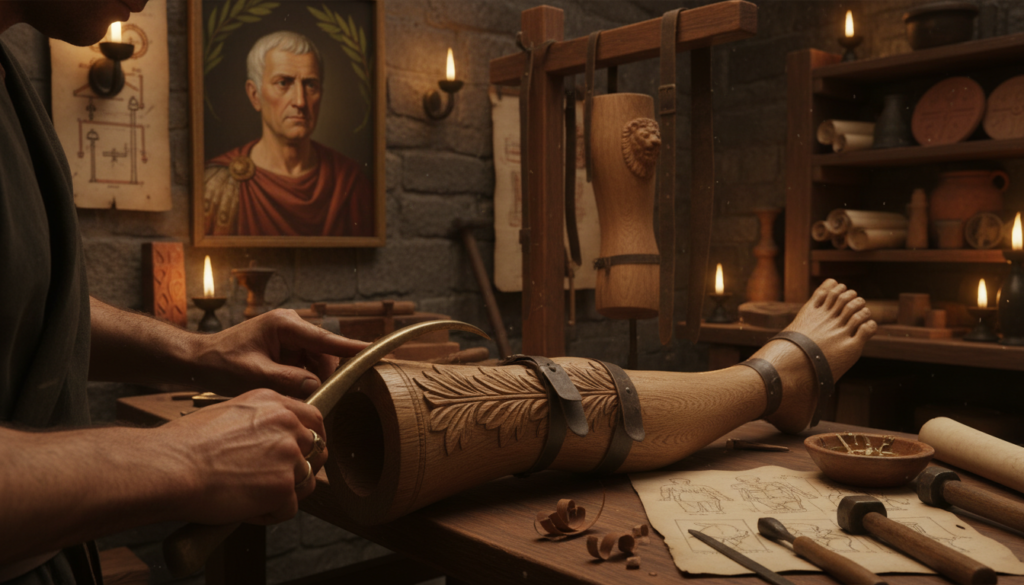
The Capua leg is a great example. It was made around 300 B.C. in Italy. It had a bronze shell and a wood core, held by leather straps. It was made for walking, not just for looks.
Advances in Metal Prosthetics
Romans used metal because it was strong. Bronze and iron were good for withstanding stress. This was important for devices used outside.
War also drove progress. Pliny the Elder wrote about Marcus Sergius, who lost his hand in battle. He got an iron hand to fight again. It shows function was key.
These Prosthetics were made to fit each person. Makers had to adjust them for comfort and balance. It shows early prosthetic specialists were skilled.
Medical Infrastructure to Support Prosthetics
Rome had no modern clinics, but they had skilled makers. You needed metalworkers, leatherworkers, and woodworkers. Plus, someone who knew about comfort and skin.
For soldiers and the elite, there were clear paths. Money, status, and military connections helped. It was like early prosthetic rehab—training and protecting your body.
Today, prosthetic rehab is led by physiatrists. The Roman world was close, with skilled hands and materials ready. They just needed a reason to keep people moving.
| Roman example | Materials used | How it was secured | Likely goal in daily life | What it suggests about support |
|---|---|---|---|---|
| Capua leg (around 300 B.C., Italy) | Bronze shell with hollowed-out wood core | Leather straps and a fitted socket shape | Stability for standing and walking | Skilled fabrication, access to durable materials, and follow-up adjustments |
| Iron hand linked to Marcus Sergius (Second Punic War account) | Iron, shaped for grip and strength | Strapped or fastened to the forearm | Holding a shield and managing equipment | Military-driven demand and makers who could build for specific tasks |
| Everyday repairs and refits (implied by complex builds) | Metal parts, wood, leather, and padding-like layers | Replaced straps, re-shaped contact points | Comfort, reduced rubbing, better balance | A practical culture of maintenance that mirrors prosthetic rehabilitation habits |
Prosthetics in Pre-Columbian Societies
Looking for prosthetics in the pre-Columbian Americas is tricky. We don’t have neat labels like in museums. Instead, we find clues like bones, tool marks, and art.
This search feels like a detective game. We’re not just looking for what was made. We want to know what it was for. Some items might be prosthetics, but they could also be ritual or status symbols.
Archaeological Evidence from the Americas
Archaeologists look for patterns in the past. They check for repeated shapes, signs of repair, and how an object fits with the body in a burial. But, it’s hard to know if something was used daily or just for show.
To figure things out, researchers use many clues at once. It’s like a checklist, not a single proof. This method is important for finding prosthetic devices, as daily use leaves small signs.
| What’s examined | What it can suggest | Why it’s tricky |
|---|---|---|
| Bone changes near a missing limb or damaged joint | Long-term adaptation that may match support from prosthetic devices | Bone can change from many causes, including injury, infection, or aging |
| Wear patterns on wood, fiber, shell, or leather-like materials | Repeated contact points that fit a functional aid, not just display | Organic materials rarely survive, and wear can come from transport or storage |
| Burial placement and associated goods | How a community treated impairment and possible prosthetic care practices | Burials reflect belief and ceremony, not always everyday life |
| Art and iconography in murals, ceramics, and carvings | Social visibility of limb loss and possible Prosthetic solutions | Art can be symbolic, stylized, or tied to myths instead of real bodies |
Cultural Significance of Prosthetics
Prosthetics in ancient societies were more than just tools. They helped people move, look whole, and feel whole. They were about being recognized as whole too.
Even if we don’t have many examples, making prosthetics made sense. Prosthetic care included wrapping, padding, and refitting. These small choices affected comfort and identity.
Beliefs about the body influenced how prosthetics were valued. If a culture linked wholeness to the spirit or afterlife, it shaped how prosthetics were used and buried. This leaves us with clues that are meaningful but hard to read.
Influence of War on Prosthetic Technology
War changes medicine fast. Injuries pile up, and supplies get low. Yet, people need to get back on their feet.
Even before modern labs, fighters used simple fixes. These were made from wood or iron. The goal was to survive the day, not to look good.
Combat Injuries and Innovations
One famous story is Marcus Sergius of Rome. He had an iron hand to stay in the fight. It was a tool, not a decoration.
Ambroise Paré (1510–1590) was a French surgeon. He wrote about artificial limbs in 1579. He focused on making them work, like locking knees and pulleys.
A French captain wore a moving prosthesis in 1551. It helped him ride his horse. This shows the aim was to move, not just to look good.
The Role of Military Medicine
After World War I, prosthetics got better in Great Britain. Military hospitals helped with fitting and repairs. It was about keeping devices working.
In the U.S., the Department of Veterans Affairs helps a lot. They deal with complex injuries. Prosthetic tech must keep up with recovery needs.
Research and care are key at places like the NIH. They show how military needs drive prosthetic progress. Specialists make these advances useful for everyday life.
| Era | What drove demand | What changed in prosthetics | Care setting that supported users |
|---|---|---|---|
| Ancient Mediterranean wars | Close-combat wounds and amputations in active fighters | Simple limbs using wood or iron; practical attachments built for grip and stability | Local makers and healers coordinating basic fitting and upkeep |
| Roman Republic and Empire | Returning soldiers needing durable function | Iconic examples like Marcus Sergius’ iron hand, designed for battlefield readiness | Early medical organization around armies and veteran support networks |
| 16th-century European conflicts | Gunshot injuries and surgical amputation becoming more common | Ambroise Paré’s mechanical concepts: locking knees, pulley-like motion, spring-and-catch hands | Military surgery shaping standards, follow-up, and early prosthetic rehabilitation routines |
| Post–World War I Britain | Large numbers of amputee veterans needing long-term support | Expanded manufacturing; more consistent fitting and repair practices | Military hospitals helping manage fitting, repairs, and training |
| Modern U.S. veteran care | Blast-related polytrauma and complex recovery needs | Cutting-edge prosthetic technology paired with individualized training and adjustment cycles | Department of Veterans Affairs plus NIH programs supporting research and prosthetic specialists |
Craftsmanship in Ancient Prosthetics
Imagine stepping into an ancient workshop. Prosthetics weren’t just picked off a shelf. They were made just for you, fitting your body, shoes, and daily activities perfectly.
Artificial limbs looked like they were made with love, not mass-produced. You can sense the trial-and-error in every detail. From the straps to the fit, every choice was made with care.
Skilled Artisans and Techniques
The makers of these devices were not guessing. They measured, carved, and adjusted with patience. A good fit was key, as a bad fit could be a daily hassle.
The Egyptian “Cairo toe” shows this care. It was refitted many times, showing regular check-ins and adjustments. It’s like saying, “Come back if it’s not right.”
Some prosthetics were even more advanced. The Capua leg combined metal for strength with wood for lightness. It used leather straps for a secure fit. This practical thinking is seen in today’s prosthetics too.
Materials and Tools Employed
Materials were chosen for their local availability and durability. Wood was easy to shape. Leather offered grip and flexibility. Metal added strength where needed.
Even the “invisible” parts were important. Glue held layers together, and plaster smoothed surfaces. When you think of ancient prosthetics, imagine the texture: rough wood, soft edges, and straps that could be tightened.
| Workshop choice | What it was used for | Why it mattered to the wearer | Trade-off artisans had to manage |
|---|---|---|---|
| Wood (often carved and hollowed) | Main body shapes like feet, toes, and leg shells | Lighter weight could make daily movement less tiring | Could wear down, crack, or swell with moisture |
| Leather straps | Fastening systems and fit adjustments | Let you tighten, loosen, and re-seat Prosthetics as your body changed | Could rub skin and needed frequent repair |
| Metal (bronze, iron, copper, steel) | Load-bearing parts, reinforcements, and joints | Added stability for standing and walking | Added weight and could feel cold or unforgiving |
| Glue and plaster-based cartonnage | Bonding layers, smoothing surfaces, shaping coverings | Could reduce sharp edges and improve basic comfort | Could break down with sweat, heat, or repeated stress |
| Simple mechanics (handles, catches, springs; later pulleys and gears) | Grip help and controlled motion in more complex artificial limbs | Made certain tasks possible again, even if motion was limited | More parts meant more friction, noise, and maintenance |
Comfort was always a goal, but early prosthetics were stiff and heavy. Yet, even with these challenges, they helped people get back to their lives. They allowed people to move through the world, even if it was imperfect.
The Legacy of Ancient Prosthetics
Looking at early prosthetics, we see a common goal: to walk, work, and feel whole again. This aim remains unchanged. What’s different is the technology and how well it fits our bodies.
Same mission, new materials. Today, we use plastic, aluminum, titanium, and silicone. We also have snug sockets that help you move better. Back then, people faced tougher challenges with fewer options.
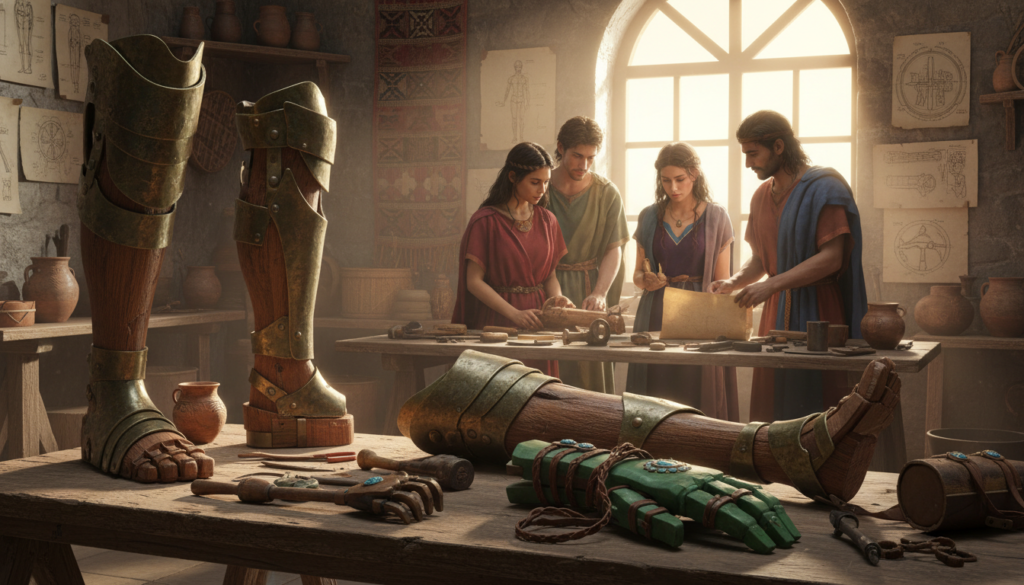
The journey from ancient to modern prosthetics isn’t a big leap. For a long time, prosthetics were made from wood, metal, glue, and leather. Each era made small but important improvements in comfort, balance, and durability.
Lasting Impacts on Modern Prosthetic Design
In Europe, from the late 15th century to the 19th, design thinking evolved. Makers in France and Switzerland created limbs that could move. They used cables, gears, cranks, and springs for control.
| Design Goal | Older Build Choices | Modern Direction | What Stays the Same |
|---|---|---|---|
| Support your weight | Wood frames, metal bands, leather straps | Titanium or aluminum supports with molded plastic shells | Stable stance and safer steps |
| Comfort on the skin | Leather liners, padding, glue-set fits | Silicone interfaces and closer-fitting sockets | Reduce rubbing during daily use |
| Controlled motion | Cables, gears, cranks, springs for bend/rotation | Refined joints and cutting-edge prosthetic technology for smoother control | Reliable movement you can trust |
| Durability over time | Repairable wood and metal parts | Lightweight composites and corrosion-resistant metals | Long wear with fewer breakdowns |
Preservation of Ancient Knowledge
We learn from what’s left behind, like Ambroise Paré’s 1579 book. It shows how design ideas spread and got better.
Archaeology also helps us understand the past. Finds like Egyptian toes and wooden-and-metal feet from Switzerland and Germany show us the journey. They remind us that today’s prosthetics come from a long tradition of solving problems.
Cultural Perspectives on Disability
Early prosthetics show more than just parts and straps. They reveal a culture’s view of a complete body. Prosthetic care was about more than just moving or gripping. It was about fitting in or standing out.
Today, prosthetic specialists talk about confidence and identity. This mix is seen in ancient times too. Historians debate if devices were for function, appearance, or both.
Ancient Attitudes Toward Impairment
In some places, losing a limb was feared for spiritual reasons. People believed a complete body was needed for the afterlife. This belief affected how they lived and died.
Some communities buried limbs to be reunited later. This way, a person could be whole in eternity. Prosthetic care then touched on memory, ritual, and the future.
Variances Across Different Societies
In Egypt, prosthetics showed two sides: rigid and flexible. This choice reflects daily life. It shows the human side of prosthetic care.
Rome valued war and status. Devices like an iron hand for combat show this. The Capua leg also shows access was tied to wealth and connections.
In medieval Europe, prosthetics were for knights and the wealthy. Prosthetic specialists worked within societal rules. This pattern repeats across cultures.
| Society | What “wholeness” tended to mean | Device examples that reflect the culture | Who likely had better access |
|---|---|---|---|
| Ancient Egypt | Appearance and practicality could overlap in daily life | Cartonnage toe for looks; wooden/leather toe designed for wear and refits | People with resources for skilled fitting and upkeep |
| Ancient Rome | Function tied to military identity and public status | Iron hand built to hold a shield; the Capua leg with high-end construction | Elites and soldiers supported by wealth or the state |
| Medieval Europe | Honor, rank, and usefulness shaped how impairment was viewed | Simple battle-ready devices for knights; costly daily aids for home life | Wealthy households and high-status fighters |
Case Studies of Famous Ancient Prosthetics
Looking closely at famous finds, Prosthetics become personal. Imagine walking to market or climbing steps. These early limbs were practical, made from what people had.
Notable Examples and Their Stories
In Egypt, the Greville Chester toe is famous. It’s made from cartonnage and dates back 2,600–3,400 years. It looks real but didn’t bend, suggesting it was for looks more than use.
The Cairo toe is another example. It’s a mix of wood and leather from 2,700–3,000 years ago. It was refitted many times, showing it was made for walking.
Near Thebes, a big toe from 950–710 BCE shows wear. It was made of wood and leather. These finds show how prosthetics fit with sandals and skin.
In Italy, the Capua leg dates back to 300 B.C. It’s made of bronze, wood, and leather. It shows how different materials were used for support.
War stories also highlight prosthetics. Marcus Sergius had an iron hand for a shield. Hegesistratus lost a foot but got a wooden one to escape. These stories mix survival with prosthetics.
| Artifact | Place and date | Materials | Clues about use | Why it matters |
|---|---|---|---|---|
| Greville Chester toe | Egypt; ~2,600–3,400 years old | Cartonnage (glue, linen, plaster) | Didn’t bend; may have favored appearance | Shows how prosthetic devices could also signal identity and status |
| Cairo toe | Egypt; ~2,700–3,000 years old | Wood and leather | Flexible; refitted multiple times for comfort | Suggests a long-term user focus in early artificial limbs |
| Big toe near Thebes | Egypt; 950–710 BCE | Wood and leather | Wear marks consistent with repeated use | Adds everyday-life evidence to the story of Prosthetics |
| Capua leg | Italy; ~300 B.C. | Bronze, hollowed wood, leather straps | Engineered structure for support and fit | Highlights durability choices in ancient prosthetic devices |
| Marcus Sergius’ iron hand | Roman world; Second Punic War era | Iron | Designed to hold a shield in combat | Shows purpose-built artificial limbs for specific tasks |
| Hegesistratus’ wooden foot (Herodotus) | Greek world; told in historical accounts | Wood | Replacement after a dramatic escape | Captures how Prosthetics entered legend and memory |
Significance of Findings in Modern Research
Today, labs study if these designs could work. A 2011 study on an Egyptian toe used biomechanics. It tested how it worked barefoot and with sandals.
We also ask today: what works, for whom, and at what cost? In 2020, the NIH and the U.S. Department of Defense started a registry. It tracks limb loss, costs, and treatment outcomes. It’s a modern way to understand artificial limbs, using data instead of old materials.
Technological Challenges of Ancient Prosthetics
Looking at early artificial limbs, we see a struggle. People wanted prosthetics that worked every day. But they faced limits in what they could make and afford.
Prosthetic care was mostly hands-on. So, every small problem mattered a lot.
Innovative prosthetics were clever but often uncomfortable. This made them hard to use for long periods. This issue affected how often and by whom these devices were used.
Limitations Faced by Ancient Societies
The materials were basic: wood, leather, iron or bronze, glue, and plaster. No plastics or modern materials were available. This caused problems like weight, heat, and rubbing.
Control systems were also a challenge. Simple hinges and straps worked for basic motions. But more complex devices needed manual adjustments. Imagine a hand that had to be cranked to close.
| Challenge | What it looked like in practice | How it shaped daily use |
|---|---|---|
| Material limits | Wood and leather swelling with moisture; iron or bronze adding weight; glue joints loosening; cartonnage cracking under stress | More repairs, shorter wear time, and fewer options for fine fit |
| Comfort and skin stress | Hard edges, pressure points, sweat buildup, and rubbing where straps met skin | People rotated wear time, padded with cloth, or saved devices for key moments |
| Simple control | Straps, hooks, and basic joints; some mechanisms needing hand-powered adjustment | Better for steady tasks than quick, natural movement |
| Maintenance reality | Frequent tightening, re-lacing, re-gluing, and reshaping by craftsmen | Prosthetic care depended on local skill and steady access to materials |
Resource Accessibility and Distribution
Access to prosthetics was not equal. In many places, only the wealthy could afford advanced devices. For others, simpler designs were more common.
Distribution followed power and need. In times of war, prosthetic care expanded. But in peace, it often shrunk back.
Conclusion: Lessons from the Past
Ancient prosthetics don’t seem old when you think about it. The Egyptian toe and early Roman limbs show a battle between function and looks. They also show our need to feel complete.
This battle is the same today, even with new materials. It shows the heart of modern prosthetic technology.
Iteration is key. The Cairo toe was updated many times. This teaches us that comfort and fit are everything.
This idea is true in prosthetic rehabilitation too. Small changes can greatly improve how you move and feel.
Insights for Modern Prosthetic Innovation
War has always pushed prosthetic technology forward. From Roman times to today, it has driven innovation. At Walter Reed National Military Medical Center, veterans get prosthetics made from advanced materials.
These prosthetics are designed to look and feel natural. They show that prosthetic specialists aim for more than just strength. They want to help people feel whole again.
The Future of Prosthetic Technology
NIH-funded research is leading the way in prosthetics. It’s using robotics, 3D printing, AI, and more. This work aims to make prosthetics more natural and easier to use.
At Vanderbilt University, a robotic leg prosthesis is being developed. It has powered joints and can predict your movements. This is the kind of technology that makes the past seem like a guide.
In the United States, prosthetic care is becoming more common. Limb loss affects millions, and the number is growing. This shows that the long history of prosthetics is important.
It teaches us that people and specialists keep working together. They have been for centuries, trying to improve prosthetics.
FAQ
Why does the history of prosthetics matter to you right now?
What’s a prosthesis, in plain terms?
Were prosthetics “modern tech,” or have people used them for a long time?
Were the earliest prosthetics built for function or appearance?
What are the oldest known prosthetics?
What is the Greville Chester toe, and why is it important?
What is the Cairo toe, and why do experts call it “practical”?
Is there proof ancient Egyptian toe prostheses were actually used for walking?
When does the timeline of prosthetics begin, based on evidence?
What did ancient Greece and Rome add to prosthetic rehabilitation?
What’s the story of Hegesistratus and the wooden foot?
What is the Capua leg, and what does it reveal about ancient design?
Did the Romans use metal prosthetics in warfare?
Did ancient societies have anything like today’s prosthetic specialists and rehab teams?
What do we know about prosthetics in pre-Columbian societies of the Americas?
Why is it so hard to interpret early prosthetic devices?
Did spirituality influence early prosthetics?
What materials did ancient prosthetics use?
Were early prosthetics comfortable?
How did war shape the evolution of prosthetics over time?
Who was Ambroise Paré, and why does he matter in prosthetics history?
How did military medicine change prosthetic access in the modern era?
What role does the NIH play in prosthetic research and rehabilitation today?
How were ancient prosthetics actually made and fitted?
What’s the big “then vs. now” shift in how prostheses are built?
What materials are common in modern prosthetic devices?
What kinds of cutting-edge prosthetic technology are being explored now?
Can you give a real example of a modern “smart” prosthetic?
How does modern research track what works in limb loss care?
What’s the biggest lesson ancient prosthetics leave for modern prosthetic specialists?
Get More Medical History
Join our newsletter for fascinating stories from medical history delivered to your inbox weekly.