The History of Healing
 Robert Koch and the Golden Age of Bacteriology
Explore the legacy of Robert Koch, a pioneering microbiologist who shaped the Golden Age of Bacteriology and advanced our understanding of disease.

In 1900, tuberculosis killed about 1 in 7 people in the United States and Europe. This was a huge problem that scared everyone. It made doctors and lab workers want to find out what caused it.
From about 1870 to 1900, bacteriology changed fast. Cities grew, and outbreaks spread. People stopped believing in “bad air” as the cause.
Robert Koch was a key figure in this time. He wasn’t just famous for his work. He made germ hunting a repeatable process. His work on anthrax in the 1870s showed that one microbe could cause one disease.
There were important dates in this story. On March 24, 1882, Robert Koch found the tuberculosis bacillus in Berlin. Two years later, in 1884, he found the cholera organism, now called Vibrio cholerae.
We’re not just looking at old facts. We’re diving into real problems and challenges. You’ll see how bacteriology became a hands-on field. It was all about hard work and determination during the Golden Age of Bacteriology.
Key Takeaways
- The Golden Age of Bacteriology (about 1870–1900) reshaped how people understood infectious disease.
- Robert Koch helped make bacteriology reliable by pushing pure-culture methods forward.
- Koch’s early anthrax studies in the 1870s set the stage for linking germs to specific illnesses.
- On March 24, 1882, Robert Koch announced the tuberculosis bacillus in Berlin.
- In 1884, Koch reported the cholera organism later named Vibrio cholerae.
- This story centers on real-world outbreaks, lab obstacles, and competing research—not just theory.
Introduction to Robert Koch
Have you ever wondered who Robert Koch was? He was a German doctor and scientist (1843–1910). He lived when medicine was just starting to rely on proof. His work was all about finding out what made people sick.
He was known for his practical thinking. He wanted answers that could be tested and trusted. This mindset was clear from the start of his career.
Early Life and Education
Robert Koch studied in a time when chemistry and medicine were merging. At the University of Göttingen, he learned to value clear evidence. It was all about showing your work, not just talking about it.
His education was shaped by great minds. Rudolf Henle taught him about disease agents. Georg Meissner, Friedrich Wöhler, and Wilhelm Krause added to his knowledge of physiology, chemistry, and anatomy. These subjects helped Koch in his detailed research.
Career Beginnings
Before he was famous, Koch worked as a country doctor. It was a tough job, but it taught him a lot. He saw infections up close and learned about their patterns.
The Franco-Prussian War (1870–1871) also shaped him. In war medicine, speed and accuracy are key. This experience made him focus on real-world disease problems.
Influences and Inspirations
The University of Göttingen taught Koch to think critically. He approached medical mysteries by observing and testing. Rudolf Henle’s ideas about disease agents inspired him to use better methods.
Here’s a quick look at the big influences that shaped his early direction and helped make his scientific research feel so grounded:
| Influence | What you can take from it | How it shows up in Koch’s approach |
|---|---|---|
| Rudolf Henle | Push for clear causes of disease, not guesswork | Hunt for specific agents and demand proof you can repeat |
| Georg Meissner | Strong physiology mindset (how bodies function under stress) | Connect symptoms to measurable biological changes |
| Friedrich Wöhler | Chemistry as a practical tool for medicine | Bring lab discipline into everyday medical questions |
| Wilhelm Krause | Detailed anatomy and microscopic structure | Careful observation and attention to what’s actually visible |
Robert Koch was shaped by patients, war, and the University of Göttingen’s emphasis on evidence. This mix made him treat disease like a case that needed solving.
The Foundations of Bacteriology
Looking into medical history, bacteriology is like a detective story. It’s about finding tiny suspects and using lab steps to prove their role. This made the germ theory of disease seem like solid evidence.
In the late 1800s, things were moving fast. Louis Pasteur and Joseph Lister were already working on contamination and disinfection. This made it possible to pinpoint which organism was causing a disease.
Defining Bacteriology
Bacteriology is all about studying bacteria and how to handle them. It involves isolating them, growing them, and keeping them separate. Keeping samples clean is key to getting accurate results.
From 1870 to 1900, the field grew quickly with better tools. In just thirty years, scientists linked 20 bacterial pathogens to major diseases. This made the germ theory of disease seem more real and less mysterious.
| What you’re trying to prove | What has to happen in the lab | Why it matters for germ theory of disease |
|---|---|---|
| A single microbe is linked to a single illness | Find the organism in diseased material and keep the sample uncontaminated | Moves the idea from “bad air” and luck to a specific, testable cause |
| You’re studying the right culprit, not a crowd | Isolate one type of organism and maintain it as a pure culture | Lets bacteriology compare “one suspect at a time” instead of a messy mix |
| The organism behaves the same way each time | Grow it under repeatable conditions and observe consistent traits | Gives a microbiologist a dependable pattern to check across cases |
Koch’s Contribution to Microbiology
Robert Koch made pure culture work practical and repeatable. His work on anthrax in the 1870s showed how careful isolation could pinpoint a target. This made microbiology feel more like a controlled test.
With the ability to grow microorganisms in pure culture, the detective work got sharper. It became clear that one specific organism could cause one specific disease. This changed what counted as proof in bacteriology, giving microbiologists a stronger case.
The Discovery of Pathogenic Bacteria
Think of this stretch of medical history as three case files you can flip through fast: one on farm animals, one on Tuberculosis, and one on waterborne chaos. Robert Koch didn’t just “find germs.” He showed you how to prove which microbe caused which disease, again and again, in a way other labs could copy.
The pattern matters. See it once, and you start spotting it everywhere: collect a specimen, isolate the suspect, grow it clean, then match it back to the disease. That mindset reshaped how people argued about illness—whether the culprit was Mycobacterium tuberculosis in the lungs or Vibrio cholerae in the gut.
Identifying Bacillus anthracis
After the Franco-Prussian War, Robert Koch was back in civilian life and staring down anthrax in livestock. Farmers didn’t need theory; they needed answers. Koch tracked the anthrax bacillus in sick animals and tied it to the disease with clean, repeatable steps, not hand-waving.
His bigger win was method. In 1881 he published a paper that laid out how to study organisms in pure cultures using his plate technique. People called it the “bible of bacteriology” because it gave labs a simple rule: if you can grow a microbe in pure culture, you can test cause and effect with real confidence.
Discovering Mycobacterium tuberculosis
By the 1880s, Tuberculosis was ripping through Europe. Roughly one in seven deaths was linked to it, and plenty of infected people looked fine—until they didn’t. It had scary old names, too: the Greeks around Hippocrates called it phthisis (“wasting away”), and English speakers knew it as “consumption” or the White Death.
Before Koch, smart people argued over what “tuberculosis” even meant. Rudolf Virchow thought it might be several diseases under one label. René Laennec pushed back, saying it was one process that could hit different organs. Then in 1865, Jean Antoine Villemin passed the disease to experimental animals, which screamed “infectious”—but the exact cause stayed out of reach.
Robert Koch started his grind in August 1881, using pathological material from Berlin’s Charité Hospital and building on Villemin’s transmission work. Two problems slowed everything down: the organism was brutally hard to grow, and it didn’t take standard stains. So he got creative—infecting guinea pigs and using a strong alkali-based staining approach until the rods showed up.
That staining fight wasn’t just annoying; it hinted at something real. Mycobacterium tuberculosis had unusual cell wall traits that made it behave differently from the bacteria people knew. Koch kept checking: he found it in every TB specimen he studied, saw counts rise as disease worsened, and watched them drop as recovery set in.
Culture was the next wall. Coagulated blood serum worked, but colonies took weeks to appear. From those pure cultures, he inoculated guinea pigs; they developed tuberculosis that matched the human pattern in symptoms and pathology. On March 24, 1882, less than eight months after starting, he presented the tubercle bacillus to the Berlin Physiological Society.
The Significance of Vibrio cholerae
Cholera raised the stakes in a different way: speed. The disease had been endemic in India for centuries, reached Europe in 1831, and by 1875 it had already been tied to four major pandemics. Koch had watched its ugly rhythm during the European epidemic years from 1866 to 1875, so he knew what was coming when Egypt flared in 1883.
The response turned into international competition. A French commission working under Pasteur’s auspices—led by Pierre-Paul-Émile Roux and Louis Thuillier—arrived in Alexandria in mid-1883. Germany sent its own group with Robert Koch in charge, landing in August 1883. During the Egyptian epidemic, roughly 60,000 to 100,000 people died, and Thuillier was among them; Koch attended his funeral despite his personal dislike for Pasteur and the French camp.
There was a practical snag: the German team arrived after the peak, so good specimens were scarce. Koch headed to India in December 1883, and there the evidence came in hot. With fresh material he could see the “comma bacillus” clearly—curved, easy to spot among intestinal organisms—and he grew it in pure culture quickly.
In February 1884 he reported isolating Vibrio cholerae. Pasteur and others doubted him because Koch couldn’t reliably reproduce cholera in animals. Yet, the argument kept circling back to hard facts: the organism’s steady presence during cholera outbreaks, plus tight epidemiology, pushed the “comma bacillus” into the role of cause.
| Case file | What Koch needed to show | Big obstacle in the lab | Clue you could actually see | What made it persuasive at the time |
|---|---|---|---|---|
| Anthrax (Bacillus anthracis) | That one specific bacillus matched one specific animal disease | Getting a pure culture that stayed uncontaminated | Distinct bacilli linked to sick livestock samples | A repeatable plate method that other labs could copy from his 1881 work |
| Tuberculosis (Mycobacterium tuberculosis) | That a single organism explained Tuberculosis across cases and severity | Slow growth and stubborn staining | Rod-shaped bacteria revealed with strong alkali staining | Consistent finding in specimens, plus guinea pig infection from pure culture |
| Cholera (Vibrio cholerae) | That a consistent “suspect” appeared during epidemics and could be isolated | Specimen timing and the failure to reproduce disease in animals | Curved, comma-shaped cells among intestinal microbes | Pure culture plus epidemiology and invariable presence in outbreak material |
Koch’s Postulates Explained
Koch’s postulates are like a checklist for proving who did it. They were key in the early days of bacteriology. They helped turn the germ theory of disease into something you could test.
They also helped understand disease better. You could gather evidence step by step. This way, you could see if the same suspect kept showing up.
The Four Steps of Koch’s Postulates
Koch used these steps to study tuberculosis. He aimed to make lab results clear, not to win debates.
- Find the same microbe in the sick: Koch looked for a consistent organism tied to the disease, not random “germs” that showed up sometimes.
- Isolate it and grow a pure culture: He separated the suspect organism and grew it on its own, so the test didn’t get muddied by a mix of microbes.
- Cause the disease on purpose: Koch inoculated guinea pigs with material from the pure culture and watched for tuberculosis to develop.
- Re-isolate and match it: From the newly sick guinea pigs, he recovered the same organism again, tying the chain of cause and effect into a loop.
The guinea pig step was controlled. Animals inoculated with pure-culture material developed TB. This TB looked like what doctors saw in human patients.
| Checklist step | What it checks | Why it reduced doubt |
|---|---|---|
| Same organism found in disease | Consistency across cases and tissues | Pushes you away from coincidence and toward pattern |
| Pure culture grown | One suspect at a time | Rules out “it was the mix” as an excuse |
| Inoculation into guinea pigs | Reproducible illness with clear signs | Shows the organism can start the disease process |
| Re-isolation and match | Same organism returns after illness | Closes the loop so cause isn’t just assumed |
Importance in Disease Etiology
Koch’s postulates were a big deal. They gave researchers a way to connect one organism to one illness. This is what disease etiology needs: a clear trail, not a hunch.
Because of these postulates, the germ theory of disease became something you could demonstrate in a lab. This changed what “proof” looked like in medicine. It also changed the questions you could ask next.
Innovations in Laboratory Techniques
Koch didn’t win in bacteriology by guessing. He won by building better lab moves—simple, repeatable steps you could trust. If you’ve ever wondered what a microbiologist really does, this is it: turn messy samples into clean proof, one tool at a time.
Pure culture was the superpower. During his anthrax work in the 1870s, Koch pushed hard on methods that kept one microbe separated from the crowd. In 1881, he published a methods paper with the plate technique, and it spread fast through scientific research like a must-have recipe.
The Use of Agar in Cultivation
To make pure culture routine, labs needed solid surfaces that didn’t melt or turn to soup. That’s where agar-based media fit into the bigger shift toward reliable solid media. The goal wasn’t fancy equipment; it was control. You wanted isolated colonies you could pick up, move, and test again.
This was a major quality jump for bacteriology because it made results easier to repeat across labs. It also changed the daily rhythm of scientific research: pour plates, incubate, check for growth, then repeat until the culture stayed consistent.
Even with better solid media, tuberculosis was a grind. Koch tried multiple nutrient setups and got growth when he added coagulated blood serum. The catch? Colonies needed weeks of incubation, which forced patience into the workflow of any microbiologist chasing that organism.
| Lab problem you’re trying to solve | Koch-era technique that helped | What you could actually see or measure | Why it mattered in scientific research |
|---|---|---|---|
| Mixed microbes in the same sample | Plate technique and careful transfers toward pure culture | Separated colonies with distinct shapes and edges | Let different labs repeat tests on the same organism |
| Media that wouldn’t stay solid during incubation | Shift toward solid culture media, including agar-based plates | Stable surface for colony isolation and counting | Made everyday bacteriology more consistent and less luck-based |
| Slow-growing tuberculosis that “refused” to show up | Coagulated blood serum and long incubation schedules | Delayed, small colonies after weeks, not days | Forced tighter controls so a microbiologist didn’t confuse contamination with real growth |
Staining Techniques Developed by Koch
Now for the part that sounds easy, but wasn’t: seeing the germ. Tuberculosis resisted the standard stains of the day, so it could hide in plain sight. That meant a slide could look “clean” even when it wasn’t.
Koch’s workaround used a harsher approach, including strong alkali solutions, to push stain into stubborn cells. Once it worked, rod-shaped bacteria became visible in infectious material. For bacteriology, that was a big deal, because you could now point to a shape, not just a hunch.
There was a weird bonus here, too. The staining struggle hinted that tuberculosis had unusual cell wall traits, unlike many bacteria people already knew. So even before modern chemistry, careful scientific research was already whispering: this organism plays by different rules.
Koch’s Influence on Public Health
Koch didn’t just win in the lab; he changed what health officials could do in real life. Finding one cause over and over changed everything. The Germ theory of disease became a clear guide.
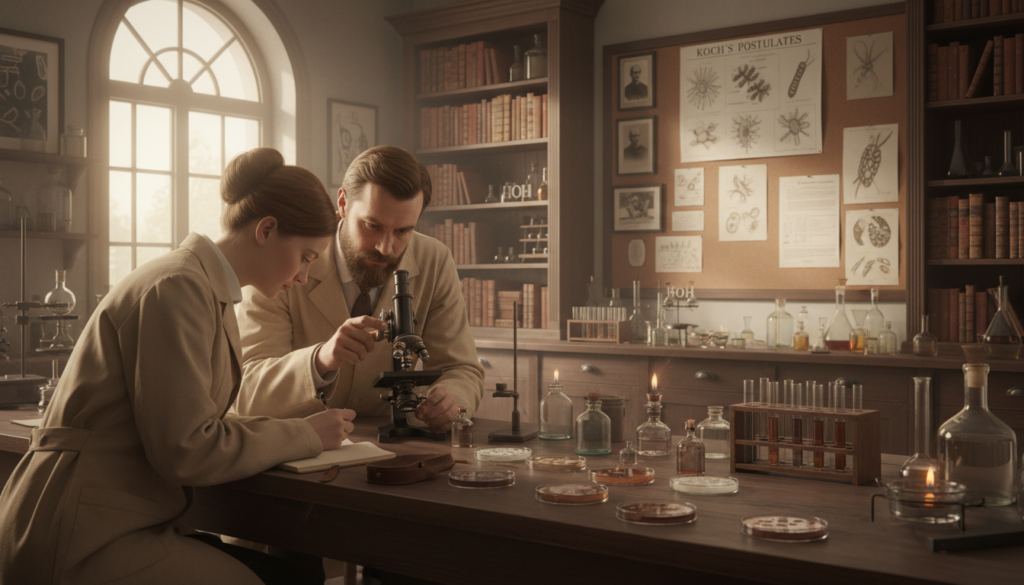
Outbreaks didn’t wait for perfect answers. People wanted safer water, cleaner hospitals, and fewer funerals. Koch’s method turned fear into practical steps to prevent disease.
Impact on Disease Prevention
In the 1880s, Tuberculosis killed about one in seven people in Europe. It didn’t always look serious at first. Some carried the infection quietly, making daily life risky.
Koch found the bacteria behind Tuberculosis. This gave public health a clear target. Find the source, reduce exposure, and watch for signs of spread.
Cholera showed the same pattern, but faster and louder. Koch linked it to a specific bacillus. This helped officials focus on containment, not blame.
| Public health problem | What Koch’s evidence clarified | How that shaped disease prevention |
|---|---|---|
| Tuberculosis in crowded cities | A single, identifiable germ tied to consistent lab findings | More attention to isolation practices, ventilation, and tracking suspected spread |
| Cholera outbreaks | A specific bacterium linked to patterns of transmission | More focus on water safety measures and rapid containment steps during flare-ups |
| Hospital and wound infections | Infection could be driven by microbes, not “bad air” alone | Stronger case for disinfection routines already gaining ground through Joseph Lister |
Establishing Germ Theory
It wasn’t happening in a vacuum. Louis Pasteur had already pushed hard on microbes and wound sepsis. Lister’s disinfection techniques were proving their worth in surgery. Koch added something public health teams love: repeatable proof that held up under pressure.
That’s how the Germ theory of disease became usable at scale. It’s not just a big idea, but a daily habit. Collect evidence, identify the organism, and respond with steps that match the threat. And with Tuberculosis, every improvement felt urgent, because so much spread could happen before anyone even looked sick.
The Role of the Pasteur-Koch Rivalry
Imagine two top labs on opposite sides of Europe, racing to find invisible foes. Louis Pasteur in Paris was a buzz, while Robert Koch in Germany was tough. Their rivalry wasn’t just about pride. It changed how science was done, argued, and believed.
When cholera hit Egypt in 1883, it was more than a scientific battle. It was urgent, public, and deadly.
Key Differences and Approaches
Pasteur’s team focused on stopping outbreaks. A French team, led by Pierre-Paul-Émile Roux, went to Alexandria in 1883. Louis Thuillier was with him, showing Pasteur’s style: bold and practical.
Koch arrived in August 1883 with a German team. Everyone knew it was a competition. Koch was strict and methodical, famous for Koch’s postulates.
Koch wanted clear proof and repeatable results. Pasteur’s team wanted fast help, even without all the proof.
Collaborative and Competitive Dynamics
The Egyptian epidemic was harsh, with 60,000 to 100,000 deaths. Yet, the rivalry didn’t stop humanity. When Thuillier died, Koch went to his funeral. He didn’t hide his dislike for Pasteur but showed respect for the loss.
Back in Europe, the debate was about proof. In February 1884, Koch said he found the cholera organism. But Pasteur and others were skeptical. One reason was Koch couldn’t make cholera in animals, a problem with Koch’s postulates.
But the story didn’t stop. The organism kept showing up in outbreaks. This mix of lab and field findings drove science forward, even with the rivalry.
| 1883–1884 Rivalry Moment | French Commission (Pasteur’s Network) | German Commission (Koch’s Team) | Why It Mattered for scientific research |
|---|---|---|---|
| Alexandria mission launch | Sent mid-1883 under Louis Pasteur’s auspices | Arrived August 1883 after being sent by the German government | Made outbreak work feel like parallel missions, not a shared project |
| Key people in the field | Pierre-Paul-Émile Roux and Louis Thuillier | Robert Koch leading the commission | Put recognizable faces on competing methods and standards |
| Human cost inside the labs | Thuillier died during the epidemic work | Koch attended the funeral despite personal tension | Showed rivalry didn’t erase respect for sacrifice and risk |
| Proof and pushback (Feb. 1884) | Skepticism when animal reproduction failed | Claimed isolation of the cholera organism | Raised a public debate over what counts as “enough” evidence beyond Koch’s postulates |
Later Research and Contributions
After finding tuberculosis on March 24, 1882, and studying cholera in 1883–1884, Koch changed his ways. He focused on method first, then on claims. This approach helped make bacteriology a science based on evidence, not guesses.
In the years after 1876, labs in Europe quickly identified many pathogens. Koch’s work on pure cultures made this easier. This led to more organized scientific research, like what’s done today at places like the Koch Institute.
Studies on Typhoid Fever
Typhoid fever was a big concern in the late 1800s. It spread fast and caused scary outbreaks. Koch’s careful methods were as important as his findings.
He would isolate, grow, and study the germ. This approach helped make bacteriology a shared science. It kept research grounded, even during outbreaks when everyone wanted answers fast.
Advancements in Vaccine Development
When diseases were linked to specific germs, prevention became a focus. The same methods used to find germs also helped develop vaccines. It was a slow, step-by-step process.
Koch’s work laid the foundation for modern labs. His research helped make bacteriology a practical field. His name is now linked to institutions like the Koch Institute, showing his lasting impact.
| Late-Stage Focus | What You’d See in the Lab | Why It Mattered for Public Health |
|---|---|---|
| Linking a suspected cause to a specific disease pattern | Careful sampling, isolation attempts, and repeated culture checks | Helped health officials argue from evidence when deciding what to control |
| Refining pure culture habits | Clean growth on solid media, consistent colony appearance, and contamination control | Made results more repeatable across cities and countries during outbreaks |
| Turning identification into prevention | Comparing strains, tracking how immune responses might be triggered, and measuring safety signals | Supported the wider late-19th-century move toward vaccine development without skipping steps |
Awards and Recognition
Robert Koch’s work in modern lab medicine is well-known. He didn’t just get recognition for being famous. His work was tested and proven by others.
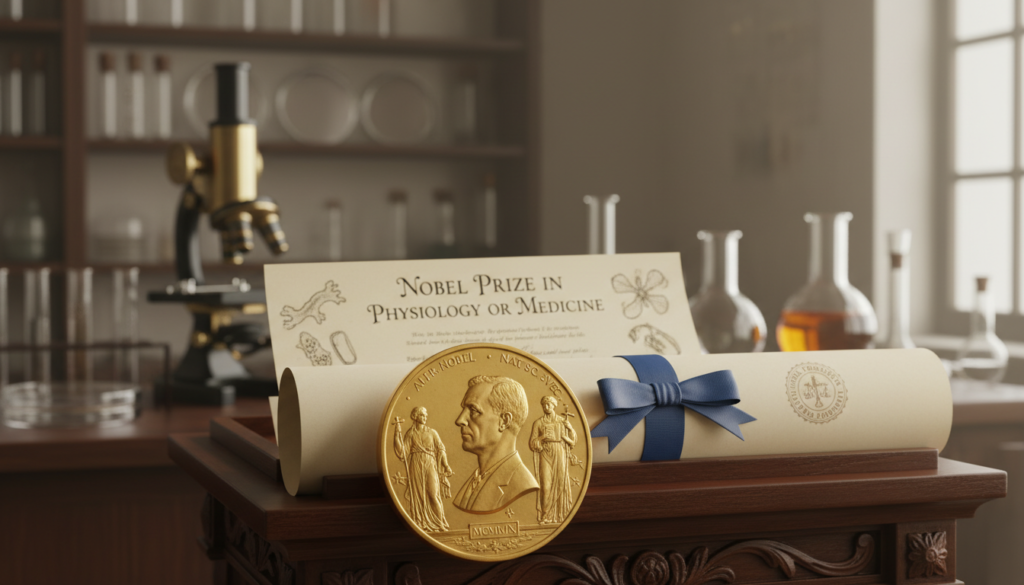
Koch’s fight against Tuberculosis was groundbreaking. He showed how to see and test the disease. This was a big step forward.
The Nobel Prize in Physiology or Medicine
In 1905, Robert Koch won the Nobel Prize in Physiology or Medicine. This award was for his work on Tuberculosis. It was a big moment.
Koch faced many challenges in his research. He used special staining and grew the bacteria on blood serum. This took weeks.
He then tested the bacteria on guinea pigs. On March 24, 1882, he shared his findings in Berlin. This turned Tuberculosis into a disease we could study.
| What Koch did | Why it mattered | What it changed for Tuberculosis research |
|---|---|---|
| Used strong alkali staining to visualize the bacillus | Made the pathogen show up clearly under a microscope | Turned “maybe” cases into observable, testable findings |
| Grew the organism on coagulated blood serum over weeks | Proved it could be cultivated outside the body | Enabled follow-up experiments in many labs, not just his |
| Proved causation through inoculation in guinea pigs | Connected the germ to the disease with direct evidence | Strengthened the case for targeted containment and diagnosis |
| Presented results publicly in Berlin on March 24, 1882 | Put the method and the claim in front of the scientific world | Sped up international work on Tuberculosis control |
Legacy in Science and Medicine
Before the Nobel Prize, Koch changed lab work. His 1881 paper became a key guide. It showed how to get real results.
Koch’s work was meant to be used and verified. His methods for Tuberculosis and cholera were designed for others to follow. This was a big step forward.
With Koch’s discovery, public health could improve. Sanitation and diagnosis became more effective. The Nobel Prize was just the start of his lasting impact.
The Enduring Legacy of Robert Koch
When you step into a lab today, you can feel Robert Koch’s presence. He taught us to isolate, grow, compare, and not settle for “maybe.” This approach turned bacteriology into a science you can test.
His work on anthrax in the 1870s and his 1881 methods paper set the stage. It was a new way to do things.
In the 1880s, tuberculosis was a huge problem in Europe. It killed about one in seven people. Doctors like Rudolf Virchow and Jean-Antoine Villemin were trying to figure out what it was.
Robert Koch used the microscope to prove his point. He showed that tuberculosis could be caused by a specific germ. His work was groundbreaking.
Cholera outbreaks were also a big deal back then. They caused panic and made it hard to keep ports open. Koch’s work helped identify the germ behind cholera, Vibrio cholerae.
This wasn’t just a win for Koch. It was a victory for science in the public eye. It showed how science can solve big problems.
So, why does Koch’s work matter today? It’s because his methods are the foundation of modern microbiology. Scientists follow his steps to find answers and prove their findings.
The Koch Institute carries on his legacy. They follow the evidence and keep looking for the truth. It’s a tradition of excellence in science.
FAQ
What was the “golden age of bacteriology,” and why does it matter to you today?
Who was Robert Koch, in plain English?
Where did Koch learn to think like a disease detective?
How did Koch’s early medical work shape his later breakthroughs?
What does “bacteriology” actually mean?
Why is pure culture such a big deal in bacteriology?
What was happening around Koch—was he working alone in a vacuum?
What did Koch prove with anthrax (Bacillus anthracis)?
Why was tuberculosis such a dramatic case in Koch’s time?
Before Koch, what did scientists argue about tuberculosis?
What problems made Mycobacterium tuberculosis so hard to identify?
How did Koch actually isolate the tuberculosis bacillus?
How did Koch manage to grow the TB organism if it was so stubborn?
What happened on March 24, 1882 in Berlin?
Why was cholera a high-stakes target for Koch?
What was the Pasteur-Koch rivalry during the 1883 cholera outbreak?
How deadly was the Egyptian cholera epidemic, and what human moment cut through the rivalry?
Why did Koch go from Egypt to India in late 1883?
What did Koch report about the cholera organism in 1884?
Why did Pasteur and others doubt Koch’s cholera claim at first?
What are Koch’s postulates, and why should you care?
How did Koch’s tuberculosis work demonstrate Koch’s postulates in action?
What lab tools made Koch’s breakthroughs possible?
Where does agar fit into this story?
How did Koch’s discoveries change public health, not just lab science?
How did Koch help “lock in” germ theory of disease?
What did Koch do after anthrax, tuberculosis, and cholera?
What major award did Robert Koch receive, and for what?
Why is Koch’s 1881 methods paper sometimes called the “bible of bacteriology”?
How does Koch’s legacy show up in modern microbiology and research culture?
Get More Medical History
Join our newsletter for fascinating stories from medical history delivered to your inbox weekly.