The History of Healing
 Unlock the Mysteries of Temple Medicine
Discover spiritual healing in ancient cultures through sacred rituals, herbal remedies, and timeless practices that restored balance to mind, body, and spirit.

Did you know over 80% of the world’s people use traditional healing? The World Health Organization says so. This isn’t a small group — it’s most of us. And these practices go back thousands of years to sacred temples.
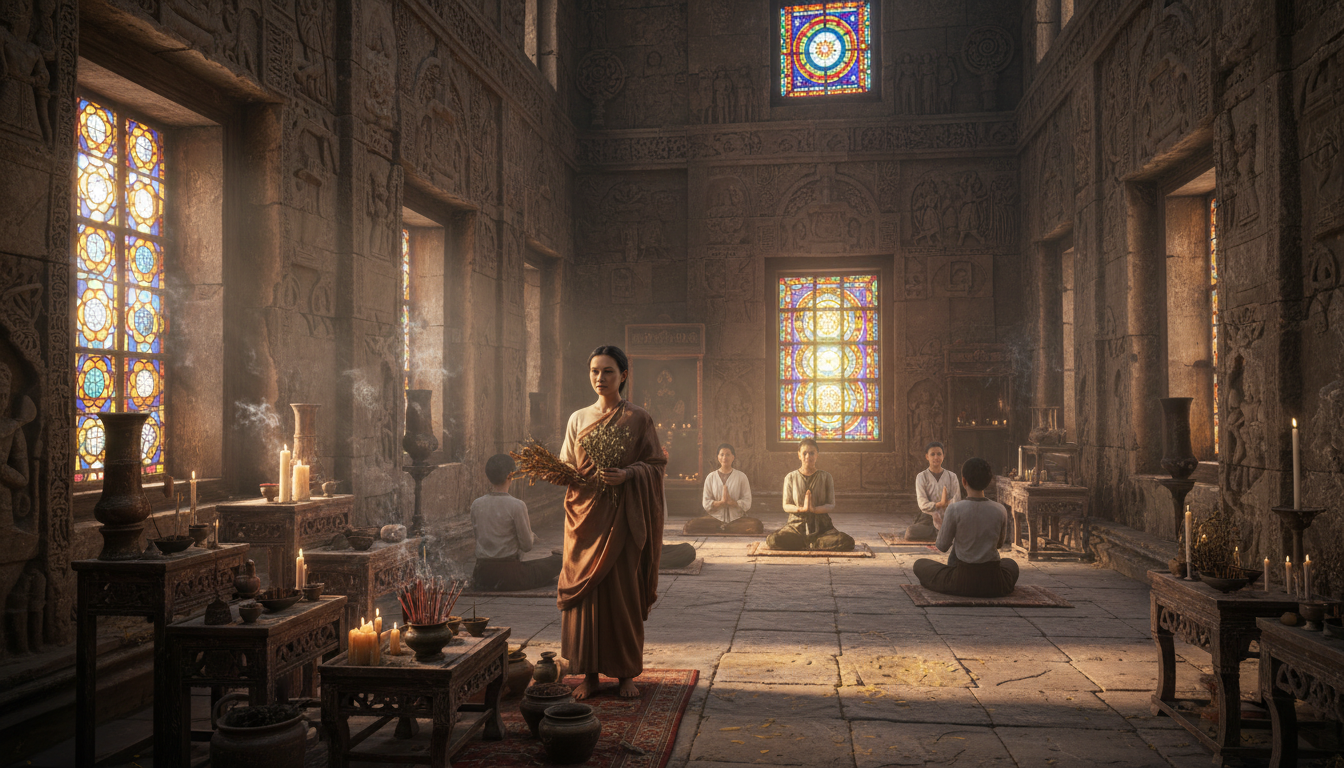
In ancient Egypt, Greece, India, and China, temples were key. So were indigenous communities in Africa and the Americas. They all found the same truth: healing the body means healing the mind and spirit too.
Ancient healing wasn’t just random. It was based on deep understanding and practice. Herbert Benson, Deepak Chopra, and Andrew Weil have studied this for years. They found that ancient healers were right on.
These ancient practices were not just guesses. They were systems that worked for generations. Todd Pesek said they came from a basic need for health and happiness.
Today, many people are exploring these ancient ways. They try acupuncture, Ayurveda, herbal medicine, and fasting. But they often feel like something is missing. That something is the spiritual part of healing.
We’re going to explore how these ancient healing systems worked. We’ll see why they’re coming back and what they can teach us. This journey is deep, but it’s worth it.
Key Takeaways
- Spiritual healing in ancient cultures was practiced across every major civilization, from Egypt and Greece to China and the Americas.
- Ancient spiritual healing practices were not random rituals — they were structured systems developed through centuries of observation and experience.
- The core principle connecting all temple medicine traditions is the unity of body, mind, and spirit in the healing process.
- Spiritual wellness in history evolved as a direct response to humanity’s basic need for health and survival.
- Modern holistic healing journeys — through acupuncture, Ayurveda, herbalism, and fasting — often lead back to the same spiritual foundations ancient healers championed.
- Temple medicine is making a comeback as more people recognize that physical treatments alone don’t address the whole person.
What is Temple Medicine?
Thousands of years ago, people went to temples to get healed. These were sacred spaces where priests and healers used herbs and trance states to treat the sick. It’s pretty wild, right? Let’s explore what temple medicine was and where it started.
Definition and Origins
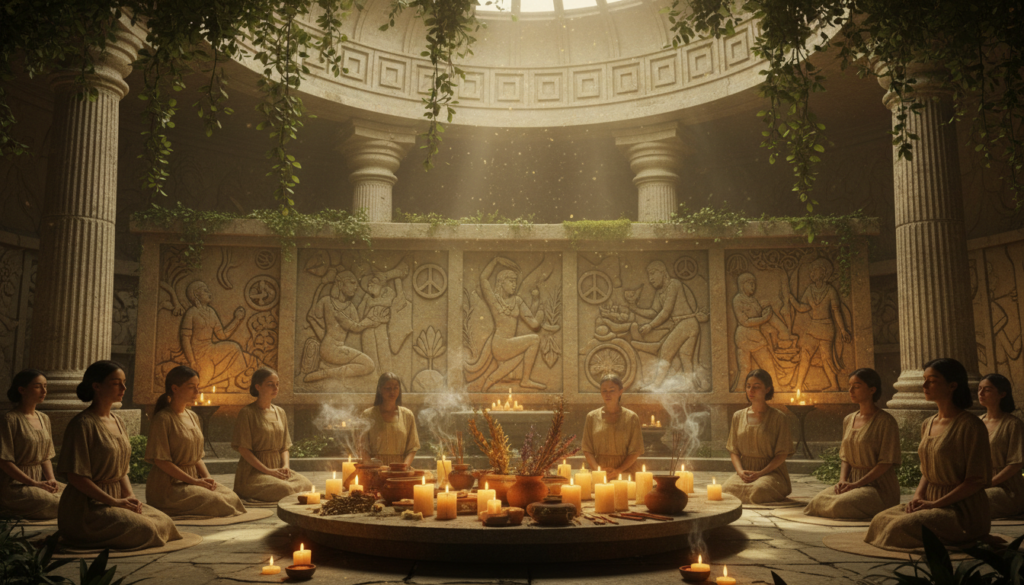
Temple medicine was about healing in ancient times. It happened in sacred spaces in Egypt, Greece, India, and China. Priests and healers used spiritual ceremonies and herbal remedies to treat illness.
These ancient rituals used hypnotic states to heal. Researchers like Dr. John Souglides have studied this a lot. The goal was to clear emotions, break old patterns, and grow spiritually. Hypnosis was seen as a way to connect with the divine.
Energy systems were also key. Chinese healers worked with Chi. Indian practitioners channeled Prana. Egyptian priests harnessed Sekhem energy. Each culture saw the body as a field of vibration and light.
Key Principles
Traditional healing in temples was based on a few main ideas:
- The mind and body are connected — you can’t heal one without the other
- Spiritual healing addressed the soul, not just symptoms
- Natural remedies were preferred over invasive techniques
- Metaphysics guided every practice
Comparison with Other Medical Practices
| Aspect | Temple Medicine | Ancient Greek Secular Medicine | Modern Western Medicine |
|---|---|---|---|
| Primary Focus | Mind, body, and spirit together | Body and humoral balance | Physical symptoms and disease |
| Setting | Sacred temple spaces | Physician’s home or public spaces | Hospitals and clinics |
| Main Tools | Trance states, herbs, ritual | Diet, exercise, surgery | Pharmaceuticals, surgery, imaging |
| Spiritual Element | Central to the process | Minimal after Hippocrates | Typically excluded |
| Practitioner | Priest-healer or shaman | Trained physician | Licensed medical doctor |
Temple medicine was unique because it aimed for wholeness. It wasn’t just about masking pain. It was about transforming the person from the inside out. And as we’ll see next, the history behind these practices runs incredibly deep.
Historical Background of Temple Medicine
Temple medicine is really interesting. It wasn’t just one thing in one place. It showed up all over the world, in places that had no contact with each other. This shows us how deep our need for healing in sacred spaces goes.
Ancient Civilizations That Embraced Sacred Healing
Many ancient civilizations built their health systems around temples. Egyptian priests used sound, herbs, and crystals for healing. Greek temples, called Asclepeions, helped patients by letting them slept there, hoping for visions.
In India, yogic ashrams taught about karma and the soul’s purpose. Traditional Chinese Medicine focused on balance and the life force called Qi. Native American traditions saw health as a balance of mind, body, spirit, and community. African tribes believed in the Almighty Creator and ancestral spirits.
| Civilization | Core Healing Approach | Sacred Element |
|---|---|---|
| Egypt | Sekhem energy work | Sound, herbs, crystals |
| Greece | Dream incubation | Trance states |
| India | Yogic spiritual alchemy | Karma and vibration |
| China | Qi cultivation | Yin-Yang, Wu Xing |
| Native America | Mind-body-spirit harmony | Creator, community, environment |
| Africa | Ancestral spirit connection | Supreme Creator, living dead |
How It Changed Over the Centuries
Ancient healing practices didn’t stay the same. As empires changed, so did these methods. Greek scholars learned from Egyptian temples. Indian teachings spread through trade routes. Each new generation added to the knowledge.
Pioneers Who Shaped the Path
Figures like Imhotep in Egypt and Hippocrates in Greece were key. They drew from temple medicine. In India, Patanjali’s yogic teachings are used in energy healing today. These healers were more than just doctors; they were bridge builders.
The Philosophy Behind Temple Medicine
Temple medicine was more than just treating physical ailments. It connected your thoughts, spirit, and body into one system. Today’s holistic healing practices come from these ancient ideas.
The Link Between Mind and Body
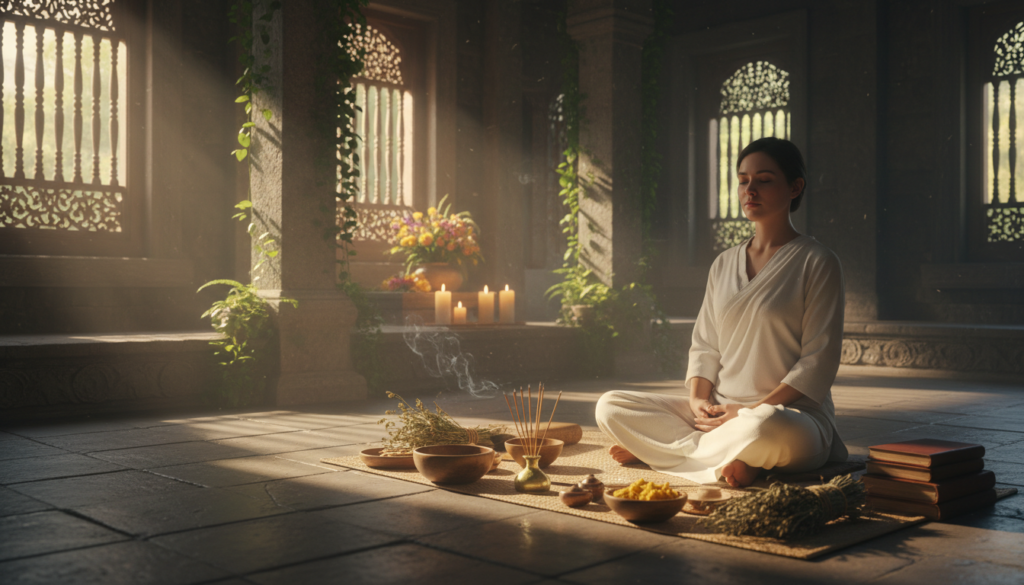
Eastern traditions like Hinduism, Buddhism, and Taoism knew a secret thousands of years ago. They said your mind can make your body sick. In Hinduism, five passions were seen as the cause of mental illness (Kakar, 2003).
Buddhism looked at it differently. It said suffering starts in the mind. Cloudy thinking and emotions like anxiety and greed are the problem. The solution? Mindfulness and accepting things as they are.
Chinese Medicine said emotions can cause illness. Depression can block the heart. A physical illness can make you emotionally weak. We now call these psychosomatic symptoms.
The Sacred Dimension
In ancient cultures, spiritual healing was part of medicine. Indigenous spiritual practices included prayer, ritual, and ceremony. Shamanic healing used special states of consciousness to treat illness spiritually.
Nature as the First Pharmacy
Temple healers used natural remedies from their surroundings. Plants, minerals, and sacred waters were key.
| Tradition | Core Belief | Primary Remedy Approach |
|---|---|---|
| Hindu Ayurveda | Balance of five elements | Herbal formulas, dietary changes |
| Chinese Medicine | Unity of body and spirit | Acupuncture, herbal teas |
| Buddhist Healing | Suffering originates in the mind | Meditation, mindfulness practice |
| Indigenous Shamanism | Spiritual imbalance causes illness | Plant medicines, ritual ceremonies |
These ideas led to the practices temple healers used every day. We’ll explore these next.
Practices and Techniques in Temple Medicine
Temple medicine was more than just sitting quietly. It was about using structured methods passed down for generations. Let’s look at the main three.
Meditation and Breathing Exercises
Eastern traditions aimed to purify the mind. They sought a calm, mindful state, similar to today’s “flow.” Ancient Egyptians, Greeks, and Eastern cultures used hypnotic trance to access the subconscious.
The Native American Vision Quest is a great example. It involved stopping daily activities for deep self-reflection (Portman, 2006). These rituals were not one-time events. Native American ceremonies were held every single day for thanks, healing, and blessings.
“There are only two ways to life: one is with constant conflict, and the other is with surrender.” — Swami Muktananda
Dietary Recommendations
Temple healers knew food affects mood. They gave specific diets based on health needs. Shamanic healing often combined diet with spiritual practices for a complete reset.
Herbal Treatments
Herbs were key in temple medicine. Each culture used local plants to create its own remedies.
| Culture | Popular Herbs | Primary Use |
|---|---|---|
| Ancient Egypt | Frankincense, Myrrh | Wound healing, spiritual cleansing |
| Ancient Greece | Chamomile, Valerian | Sleep, anxiety relief |
| Native American | Sage, Sweetgrass | Purification, ceremony |
| Ayurvedic (India) | Ashwagandha, Turmeric | Inflammation, stress |
These methods combined physical and spiritual health in ways modern science is catching up on. It’s pretty amazing, right?
The Role of Temple Healers
Who were the temple healers? They weren’t just random people. They followed long paths of preparation. Their work was serious.
Let’s explore what made these healers special. How did they heal? And what kept them honest?
Qualifications and Training
Becoming a temple healer wasn’t a choice. It was a calling. In African traditions, a future healer might have experiences seen as psychosis. But the community saw it as a sign from ancestors.
A diviner had to confirm these experiences. Then, the apprentice lived with a trainer. They learned about medicinal plants and dream analysis.
In Eastern traditions, the path was different but just as tough. A seeker had to give up their ego to a guru. This training was painful and slow, but it was worth it.
In Chinese Medicine, knowledge was passed down through generations. A healer treated patients like a loving parent. They used five key techniques: looking, listening, smelling, inquiring, and palpating.
The Healing Process
The healing process was deep and layered. Healers looked at the whole person, not just symptoms. They used dream interpretation, herbal remedies, and energy work.
Some healers learned from indigenous communities. They spent time in rainforests and participated in ayahuasca ceremonies. Each experience made them better.
Ethics in Temple Medicine Practices
Temple healers followed strict ethics. Their relationship with patients was sacred. Ego had no place.
If a healer acted selfishly, they lost their gift. The community held them accountable. Trust was key, and breaking it meant losing everything.
FAQ
What exactly is temple medicine, and where did it originate?
What are the key principles that connect different temple medicine traditions?
How does temple medicine differ from modern Western medical practices?
Which ancient civilizations practiced temple medicine, and what made each unique?
How did temple medicine evolve over the centuries?
Who were the key figures and traditions that shaped temple medicine history?
What role does the mind-body connection play in temple medicine?
How do spiritual elements factor into temple healing?
What natural remedies were commonly used in temple medicine?
How were meditation and breathing exercises used in ancient temple healing?
What dietary recommendations were part of temple medicine traditions?
What qualifications and training did ancient temple healers need?
What does the healing process actually look like in temple medicine?
What ethical principles guided ancient temple healers?
Get More Medical History
Join our newsletter for fascinating stories from medical history delivered to your inbox weekly.