The History of Healing
 Sushruta: The Ancient Surgeon Ahead of His Time
Explore the legacy of Sushutra, the ancient pioneer of surgery, whose groundbreaking work laid the foundations for modern medical practices.

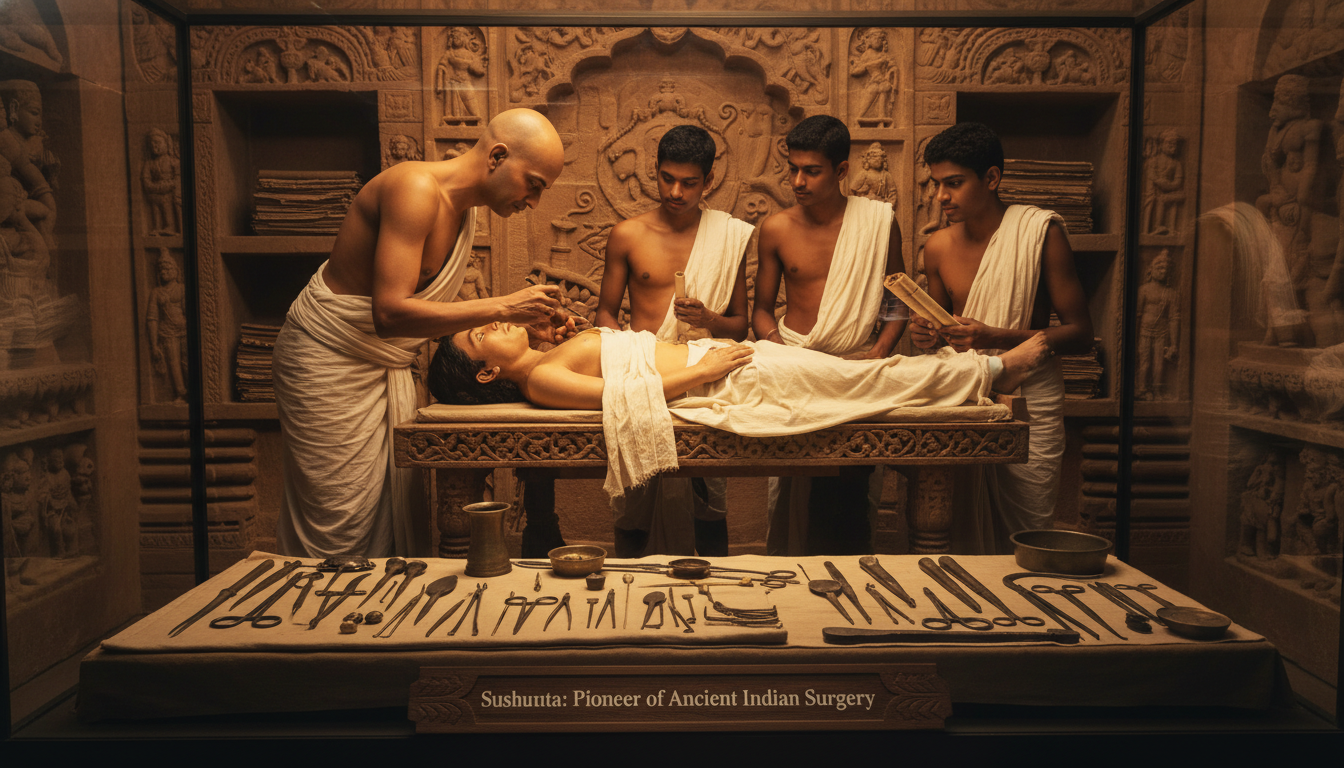
Over 2,500 years ago, Indian surgeons were already doing nose rebuilds with skin flaps. This was long before modern hospitals. Sushruta was a key figure in this work.
Sushruta worked in Kashi (now Varanasi) around 600 BCE. He was a surgeon long before Hippocrates and Galen were known in the West. He’s often called the father of surgery.
But that title doesn’t tell the whole story. Sushruta’s work was more than just cuts and stitches. It was a new way of thinking about injury, disease, and repair.
Sushruta’s world was surprisingly practical. He used sharp tools and clean techniques. He also believed in hands-on training and ways to reduce pain.
He even described bold procedures like nose jobs using cheek or forehead flaps. He also talked about skin grafting, fracture care, and cataract methods. His focus on wound management was also groundbreaking.
His ideas were not just rumors. They were written down in the Sushruta Samhita. This text is full of anatomy, pathology, toxicology, and step-by-step instructions. Today, Sushruta’s work is talked about in plastic and reconstructive surgery, orthopedics, and surgical education.
Key Takeaways
- Sushruta practiced around 600 BCE in Kashi (Varanasi), India.
- He’s widely known as the father of surgery for his system-based approach to care.
- Ancient Indian surgery under Sushruta included rhinoplasty, grafting, fracture care, and cataract techniques.
- He emphasized instrument design, cleanliness, and hands-on training.
- The Sushruta Samhita recorded detailed medical knowledge and surgical steps.
- His work is discussed in modern fields like reconstructive surgery and surgical education.
Introduction to Sushruta’s Legacy
When you explore the history of hands-on medicine, Sushruta’s name keeps popping up. His teachings don’t view surgery as a last resort. Instead, they see it as a skill to be learned and respected.
This legacy draws us to Kashi India, a city with a rich history. Today, places like Benares University continue to explore these ancient ideas.
Who Was Sushruta?
Sushruta lived around the 6th century BCE, possibly around 600 BCE. He was an ancient Indian surgeon and physician. He worked in Kashi India, one of the oldest cities in the world.
His training followed the guru-disciple model, known as Guru–Shishya Parampara. This model connects him to Divodasa in the Dhanwantri gurukul lineage. It shows that Sushruta’s teachings were learned through direct interaction, not just reading.
What’s surprising is his focus on careful physical exams. He used sight, touch, hearing, and more before starting treatment.
He was also a teacher, with his teachings linked to Benares on the Ganges. This teaching approach is why Benares University is often mentioned in discussions about the region’s academic history and medical past.
| Legacy thread | What it looks like in daily practice | Why it mattered then | Why you should care now |
|---|---|---|---|
| Apprentice-style training | Students learn by watching, repeating, and getting corrected | Skills stayed consistent across generations | It echoes how clinical rotations work today, including at Benares University |
| Whole-body examination | Use multiple senses, not guesswork | Better decisions before cutting or cauterizing | It sounds like the basics you expect in modern exams |
| Ethics and self-control | Clear expectations for conduct, cleanliness, and restraint | Trust mattered in close-knit communities | The Sushruta teachings remind us that skill without character is risky |
| Strong link to place | Knowledge tied to Kashi India and its teaching culture | Cities shaped what was studied and shared | Medical history feels more real when tied to a living city |
Historical Context of His Time
The world was building medical traditions around Sushruta’s time. India, Greece, Egypt, China, and Mesopotamia all had their own approaches. Indian medicine started earlier than many, by centuries, which shows the confidence in Sushruta’s teachings.
But anatomy was tough. In many places, cutting into a body was taboo. Corpses were seen as sacred or “impure.” Yet, Sushruta pushed for anatomical learning, knowing guesswork in surgery could be brutal.
Reconstructive surgery was also important. Disfigurement, like nasal amputation used as punishment, could ruin a person’s life and standing.
So, Kashi India in that era was a place where medicine was practical. It was a response to visible suffering—pain, infection, stigma—and the need to repair what life (or society) had taken.
This tradition is why it’s discussed in modern classrooms and conversations, including around Benares University. You’re not just reading history; you’re seeing how practical problems shaped medical thinking.
The Surgical Techniques of Sushruta
Sushruta changed how we see ancient medicine. His approach to ancient Indian surgery was organized and practical. It shows a system made for real patients, not just stories.
Planning was key in his work. It wasn’t just about cutting. He measured, chose tools, controlled bleeding, and thought about healing. This mindset is seen in his surgical instruments and methods.
Innovative Procedures and Instruments
Sushruta had a set of eight main operations. These were like a toolkit for making decisions. This structure helped ancient Indian surgery stay organized.
He described different operations, like hernia repair and cesarean sections. He also talked about treating bones and classifying injuries. This shows his focus on treating each patient carefully.
He used 121 surgical instruments, divided into blunt and sharp tools. These tools were designed for grip, control, and clean work. They were made to help surgeons do their job well.
Materials were important too. Iron, copper, and gold were used for cleanliness. The focus was on sharp edges, correct sizing, and sturdy build.
| Tool group | What it helped do | Why it mattered in practice |
|---|---|---|
| Shastras (sharp) | Clean cuts for incision and excision, plus careful opening for drainage | Sharper edges meant quicker work and more precise control of tissue |
| Yantras (blunt) | Grasping, retracting, exploring, holding, and stabilizing | Blunt control reduced tearing and helped keep the field steady |
| Needles and threads | Closing wounds with suturing and managing tension across skin | Better closure supported healing and limited reopening during movement |
| Cautery tools | Controlling bleeding and treating targeted areas with heat | Heat-based control helped reduce bleeding and supported cleaner wound edges |
Sushruta also talked about keeping tools in good condition. He discussed methods like tempering and using caustics/alkalis, water, or oil. This shows his focus on maintaining tools for reliable use.
Use of Anesthesia in Ancient Surgery
No machines or IV drips were used. Yet, Sushruta didn’t ignore pain. He used wine, cannabis incense, and mixtures like henbane and Indian hemp for sedation.
Delivery methods varied, including oral use, inhalation, and topical application. The goal was to reduce fear, dull pain, and keep the patient calm. This fits with the focus on preparation in ancient Indian surgery.
He also gave practical rules for surgery. He advised feeding patients and giving strong wine before surgery. But for some problems, he warned against food.
After surgery, he focused on pain control, bleeding risk, and after-care. This approach managed the whole experience, not just the surgery itself.
Sushruta’s Contributions to Medicine
Ever wonder how surgery became something we can teach, repeat, and get better at? Sushruta’s work in medicine is key. It shows us how to do medical work step by step, with the right tools and timing.
Foundational Text: The Sushruta Samhita
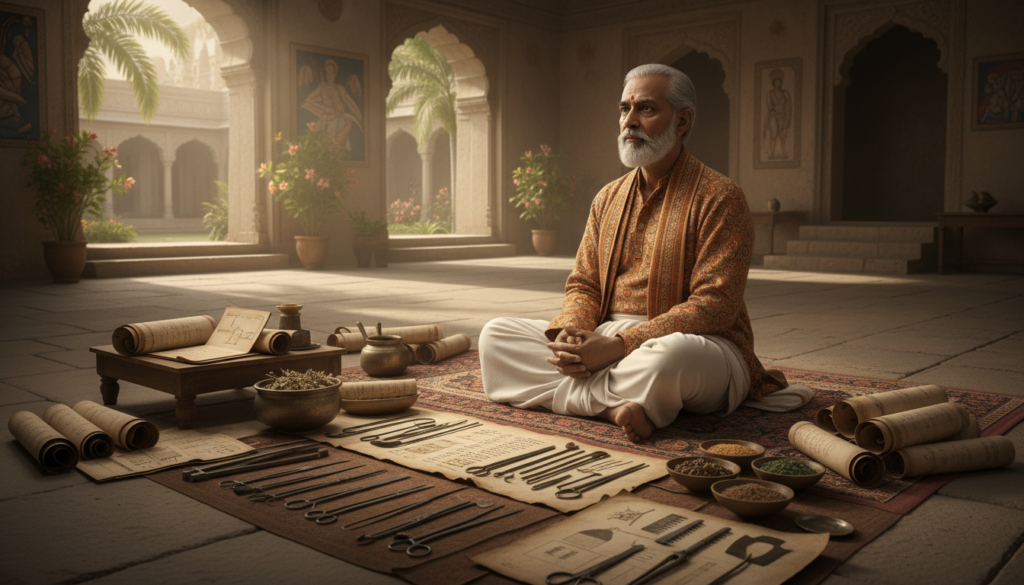
The Sushruta Samhita is like a guide for the human body. It’s the oldest known surgical text. It’s divided into six main parts, making it easy to follow.
Inside, you’ll find detailed information. It covers surgical basics, like keeping wounds clean. It also talks about diseases, the body’s structure, and how to treat injuries and poisonings.
- Scope: lists 1120 illnesses or disease entities
- Materia medica: 700 medicinal plants, plus preparations from minerals and animals
- Technique: covers wound closure, suturing, bandaging, cauterization, and extractions
- Specialties: includes orthopedics, ophthalmology, obstetrics/gynecology, and trauma care
That’s why Sushruta is called the father of plastic surgery. His work is detailed, focusing on repairs, closure, and care after surgery.
Influence on Modern Surgical Practices
The journey from oral teaching to global influence is fascinating. Sushruta’s teachings were passed down for about two centuries before being written down. This helped his work survive and spread.
During Caliph Al-Mansur’s rule (754–775 CE), his teachings were translated into Arabic. Later, Ibn Abi Usaybia (1203–1269 CE) made another Arabic translation. Latin versions from Arabic texts then spread through Europe for many years.
| Milestone | What happened | Why it mattered for surgical practice |
|---|---|---|
| Oral transmission (~2 centuries) | Teachings were preserved through memorized instruction before compilation | Kept procedures consistent enough to be copied and checked |
| Al-Mansur era (754–775 CE) | Arabic translations were commissioned in some accounts | Moved core ideas across regions and medical schools |
| Ibn Abi Usaybia (1203–1269 CE) | Produced another Arabic translation | Helped stabilize the text tradition used for later adaptations |
| Early 1800s | Hessler translated into Latin; Muller translated into German | Made the material easier to study inside modern academic systems |
| 1907, Calcutta | Kaviraj Kunja Lal Bhishagratna published an English translation in three volumes | Opened wide access for clinicians, historians, and students |
| 1962–1976 | Work beginning in 1962 led to a cataract-related masterpiece being made public in 1976 | Put technical eye-surgery descriptions back into active discussion |
| Long-form modern translation work | Dr. Singhal worked with over 15 Ayurvedic colleagues from the Institute of Medical Sciences for 14 years on translation work | Strengthened how reliably the text can be compared to modern clinical language |
The bridge to today is the way Sushruta documented procedures. He used a structure of procedure + instrument + aftercare. This structure is the foundation of modern surgery. It’s why Sushruta’s work is so important in medicine and the history of plastic surgery.
Sushruta and Ayurvedic Medicine
Sushruta’s world didn’t separate “treating” from “operating.” Ayurvedic medicine aimed for balance. So, ancient Indian surgery was part of daily healing, not a separate craft.
This approach is why we’re drawn to it today. In 2024, Rajeev Gupta calls Sushruta “ahead of his time.” He shows how modern doctors can learn from ancient Indian thinking.
Integration of Surgery in Ayurveda
Shalya Tantra was a key part of Ayurveda. It had rules, tools, and training. Surgery was seen as a normal part of Ayurvedic medicine, used when diet and herbs weren’t enough.
Sushruta’s work covered a wide range. His methods included anatomy, wound care, and cosmetic repairs. He also handled areas we now split into specialties.
- Reconstructive and cosmetic repair
- Obstetrics and gynecology care
- Ophthalmology-focused procedures
- Orthopedics and bone setting
- Traumatology and injury management
- Pharmacology linked to surgical recovery
Role of Herbs and Natural Remedies
Plant-based practice was key in ancient surgery. Dhoopana, or fumigation, was used to clean areas like operating rooms. It was a practical habit, not just a wellness ritual.
Traditional materials for Dhoopana included guggulu, vacha, and white mustard. Salt, mustard, and clarified butter were used for early antisepsis. They aimed to limit infection from air and touched surfaces.
Pain control also used natural remedies. Later, cannabis, henbane, and opium were used to sedate patients. They helped patients tolerate procedures without panic.
| Practice in Ayurvedic medicine | Where it shows up in care | Materials named in traditional use | Why it mattered for Shalya Tantra and ancient Indian surgery |
|---|---|---|---|
| Dhoopana (fumigation) | Operating rooms, labor wards, postoperative wards | Guggulu, vacha, white mustard, saindhava (rock salt), nimba (neem) leaves | Supported cleaner spaces and fewer wound complications during hands-on procedures |
| Surface and tool cleansing | Pre-op prep and postoperative handling | Salt, mustard, clarified butter | Early antisepsis-style habits aimed at reducing contamination from contact and shared surfaces |
| Herb-based sedation and pain dulling | During procedures and difficult wound care | Cannabis preparations, henbane, opium/cannabis (as discussed in later readings) | Helped patients stay calm and tolerate discomfort, making delicate work more doable |
| Recovery support with pharmacology | Postoperative routines and healing phases | Herb and diet guidance (paired with local care) | Kept surgery connected to daily healing habits, a core idea in Shalya Tantra |
Sushruta’s Impact on Health Care
Ancient surgery might seem messy and rushed. But Sushruta’s teachings are more like a detailed guide for keeping people safe. Many of his methods are used in American hospitals today.
Advancements in Patient Care and Safety
Sushruta focused a lot on keeping patients safe. He wanted clean tools, hands, and spaces before surgery. He also made sure the operating and recovery areas were very clean.
He chose high-quality metals like copper, iron, and gold for his tools. He made sure they were well cleaned. This shows his focus on quality and cleanliness.
After surgery, Sushruta didn’t stop there. He emphasized careful suturing, firm bandaging, and wound care. He also stressed watching for complications and supporting healing with rest and diet.
Surgical Education and Training Methodologies
Sushruta’s approach to teaching surgery is surprisingly modern. He didn’t just teach theory. He trained students to use their hands, eyes, and judgment. He knew one mistake could harm many.
“theory without practice is like a one-winged bird that is incapable of flight”
Students practiced on models before working on real people. They used everyday materials to practice their skills. This helped them feel steady and confident.
- Incisions on vegetables like Pushpafala (Cucurbita maxima), Alavu (Lagenaria vulgaris), and Frapusha (Cucumis pubescens)
- Evacuation practice on leather bags filled with water and urinary bladders of dead animals
- Scarification on animal hides
- Venesection practice on vessels from dead animals or water lily stalks
- Probing and stuffing with bamboo reeds
- Extraction practice using fruits like Panasa (Artocarpus integrifolia)
- Scraping on resin spread on Shalmali wood (Bombax malabaricum)
- Suturing on cloth, skin, or hides
- Ligatures and bandaging on dummies
- Cauterization practice on flesh
- Catheterization on unbaked earthen vessels filled with water
He also believed in studying cadavers. Bodies were wrapped in grass and soaked in river water for 7 days. This made tissues soft, allowing students to learn by touch. It was a hands-on way to learn anatomy for real-world safety.
| What trainees practiced | Training material | Skill being built | Why it matters for patient safety |
|---|---|---|---|
| Incisions and controlled depth | Pushpafala (Cucurbita maxima), Alavu (Lagenaria vulgaris), Frapusha (Cucumis pubescens) | Steady cuts, clean lines, consistent pressure | Fewer slips, less tissue damage, more predictable healing |
| Fluid evacuation | Leather bags with water; animal urinary bladders | Controlled release, timing, and hand positioning | Reduces rough handling that can worsen bleeding or swelling |
| Venesection | Dead animal vessels; water lily stalks | Targeting a vessel without overcutting | Lowers the risk of needless blood loss and panic moves |
| Suturing and closure | Cloth, skin, or hides | Even spacing, secure knots, tension control | Supports tight closure and cleaner wound edges |
| Bandaging and immobilization | Dummies | Firm wrap without cutting off circulation | Helps prevent swelling, shifting, and delayed repair |
| Anatomy by layers | Cadaver study after 7 days submerged in river water, wrapped in grass | Understanding tissue planes through direct inspection | Builds safer decisions when working near delicate structures |
The Ethical Dimensions of Sushruta’s Work
Looking beyond the scalpels and stitched skin, we see a strong focus on ethics. Sushruta’s teachings are not just theories. They are practical rules for a busy, risky environment with real people.
Principles of Medical Ethics in Ancient Times
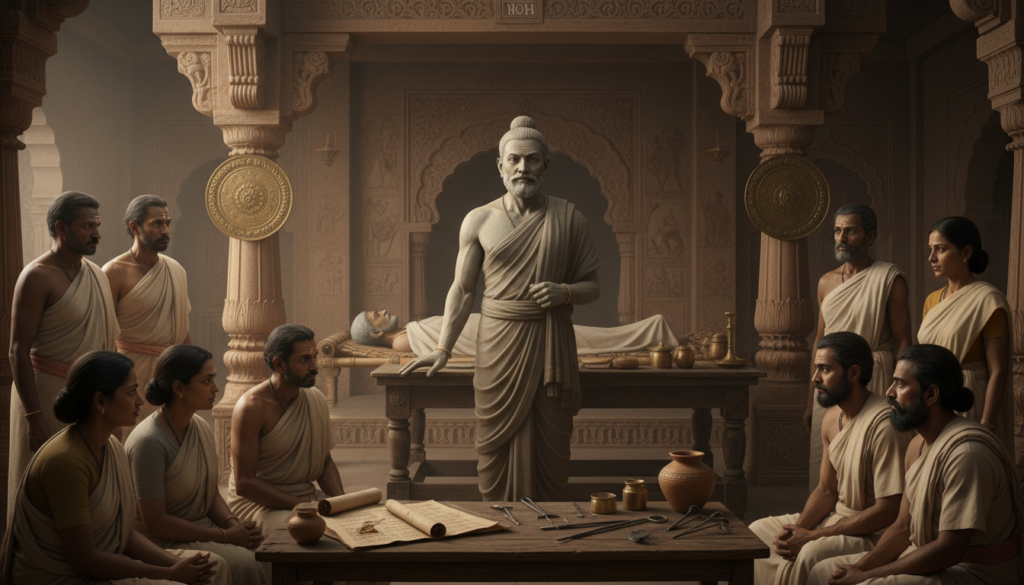
Sushruta taught at Benares and created an early code of ethics. It was simple and practical. It emphasized that patient care begins before surgery.
He stressed the importance of cleanliness and prepared tools. Fasting was also used to ensure safety. The goal was to avoid mistakes.
Sushruta also promoted careful diagnosis. He used all senses to observe and examine patients. This approach is similar to today’s methods, blending ethics and safety.
| Ethical focus | How it shows up in Sushruta teachings | Why it mattered for patient care |
|---|---|---|
| Safety before speed | Preparation steps, including fasting when required | Lowered the odds of complications during stressful procedures |
| Clean practice | Emphasis on cleanliness and instruments kept in safe condition | Reduced infection risk in an era without antibiotics |
| Careful diagnosis | Detailed observation and physical exam using all senses | Helped avoid irreversible choices based on weak guesses |
The Patient-Doctor Relationship
The stakes were high. In stories like the Ramayana, amputations were tied to punishment and shame. Later, amputations were used as penalties, making repair a matter of dignity.
Trust was key. Reconstructive surgery was painful and risky. The surgeon had to be steady and clear about risks.
There’s a thread of consent and recordkeeping in later family practice. The Kanghiari family kept patient records and consents until 1440. They passed on rhinoplasty methods through generations, showing the importance of secrecy and skill.
This all points to medical ethics as a real relationship, not just a slogan. Sushruta’s teachings put patient dignity at the center, even in harsh settings with uncertain outcomes.
Comparison with Contemporary Surgeons
If you first learned about surgery in Greece, you’re not alone. But when you look at the dates, things get more interesting. Sushruta was teaching and practicing in Kashi around 600 BCE, before many Greco-Roman names.
This isn’t about who was the best doctor. It’s noticing two paths of medical thinking. They sometimes meet, sometimes don’t. Both paths helped shape what we call “good medicine.”
Sushruta vs. Hippocrates
Sushruta was hands-on and knew a lot about tools. His tradition focused on procedures, instruments, and training through dissection. It was all about showing and doing.
Hippocrates, on the other hand, focused on observing and ethics. It was about watching patients, tracking patterns, and acting carefully. These were different approaches, and that’s what matters.
| Angle | Sushruta | Hippocrates |
|---|---|---|
| Timeline anchor | Work in Kashi around 600 BCE | Later Greek medical tradition commonly taught early |
| Main emphasis | Procedures, instruments, and surgical planning | Observation-based care and practical ethics |
| Training feel | Anatomy learning tied to dissection and technique drills | Careful notes on symptoms, course, and bedside judgment |
If you only heard about the Greek side, you missed a lot. You missed an early, parallel story in surgery. This story showed how technique and teaching were organized early on.
Global Influence on Surgical Practices
Now, let’s talk about how ideas spread. Sushruta’s work went through Arabic translations, including work under Caliph Al-Mansur. Later, Arabic-to-Latin paths helped spread surgical knowledge in Europe.
Rhinoplasty shows how ideas moved. Sushruta’s method was known as “the Indian method” in Arabic tradition. It spread to Persia and by the 1400s reached Sicily, where it evolved into the “Italian method”.
But there were challenges, like hair growth on the flap and intolerance to cold. Then, in 1793 in Poona, British surgeons saw Indian rhinoplasty for the first time.
James Findlay and Thomas Crusoe published details in the Madras Gazette. Soon after, Mr. Lucas described it again in The Gentleman’s Magazine (London) in October 1794.
The story of Cowasjee, a Mahratta bullock driver, is unforgettable. He lost his nose and hand to Tipu Sultan in 1792. A year later, a potter near Poona rebuilt his nose. This adds a vivid chapter to surgery’s history, alongside Hippocrates and far from Sushruta.
Modern Interpretations of Sushruta’s Techniques
Reading Sushruta today is not just about history. It’s like seeing a draft of ideas we already know. These include triage, wound care, and plastic and reconstructive surgery. The logic behind these ideas is surprisingly relevant, even with different tools.
Relevance in Today’s Surgical Procedures
Rhinoplasty is a great example. Sushruta used a leaf template to measure the defect. Then, he cut a cheek skin patch in a specific way. He left part of it attached.
He also made sure the nostrils stayed open. He used hollow tubes or reeds for this. Later, the idea of using a forehead flap was explored, but the basic idea remains the same in modern surgery.
It’s not just about noses. Sushruta’s work in orthopedics and ophthalmology is also relevant today. His methods in wound management and instrument design are also seen in modern medicine.
| Technique described in Sushruta’s tradition | What you’d call it today | Core idea that stil feels familiar |
|---|---|---|
| Leaf template to size nasal loss; cheek flap partly attached | Reconstructive rhinoplasty planning and flap design | Measure first, match tissue, protect blood supply |
| Scarifying margins; careful flap attachment | Wound bed preparation and graft/flap inset | Make edges ready so tissue can take and heal |
| Cotton and pure sesame seeds as dressing material | Layered postoperative dressing and wound coverage | Cover, cushion, and keep the site stable |
| Hollow tubes/reeds to keep nostrils open | Nasal stenting to maintain airway and shape | Support the passage while tissue settles |
| Fracture classification with stabilization approaches | Orthopedic assessment and immobilization principles | Sort the injury, then hold it steady to recover |
Reviving Ancient Practices in Modern Medicine
Some old ideas are being looked at again in a new way. Dhoopana, or herbal fumigation, is being talked about for reducing germs. This is important in today’s fight against hospital infections.
The study of Sushruta’s work has seen a resurgence. Bhishagratna’s 1907 English volumes helped bring Sushruta back into the spotlight. Later projects continued this trend, including a 1976 release focused on cataracts. The Sushruta statue at Patanjali Yogpeeth in Haridwar, India, is a symbol of this renewed interest.
When we talk about plastic and reconstructive surgery today, we’re not saying it’s the same. We’re seeing that the problem-solving approach—measure, plan, preserve function, support healing—is timeless. This is true from rhinoplasty to how surgeons work with their hands.
Conclusion: Sushruta’s Enduring Legacy
Looking back, it’s amazing. The Sushruta Samhita shows surgery as a precise art. It’s not just about bravery. It’s about careful planning and improvement.
This is why many call him the father of surgery.
Lessons Learned from His Life and Work
Sushruta’s work shows a modern approach to medicine. He believed in studying anatomy through cadavers, even when it was forbidden. He also taught the importance of practicing on non-living things first.
This way, you learn without harming real people.
His work was vast. He did everything from fixing noses to treating wounds. He even used plants to help with pain, showing early forms of anesthesia.
Future Implications for Surgical Science
His ideas don’t replace today’s medicine. But they can change how we think. What if surgical training focused more on practice, like Sushruta suggested?
And could ancient herbal treatments inspire new ways to fight infections?
There’s another important lesson. Medical progress has always been worldwide. Sushruta’s work shows that breakthroughs come from everywhere, not just one place or time. Seeing him as the father of surgery can make us appreciate today’s surgery even more.
FAQ
Who was Sushruta, and why do people call him the father of surgery?
Where and how did Sushruta learn and teach medicine in ancient India?
What was the world like around 600 BCE, and why did surgery matter so much?
What were Sushruta’s main surgical categories?
What kinds of surgical procedures in ancient India are described in the Sushruta Samhita?
How many instruments did Sushruta describe, and what were they like?
Did Sushruta use anesthesia or pain control in ancient surgery?
What is the Sushruta Samhita, and why is it such a big deal?
How did Sushruta’s teachings spread beyond India?
How is Sushruta connected to Ayurvedic medicine?
What herbs and natural remedies show up in Sushruta’s surgical world?
What did Sushruta get right about patient care and surgical safety?
How did Sushruta train surgeons—did he really use simulation?
Did Sushruta establish medical ethics in ancient times?
What do we know about the patient-doctor relationship in Sushruta’s tradition?
How does Sushruta compare with Hippocrates?
How did Sushruta’s rhinoplasty technique influence global plastic and reconstructive surgery?
What parts of Sushruta’s surgical technique are modern today?
Why are ancient practices like Dhoopana being talked about again in modern settings?
What are the biggest Sushruta contributions to medicine that people should remember?
What can today’s surgical educators and researchers learn from Sushruta’s approach?
Get More Medical History
Join our newsletter for fascinating stories from medical history delivered to your inbox weekly.