The History of Healing
 The Evolution of the Thermometer
Discover the transformative journey of the Thermometer, from its early origins to cutting-edge digital and infrared designs shaping modern temperature measurement.

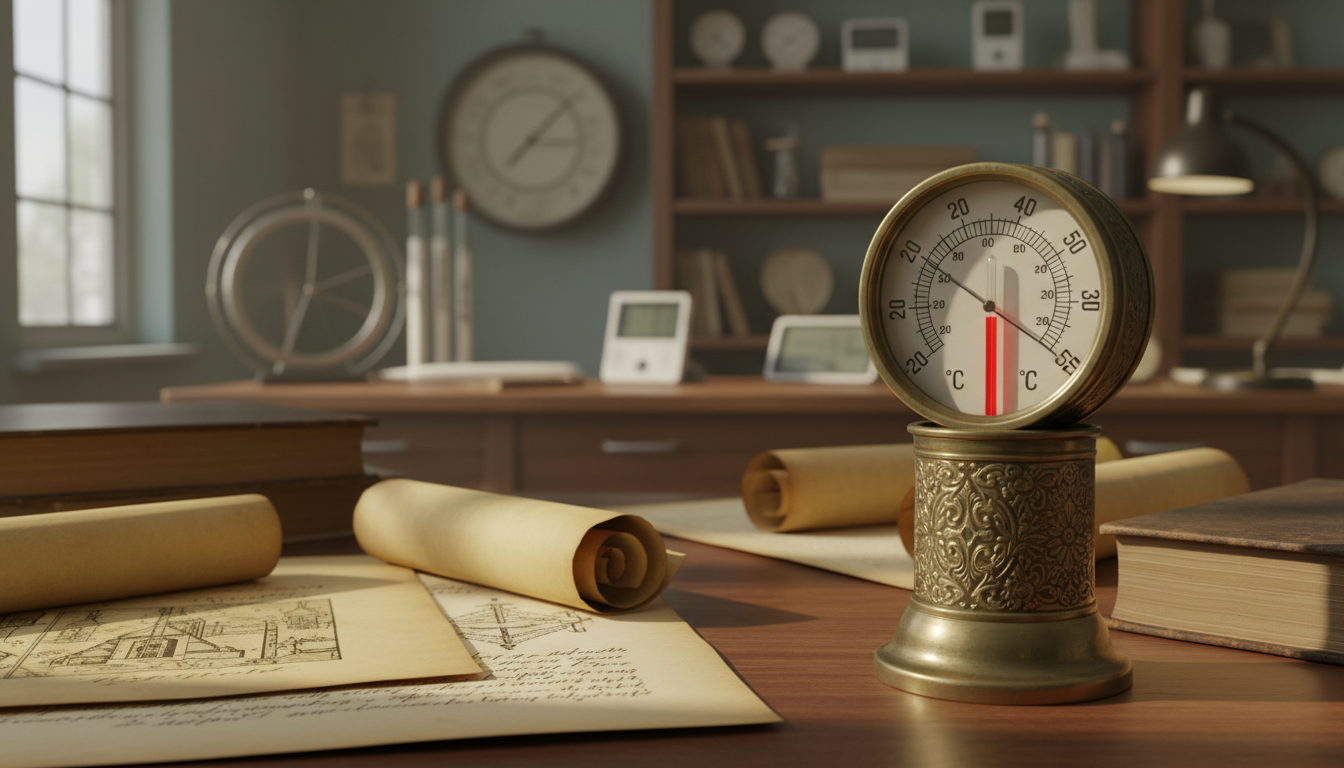
In the U.S., millions of temperature checks happen every day. This is at home, in hospitals, labs, and on factory floors. Yet, the humble thermometer didn’t come as one invention. It evolved, changed, and was debated for centuries.
A thermometer turns “hot” or “cold” into a number. It has a sensor that reacts to heat and a way to show the change. This is why a temperature gauge looks simple but is actually very clever.
Old records don’t always agree, and early devices weren’t always called thermometers. Instead of looking for one inventor, we see the thermometer evolve through many breakthroughs. These breakthroughs sometimes happened at the same time.
And yes, you should care. Before thermometers, doctors used body heat to guess if something was wrong. Today, thermometers are everywhere. They shape decisions in medicine, weather, industry, and science, affecting your day.
Archive.org hosts early coverage of the thermometer’s story. We’ll follow this trail to see how the thermometer became a key tool in modern life.
Key Takeaways
-
A thermometer turns heat into numbers you can compare, not just a “hot or cold” feeling.
-
Every thermometer needs a sensor plus a readable display, whether it’s a scale or digital readout.
-
The thermometer’s history is complicated because early records are incomplete and sometimes conflicting.
-
It’s more accurate to see the thermometer as evolving tech, not a single one-time invention.
-
Body temperature mattered in medicine long before tools existed to measure it precisely.
-
Today, the thermometer and the temperature gauge power decisions in health, industry, weather, and science.
Origins of Temperature Measurement
Before the Thermometer existed, people needed a way to know if things were getting hotter or colder. They used their senses for this. It worked most of the time, but it wasn’t always the same for everyone.
The idea of an indoor thermometer feels familiar today. People were asking the same question thousands of years ago: “Is this warm, cool, or way off?” Today, we expect a steady reading, not a guess.
Physicians like Hippocrates helped move this thinking forward. He wrote around 400 BC that you could use your hand to judge fever. This was useful but very subjective.
Later, Galen described fever as calor praeter naturam, or “heat beyond nature.” This shows how seriously people took changes in bodily warmth.
Even without numbers, this was a big change. People started tracking “sensible heat” as something that could change in a repeatable way. This habit helped make the Thermometer seem like a natural next step.
Early inventors also explored the “how” behind heat. Philo of Byzantium described a sealed sphere connected to a tube dipped in liquid. Warm the sphere and bubbles appear; cool it and liquid rises in the tube. It’s not an indoor thermometer yet, but you can watch the level move as conditions change.
Hero of Alexandria shared similar air-and-water tricks in Pneumatics, including a sun-driven fountain concept. His writings didn’t just sit on a shelf. Later translations inspired tinkerers who wanted a dependable Thermometer.
| Early approach | How it worked | What it could tell you | Big limitation |
|---|---|---|---|
| Hand-to-skin checks (Hippocrates) | You compare body warmth by touch | “Feels feverish” versus “seems normal” | Depends on the observer, the room, and even fatigue |
| Medical framing of fever (Galen) | Heat is treated as a meaningful symptom | A clearer language for abnormal heat | No instrument, so no stable scale |
| Air-expansion experiment (Philo of Byzantium) | Heating air pushes bubbles; cooling pulls liquid up a tube | Visible change between hotter and colder states | Stil no standardized units or fixed reference points |
| Sun-powered pneumatic ideas (Hero of Alexandria) | Heat changes air pressure to move water | Proof that heat can “do work” and be observed | More of a concept machine than an indoor thermometer |
What’s interesting is how close they got to “degrees” thinking. Galen suggested measuring hot and cold in steps, using mixtures like ice and boiling water. Centuries later, Johann Hasler built body-focused scales using this degrees mindset for mixing medicines.
So, the story starts long before glass tubes and neat tick marks. These early comparisons, experiments, and degree-like ideas quietly set the stage for the Thermometer—and for the indoor thermometer you rely on when comfort (or health) is on the line.
The First Celsius and Fahrenheit Scales
A Thermometer isn’t useful if numbers don’t match. If one says “40” and another, they should mean the same thing in real life.
Fixed points like melting ice and boiling water were key. They were solid points to use when making a thermometer or checking a fever.
Early on, people wanted a common standard. In 1665, Christian Huygens suggested using melting ice and boiling water. Carlo Rinaldini agreed in 1694. Isaac Newton proposed a 12-degree scale in 1701, but it wasn’t universal.
Anders Celsius and His Contribution
Anders Celsius lived in a world with many scales. Tracking weather or comparing lab notes was hard because of the confusion.
He did careful tests to bring order. He found that freezing is steady, but boiling changes with air pressure. He also gave a rule for adjusting readings when air pressure isn’t standard.
In 1742, Celsius suggested a scale with 0 at boiling and 100 at freezing. After his death, the scale was flipped to what we know today. Linnaeus is famous, but records show Celsius’s direct scale was used by others too.
In 1948, an international meeting chose the Celsius scale. This choice quietly shapes how we use thermometers today.
Daniel Gabriel Fahrenheit’s Innovations
Daniel Gabriel Fahrenheit focused on making the instrument reliable first. In 1714, he created a mercury Thermometer, avoiding messy mixes.
By 1724, he introduced the Fahrenheit scale with high-quality mercury thermometers. Mercury expands predictably, making results reliable.
He chose specific points for calibration. He used an ice-and-sea-salt mix for zero and set a “healthy human mouth” at 96 °F. He later set freezing at 32 °F, creating 180 degrees between freezing and boiling at sea level.
Lord Kelvin proposed an absolute temperature scale in 1848. It’s important for science labs, even if your Thermometer at home is simple.
| Milestone | Key idea | Fixed points used | Why it mattered for real-world use |
|---|---|---|---|
| Huygens (1665) | Standards should be repeatable | Melting ice and boiling water | Made it easier to compare one Thermometer to another instead of guessing |
| Newton (1701) | Practical scale for everyday reference | Melting ice to body temperature (12 steps) | Pointed toward common benchmarks used later in medical thermometer design |
| Celsius (1742) | Fixed points plus pressure awareness | Freezing and boiling water (originally reversed) | Improved consistency across places and weather—useful for shared records and fever thermometer comparisons |
| Fahrenheit (1714–1724) | Reliable mercury instruments and a defined scale | Ice+salt as zero; freezing later at 32 °F; boiling at 212 °F; mouth at 96 °F | Sharper, repeatable readings that built trust in instruments, including early clinical medical thermometer use |
| International adoption (1948) | Preferred naming and standardization | Degrees Celsius (°C) recognized internationally | Helped align education, manufacturing, and measurement—so a Thermometer scale stays consistent across borders |
The Emergence of Mercury Thermometers
People got tired of guessing the temperature. A quick touch on the forehead wasn’t enough. The mercury thermometer changed that, making temperature easy to read and track.
It didn’t just stay indoors. An outdoor thermometer by the back door made checking the weather a daily ritual. It helped plan your day.
Design and Functionality
A mercury thermometer is a clever glass design. It has a small bulb filled with mercury and a thin tube. Heat makes the mercury expand, showing the temperature.
On an outdoor thermometer, this simple motion gives you a quick temperature reading. It’s a clear number that shows the air outside your home.
Once makers could make consistent glass tubes and mark them well, the mercury thermometer became common. It was based on repeatable physics, not magic.
Advantages of Mercury Thermometers
Mercury was chosen because it behaves predictably across useful temperatures. This was important because earlier liquids were harder to standardize.
Daniel Gabriel Fahrenheit’s mercury instruments were known for their precision. This made comparing results easier, including with outdoor thermometers.
Medicine also changed. Doctors like Herman Boerhaave and his students made measuring fever practical. The mercury thermometer made this thinking real.
| What you notice | Mercury thermometer | Outdoor thermometer use |
|---|---|---|
| How it shows temperature | Mercury column moves up or down in a narrow glass tube against a visible scale | The same rising column gives a fast read of local air temperature near your home |
| Consistency day to day | Predictable expansion supports repeatable readings and clearer comparisons | Helps you spot patterns like morning chill vs. afternoon heat without guessing |
| Best-known historical strength | Supported more dependable, inscribed scales, specially in Fahrenheit-style instruments | Made daily weather checks feel concrete instead of “it feels colder today” |
| Why it mattered in practice | Turned temperature into a number people could record and discuss | Made temperature part of daily decisions like clothing, gardening, and travel timing |
Introduction of Alcohol Thermometers
A classic glass thermometer tells a story of liquids. The alcohol thermometer was a smart way to track temperature changes. It didn’t need guessing.
Early makers knew setup was key. Open thermoscopes could change because of air pressure. But sealed glass designs kept the focus on temperature.
The Role of Alcohol in Thermometry
Alcohol was important because it changes size with temperature. Galileo used wine in a thermoscope in 1610. This was a big step towards today’s indoor thermometers.
By the 1600s, thermometers were used for weather. They had simple scales. This helped people talk about temperature in a more precise way.
Comparison with Mercury Thermometers
Mercury thermometers became more common later. Daniel Gabriel Fahrenheit’s designs were seen as better. But alcohol thermometers were useful for everyday use.
| Feature | Alcohol thermometer | Mercury thermometer |
|---|---|---|
| Typical early use | Room and outdoor air readings; general monitoring | More standardized measurements; repeatable scale work |
| Behavior in glass | Noticeable expansion; easy to see movement in the column | Stable, smooth movement that supported finer calibration |
| Design challenge | Early open designs could be thrown off by pressure changes | Sealed designs paired well with consistent readings |
| Everyday feel | Common sense tool for an indoor thermometer on a wall | Precision tool that fit labs and repeatable testing |
Thermocouples and Digital Innovations
Thermometry changed from glass tubes to electronics. Now, a temperature gauge is more than just a readout. It’s something you can record and trust.
Fast, tough, and surprisingly simple is the vibe here. Thermocouples handle extremes well. A digital thermometer makes it easy to read on a screen.
How Thermocouples Work
In 1820–1821, Thomas Seebeck noticed a strange thing. Two different metals in a circuit reacted when their junctions weren’t the same temperature. This is called the Seebeck effect.
A thermocouple uses two metals joined at a tip. When the tip heats up or cools down, it produces a voltage. This voltage shows the temperature.
Modern thermocouples can measure from just above absolute zero to over 1600 °C. They’re used in research and manufacturing.
They also have medical uses. In critical care, thermocouples are taped to skin for monitoring. They’re also used in sealed catheters for internal readings.
| Use case | Thermocouple strengths | What it means for a temperature gauge |
|---|---|---|
| High-heat manufacturing | Handles very high temperatures and harsh environments | Stable readings even when vibration and heat would confuse other sensors |
| Medical monitoring | Small sensor tip; can be secured to skin or integrated into sealed devices | Continuous temperature gauge data instead of one quick spot check |
| Scientific testing | Wide measurement range and quick response time | Captures rapid temperature swings that are easy to miss with slower tools |
The Rise of Digital Thermometers
Now, you don’t have to squint at a liquid line. A digital thermometer shows a clear number quickly. It’s easy to read, even in a dim room.
Many electronic models solve an old problem. They keep readings steady, even when you move the device. Some can save peak values or log temperatures at set intervals.
So, thermocouples power serious measurements, while digital thermometers make everyday life easier. They offer quick feedback and a clear display.
Infrared Technology in Thermometry
You’ve probably used an infrared thermometer without thinking about the science. Just a quick scan and a beep, and you get a number. It’s like magic compared to a medical thermometer that needs to touch skin and wait.
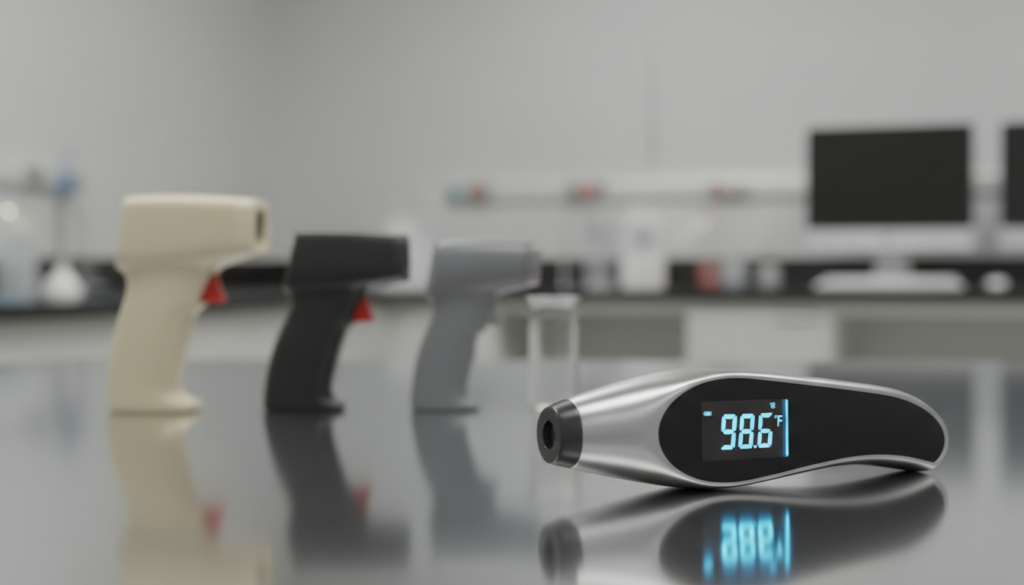
The idea is simple: everything warm gives off energy. These tools just know how to “read” it. Once you understand it, you see infrared temperature checks everywhere, from clinics to factory floors.
The Science Behind Infrared Thermometers
An infrared thermometer uses radiometric sensing instead of contact. It detects thermal radiation and converts it into a temperature value.
It’s based on the same logic as before: a sensor and a readable output. But the sensor listens to specific wavelengths of energy, not liquid expansion or electrical resistance.
This connects to blackbody radiation. Objects at thermodynamic equilibrium emit radiation in a predictable pattern. By measuring spectral radiance, the device can estimate temperature without caring about material expansion.
But, there’s a catch: emissivity. Some surfaces “shine” heat better than others. That’s why an infrared thermometer can act finicky on polished metal, while a medical thermometer aimed at skin usually behaves more consistently.
Applications in Health and Industry
In healthcare, non-contact ear temperature tech has a clear origin story. In 1964, Theodor Benzinger developed the first non-contact radiometer to measure body temperature in the inner ear canal at the U.S. Naval Medical Research Institute in Bethesda.
His goal was bold: get as close to brain temperature as possible without invasive probes. Decades later, early tympanic systems rolled out across the U.S., Europe, and Japan in the early 1990s, making infrared thermometers common in clinics.
Outside clinics, these tools are all over industry. An infrared thermometer is handy for checking conveyor parts, hot bearings, electrical panels, and food lines where contact would be slow, unsafe, or messy.
| Use case | Why non-contact helps | Common tool choice | What you watch for |
|---|---|---|---|
| Tympanic screening in busy clinics | Fast reads with minimal contact | Infrared thermometer | Earwax, probe placement, and scan angle |
| Oral or axillary checks | Stable method with clear technique | Medical thermometer | Wait time, mouth breathing, and recent drinks |
| Electrical maintenance | Safer distance from energized parts | Infrared thermometer | Reflective metals and correct emissivity settings |
| Process monitoring on production lines | Works on moving or hard-to-reach surfaces | Infrared thermometer | Steam, dust, and target spot size |
From meteorology stations to research labs, the appeal is the same. Quick sampling, repeatable checks, and fewer interruptions. You choose the right tool for the job. Sometimes it’s the speed of an infrared thermometer, and other times it’s the steady routine of a medical thermometer.
Smart Thermometers and Connectivity
A smart thermometer is like the next step after digital thermometers. It turns a simple number into a record you can check later. This changes how you use a fever thermometer every day.
Connectivity makes things easier. You don’t have to remember if it was 100.4 or 101.4. You can see the reading, when you took it, and what happened next.
Integration with Mobile Devices
Modern devices already measure and show numbers on a screen. A smart thermometer sends that info to your phone or tablet. This means fewer sticky notes and less guessing.
Once your temperature is stored, it’s easy to share or check again. You can compare morning and night readings. It’s the same info, but easier to keep track of.
Features of Smart Thermometers
Smart thermometers keep a timeline of your readings. They show time stamps, repeat readings, and a history. This is great for tracking changes during a tough week.
- Memory and tracking that saves readings so you can spot patterns fast
- Time-stamped logs that capture when the temperature was taken (not just the number)
- Clear displays that work like a regular thermometer when you don’t want to sync
- Sharing options that make it easy to share a clean record when needed
| What you do | Basic fever thermometer | Smart thermometer approach |
|---|---|---|
| Take a reading at bedtime | Read the number once and try to remember it | Stores the value with a time stamp for quick recall |
| Compare readings over a day | Manual notes, often incomplete | Builds a simple history you can scroll and compare |
| Track the “highest” point | You may miss the peak between checks | Records repeat readings so the peak is easier to spot |
| Share results with someone else | Texting from memory can be messy | Uses a saved log so the details stay consistent |
The story of thermometers is simple. They’ve always aimed to be small, affordable, and accurate. Smart thermometers just add the ability to track over time.
Accuracy and Calibration in Thermometers
A Thermometer can look precise but be way off. This is true for temperature gauges everywhere. If two tools can’t agree, comparing them is tricky.
Calibration fixed this problem. It makes Thermometers show the same numbers everywhere. Labs often use the International Temperature Scale of 1990 (ITS-90) for this.
Materials also play a big role. The sensing fluid or metal should move quickly and smoothly. Water is not good near 4 °C because it acts strangely.
Importance of Calibration
Calibration makes a Thermometer useful. It sets a common standard for readings. Without it, a gauge can seem fine but be wrong.
Standardization is key. It keeps measurements the same, whether for fevers or freezers.
Methods for Ensuring Accuracy
Calibration for old designs is simple and trusted. Modern tools follow the same steps.
- Ice point: Put the sensing end in ice and water, then mark the level.
- Steam point: Do the same in a steam bath, marking the level again.
- Scale: Split the distance between the marks into equal steps.
But, boiling changes with pressure. So, a good setup controls or corrects for pressure. This is why early workers focused on pressure.
| Accuracy factor | What can throw it off | What a careful check looks like | Where you notice it |
|---|---|---|---|
| Pressure at boiling | Low or high air pressure shifts the steam point | Use standard pressure or apply a correction during calibration | Any Thermometer verified with a boiling-water step |
| Sensor contact | Poor immersion depth or touching the container wall | Keep consistent depth and avoid contact with hot surfaces | Liquid-in-glass tools and probe-style temperature gauge checks |
| Thermal equilibration | Reading too soon before the sensor settles | Wait for a stable value; stir the bath for even temperature | Ice baths, water baths, and field checks |
| Material behavior | Slow response or non-linear expansion near certain ranges | Select stable sensing materials and verify against a reference point | Any temperature gauge used near tight tolerances |
The Future of Thermometric Technology
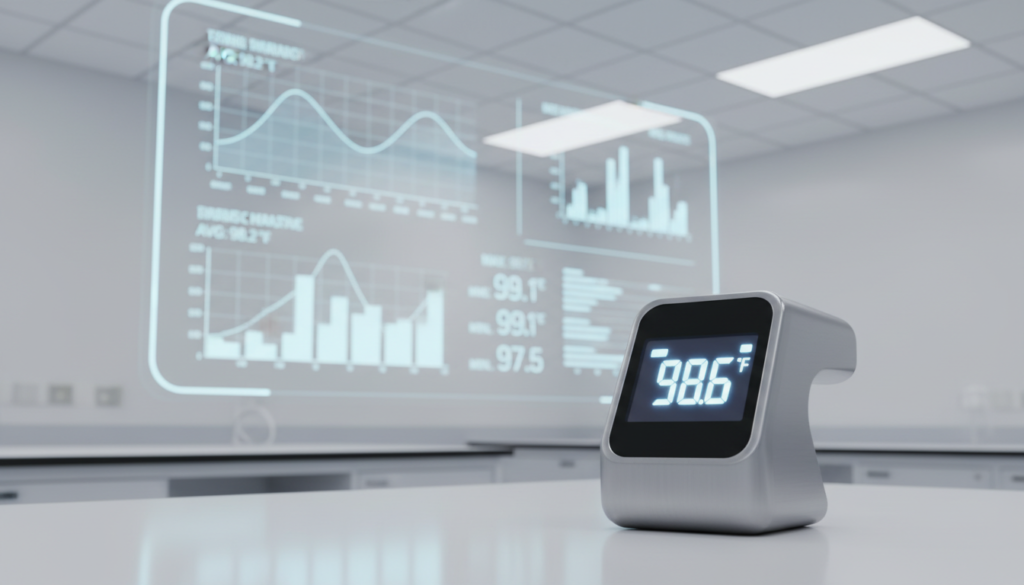
Thermometers keep getting better by changing old designs. Now, we see fewer liquid columns and more sensors. This means safer materials, faster results, and useful data for everyone.
Sustainable Materials and Eco-friendly Options
Today’s devices use solid parts and sealed housings. This makes them last longer and break less often. You can even find a digital thermometer that works months after you put it away.
Outdoor thermometers are also getting a makeover. They now use tough plastics and weather-ready seals. This makes them more durable and less likely to break.
Predictions for Thermometer Development
The future is about memory and sharing. More devices will log and send readings to your phone or other places. This means you can easily spot trends without extra work.
Accuracy will also improve, thanks to new sensors. But, it’s important to keep calibration standards. This ensures that temperature readings are the same everywhere, whether you’re in Minnesota or Arizona.
| What’s Changing | What You’ll Notice | Why It Matters Day-to-Day |
|---|---|---|
| More sensor-based designs (less liquid-in-glass) | Quicker readings and sturdier builds | A digital thermometer is easier to store, carry, and use without worry |
| Automatic logging and storage | Readings saved with dates and times | You can track trends without writing anything down |
| Better environmental protection for consumer devices | Housings that resist moisture, sun, and cold snaps | An outdoor thermometer keeps working through rough weather shifts |
| Tighter calibration practices tied to agreed scales | More consistent numbers across brands and locations | Comparisons make sense when you swap devices or travel |
Conclusion: The Thermometer’s Impact on Society
The thermometer’s story is about learning to trust numbers. Fever was first noted in ancient writings. Hippocrates was the first to tell doctors to watch for “too hot” bodies.
It took a long time for thermometers to become common in U.S. care. Now, we see infrared thermometers in clinics, airports, and workplaces.
Public health improved a lot when doctors started tracking temperatures every day. Carl Reinhold Wunderlich worked hard in the 1800s. He took temperatures for years and built a huge database.
He found that healthy temperatures stay steady, but illness patterns can be charted. He also said hands and feet can be misleading. Mouth readings can change after eating, drinking, or breathing through the mouth.
Then, the tools got better to meet the need. Early thermometers took about 20 minutes, which was too long when you’re sick. In 1866, Sir Thomas Clifford Allbutt made a smaller model that read in about five minutes.
This speed helped doctors and nurses spot danger sooner. They could respond faster because of clearer fever signs.
Scientific research also pushed the temperature frontier. Lord Kelvin’s 1848 scale gave a shared baseline to absolute zero. Now, thermocouples handle extremes from near absolute zero to industrial heat.
Infrared thermometers support non-contact checks and thermal imaging. So, whether tracking a flu spike or testing materials in a lab, thermometers help us see and solve problems.
FAQ
What is a thermometer, in plain English?
Who invented the thermometer?
How did people detect fever before medical thermometers existed?
What were the earliest “scientific” thermometer-like devices?
What did Hero of Alexandria contribute to early thermometry ideas?
When did people start thinking in “degrees” instead of vibes?
Why did fixed points like freezing and boiling water matter so much?
Who pushed the idea of standard calibration points?
What did Daniel Gabriel Fahrenheit actually invent and improve?
What was Anders Celsius’s big contribution?
Did Carl Linnaeus invent the Celsius scale we use now?
When did “degrees Celsius” become official?
Where does the Kelvin scale fit into thermometer history?
How does a mercury-in-glass thermometer work?
Why were mercury thermometers considered more reliable than earlier designs?
What role did alcohol play in thermometry?
Why were early thermoscopes sometimes wrong?
How did alcohol thermometers compare with mercury thermometers like Fahrenheit’s?
How did thermometers become a standard tool in medicine?
Why was Carl Reinhold Wunderlich so important to clinical temperature taking?
What temperatures did Wunderlich associate with high fever and dangerous fever?
Why did early clinical thermometers take so long to read?
Who made the first practical fast clinical thermometer?
How does a thermocouple work?
Are thermocouples used in medicine?
What makes a digital thermometer different from older designs?
How does an infrared thermometer measure temperature without touching you?
Who invented non-contact ear temperature measurement?
When did tympanic (ear) infrared thermometers become common in clinics?
Where do thermometers show up outside healthcare?
What is a “smart thermometer,” and what does connectivity add?
What features matter most in smart and registering thermometers?
Why is calibration such a big deal for any thermometer?
How are thermometers calibrated using freezing and boiling points?
Why does air pressure matter for boiling-point calibration?
Why do thermometric materials matter so much?
What is ITS-90, and why should you care?
Are mercury thermometers used today?
What’s driving “eco-friendly” changes in thermometer design?
What’s next for thermometers?
Where can you find deeper historical coverage of thermometer evolution?
Get More Medical History
Join our newsletter for fascinating stories from medical history delivered to your inbox weekly.