The History of Healing
 Polio Before Modern Eradication
Explore the tumultuous history of polio before modern eradication efforts transformed the global health landscape.

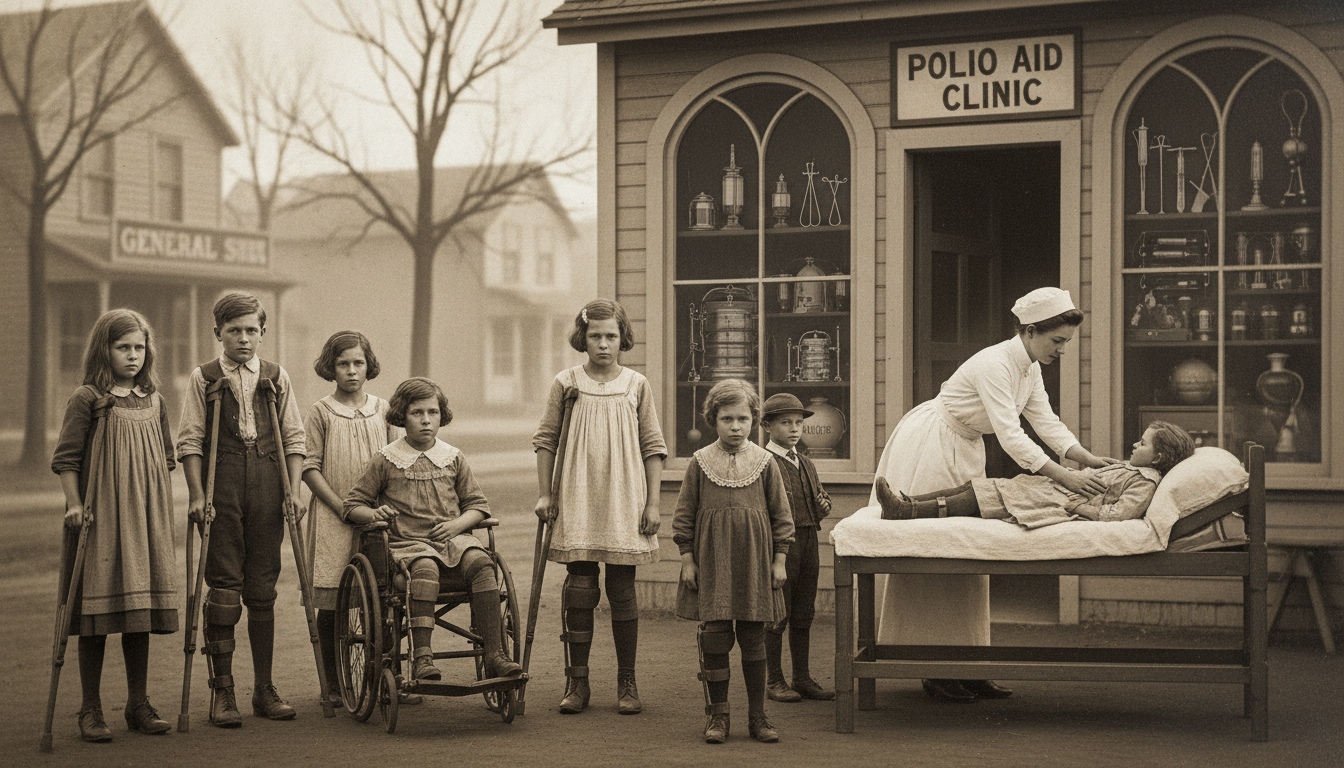
Before vaccines, polio killed or paralyzed over half a million people yearly. When today’s big efforts started, it was paralyzing over 1,000 kids daily. This shows why the fight against polio is so important.
In the late 1800s and early 1900s, polio was a huge fear in the U.S. and other countries. It could strike suddenly in summer. Parents looked for fever, stiffness, or weakness in their kids.
Polio is very contagious and can harm the nervous system. In bad cases, it can damage the spinal cord and nerves. This can cause paralysis, breathing problems, and even death, often without warning.
This part of history shows what life was like before vaccines. Vaccines in the 1950s and 1960s helped control polio. This changed how people lived in many countries. To understand this change, we need to see how bad polio was before vaccines.
Key Takeaways
- Before vaccines, polio killed or paralyzed over half a million people each year worldwide.
- At the start of major global efforts, polio was paralyzing more than 1,000 children every day.
- A polio epidemic in the early 20th century made the disease a top fear in the United States.
- Polio can attack the nervous system and cause spinal and respiratory paralysis.
- The impact of polio was often permanent, shaping families, schools, and public life.
- Vaccines in the 1950s and 1960s marked the shift from widespread outbreaks to control in industrialized countries.
A Historical Overview of Polio
Polio’s history goes way back, before we had labs and vaccines. In Polio Before Modern Eradication, the disease would appear and then disappear. It was always feared, because it could hit anyone, but mostly kids.
Origins and Early Cases
Studies show polio has been around prehistoric times. Ancient Egyptian art shows kids with withered limbs using canes. This matches polio’s effects.
Doctors started to describe it clearly in the 1700s. Michael Underwood wrote about it in 1789. In 1840, Jakob Heine made it clear it was a unique disease. This helped doctors track it better.
| Time period | What was recorded | Why it mattered |
|---|---|---|
| Ancient Egypt | Images of children with withered limbs and canes | Suggested early, recognizable patterns in the history of polio |
| 1789 | Michael Underwood described cases of childhood paralysis | Added medical language that helped separate polio from other illnesses |
| 1840 | Jakob Heine recognized the condition as its own disease | Improved diagnosis and made later comparisons during polio outbreaks possible |
Global Spread of the Virus
By the late 1800s and early 1900s, polio outbreaks were common. They hit hard in industrialized countries. Schools closed, gatherings were canceled, and summers were filled with fear.
Polio’s impact was huge, not just in hospitals. Families faced sudden paralysis, long recovery times, and lasting disabilities. Even if a patient survived, they often had to deal with lasting effects.
By the mid-20th century, polio was everywhere, with no cure. This global spread made prevention key. It set the stage for the efforts to fight polio before modern times.
Understanding Polio’s Impact in the United States
In the United States, polio’s impact was real. It caused summer closures, tense headlines, and filled hospital wards with children. Each outbreak changed daily life and made families watch for even mild symptoms.
Doctors and nurses had limited tools but were expected to act fast. As outbreaks spread from city to city, fear grew fast. This made the disease feel close to everyone, even those far from the worst-hit areas.
Epidemics of the Early 20th Century
The 1916 New York City outbreak was a turning point, killing over 2,000. Hospitals were crowded, and communities tried to limit contact in public places. Families learned new rules about isolation without clear guidance.
Later, the 1952 U.S. outbreak was the worst, killing over 3,000. It left a mark on medical records and public memory. For many, polio’s impact was seen in empty classrooms and long rehabilitation stays.
| U.S. outbreak marker | Location or scope | Reported deaths | Why it mattered |
|---|---|---|---|
| 1916 outbreak | New York City | Over 2,000 | Early mass fear, strained hospitals, wide public restrictions |
| 1952 outbreak | United States (nationwide) | Over 3,000 | Largest recorded U.S. wave, intensified demand for prevention and care |
Societal Response to Polio Outbreaks
Polio was a top fear in industrialized countries, and Americans felt it. Parents avoided crowds, and officials weighed shutdowns. Even after cases dropped, caution remained.
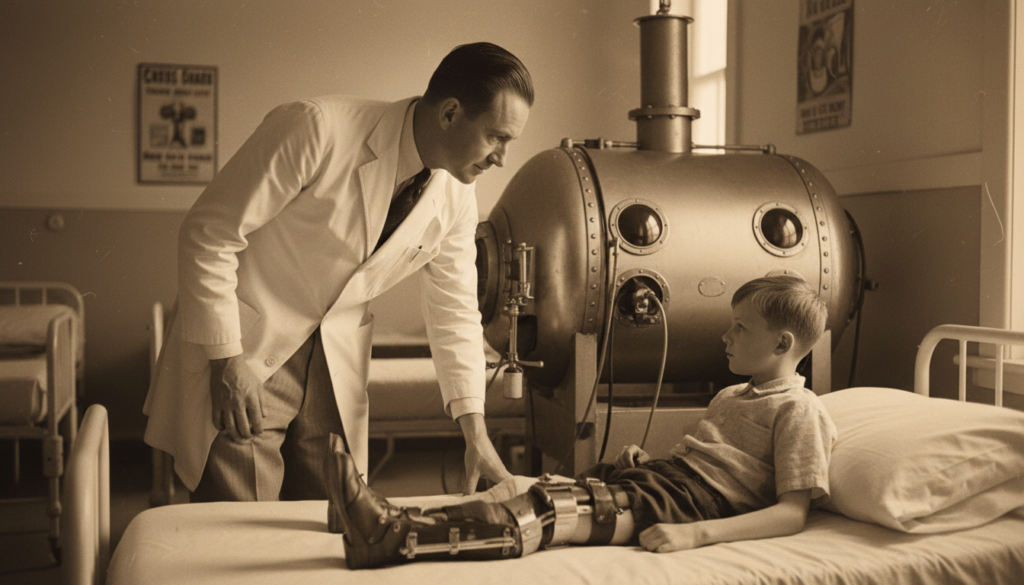
The impact of polio was seen in public spaces. Survivors often had deformed limbs and used leg braces, crutches, or wheelchairs. For severe cases, the iron lung symbolized fragile breathing.
At the bedside, treatment focused on support. Nurses provided care, assisted breathing, and physical therapy. Communities raised funds for equipment and rehabilitation. This shared experience shaped how Americans responded to large immunization efforts later.
The Medical Community’s Initial Reactions
Hospitals in the U.S. faced big challenges as summer outbreaks grew. They had too few staff, beds, and tools. The fight against polio quickly turned into emergency care.
Clinicians worked hard to track symptoms and map outbreaks. They tried to lessen the blow of polio on families already scared.
With no cure, early efforts focused on isolation and cleanliness. Schools were advised to close to prevent polio. Doctors also created standard tests for weakness and breathing issues.
Early Research and Discoveries
Researchers sought answers on why some got paralyzed and others didn’t. In 1949, John Enders, Thomas Weller, and Frederick Robbins grew poliovirus in human tissue at Boston Children’s Hospital. Their work won the 1954 Nobel Prize, making bigger tests possible.
This breakthrough made stopping polio infections seem more doable. It also helped doctors sort fact from fiction, which was key in a time of high fear.
Development of Treatment Protocols
Before the first vaccine in 1955, treatment was mainly supportive. Kids needing oxygen often used an iron lung for weeks. Teams monitored oxygen levels and adjusted settings to avoid exhaustion.
For paralysis, treatment went beyond the acute phase. It included physical therapy, braces, and wheelchairs. The history of polio in U.S. hospitals also shows long rehab and a focus on prevention as epidemics kept happening.
| Clinical challenge | Common response in early hospital care | Why it mattered for patients |
|---|---|---|
| Breathing failure | Artificial respirators, including the iron lung; close respiratory monitoring | Reduced immediate risk during the most dangerous phase and helped stabilize severe cases |
| Limb weakness and paralysis | Positioning, range-of-motion therapy, braces, and mobility aids such as wheelchairs | Supported function, limited deformities, and addressed day-to-day effects tied to the impact of polio |
| Overwhelmed wards during outbreaks | Triage routines, standardized exams, and coordinated staffing across units | Helped match resources to need while reinforcing the case for polio prevention |
The Role of Public Health Campaigns
Public health campaigns changed how we see polio. In the 1950s and 1960s, vaccines proved their worth. This made fighting polio a shared goal, not just a personal worry.
Many countries, like the United States, saw fewer polio cases. This was thanks to routine vaccinations.
Importance of Awareness Campaigns
Awareness campaigns taught us simple steps to fight polio. We learned to get vaccinated, follow schedules, and watch for signs of polio. Posters, radio, and school notices spread the word.
Community groups built trust. Local clinics and volunteers explained how vaccines work. This made vaccination a normal part of life, helping the global fight against polio.
Government Interventions and Policy Changes
In the United States, a big push for vaccination started in 1955. This was after Jonas Salk’s vaccine was deemed safe. It made fighting polio a public effort, backed by resources and plans.
By the 1970s, vaccination became routine worldwide. Health agencies used data to track polio. This helped shape today’s global fight against polio.
| Campaign focus | What was done | How it reduced risk |
|---|---|---|
| Mass communication | Simple messages on symptoms, clinic hours, and vaccine schedules | Improved uptake of polio vaccines and faster reporting during polio outbreaks |
| National immunization policy | Large-scale vaccination drives starting in 1955 in the United States | Turned polio prevention into a routine expectation, not an emergency response |
| Routine immunization worldwide | Programs scaled in the 1970s using field surveillance, including lameness surveys | Mapped hidden transmission and supported the global polio eradication effort |
| Coordinated eradication-era partnerships | Rotary International launched a global effort in 1985; the GPEI formed in 1988 | Aligned vaccination, lab testing, and surveillance to limit polio outbreaks across borders |
Advances in Vaccine Development Before Eradication
Before we controlled polio, vaccines moved from labs to schools and clinics. The goal was to stop polio fast by reaching millions.
Two main vaccines were developed. One was a shot with a killed virus. The other was a weakened virus given orally, for quick use in outbreaks.
The Salk Vaccine: Breakthrough in the 1950s
Jonas Salk created the first polio vaccine in the 1950s. He tested it on himself and his family first. Then, he tested it on 1.6 million kids in Canada, Finland, and the U.S.
On April 12, 1955, the results were in. The Salk vaccine was approved that day. In the U.S., cases dropped from 58,000 to 5,600 by 1957, and to 161 by 1961.
Salk wanted everyone to have access to the vaccine. He didn’t make money from it. In a 1955 interview, he said:
“Well, the people, I would say. There is no patent. Could you patent the sun?”
IPV mainly protected the child who got it. It lowered the chance of paralysis but didn’t stop the virus from spreading.
The Sabin Oral Polio Vaccine
Albert Sabin created a live-attenuated vaccine given orally. It was easy to give in schools and clinics. This made it great for big campaigns.
Big trials proved its worth. In the Soviet Union, 20,000 kids and then 10 million were tested. Czechoslovakia tested it on over 110,000 kids. The World Health Organization approved it based on these studies.
OPV was key for stopping outbreaks. Hungary started using it in December 1959. Czechoslovakia followed in early 1960. Cuba began nationwide use in 1962.
| Feature | Salk vaccine (IPV) | Sabin oral polio vaccine (OPV) |
|---|---|---|
| Virus type | Inactivated (killed) virus | Live-attenuated (weakened) virus |
| How it is given | Injection | Oral drops or sugar cube |
| Main strength for polio prevention | Strong individual protection against paralytic disease | Helps interrupt transmission during outbreaks |
| Landmark validation | 1.6 million-child field trial; results announced April 12, 1955 | Soviet Union trials (1958–1959) and Czechoslovakia trials (1958–1959) |
| Early real-world rollout examples | Licensed in the U.S. on April 12, 1955; rapid case declines by 1957 and 1961 | Hungary (Dec 1959), Czechoslovakia (early 1960), Cuba (1962) |
Challenges in Controlling Polio Spread
Stopping polio is harder than it seems. Small gaps in vaccination can grow fast. This happens when families move, clinics are short-staffed, or trust is lost.
Polio prevention needs steady access, clear messages, and quick action when risk rises.
Misconceptions and Fear of Vaccination
In many U.S. areas, vaccine doubts spread fast. When parents delay or skip doses, coverage drops below 95%. This makes outbreaks more likely.
Reports show coverage near 79% in some places. This shows how quickly vulnerability can grow.
Low coverage can lead to mutated viruses. These can cause paralysis and lifelong disability. This is a big concern.
COVID-19 made things worse. Clinics were used for pandemic care, and visits were delayed. This created clusters of unvaccinated kids.
This makes the global fight against polio harder. Travel and importation risks are always there.
Geographic and Cultural Barriers
Geography is a big factor. Rural areas have fewer doctors and longer trips to clinics. In cities, overcrowding and long hours can make follow-up hard.
Cultural barriers are also big. Language, past health care experiences, and misinformation can lower vaccination rates. This creates areas where polio can spread before health teams can act.
| Control challenge | How it affects coverage | How it raises outbreak risk | What helps reduce risk |
|---|---|---|---|
| Vaccine hesitancy | Delayed or skipped doses; uneven protection across neighborhoods | Creates clusters of susceptible children that can sustain transmission | Clear, local communication and easy, no-cost vaccination access |
| Coverage below 95% | Less community immunity, specially where rates drop near 79% | Makes reintroduction more likely and harder to stop once started | Catch-up campaigns and reminders through schools and clinics |
| OPV-related mutation in low-immunity settings | More people can carry and spread virus when immunity is low | Can contribute to cVDPVs that cause paralysis, increasing the impact of polio | High coverage and rapid response vaccination in affected areas |
| Strained health services during emergencies | Missed well-child visits and delayed routine immunizations | Leaves immunity gaps that can persist for months or years | Protected routine immunization capacity and mobile clinics |
| Weaker surveillance for acute flaccid paralysis (AFP) | Fewer timely reports in children under 15 and slower investigation | Delays detection, allowing silent spread before action | Consistent AFP monitoring, lab support, and funded field teams |
Surveillance is key to keeping the fight going. When AFP monitoring drops, early signs can be missed. Strong detection and quick action are vital for eradicating polio.
The Global Picture of Polio Prior to Eradication
Looking at polio worldwide, not just in the U.S., shows a different story. Many cases were missed or mislabeled, making it hard to see the problem. This delay affected early efforts to stop polio and get vaccines.
In the 1970s, surveys revealed how common polio was in Africa and Asia. This led health leaders to see polio as a major issue, not just a rare disease. They started to expand vaccination programs in many countries.
Polio in Developing Countries
In poor areas, polio spread where it was hard to keep things clean. Families had to travel far to get vaccines, making it tough to stop polio. When vaccines were missed, the virus found new places to spread.
As vaccines became more available, the next hurdle was getting them to everyone. The World Health Organization helped increase vaccine production in places like India and Indonesia. This helped get vaccines to more people faster.
| Barrier seen before wide control | What it caused on the ground | Common response used at the time |
|---|---|---|
| Late recognition of paralysis patterns | Under-counted cases and slow political urgency | Lameness surveys and stronger surveillance |
| Limited clinic access and staffing | Missed doses and uneven coverage | Mobile teams and short, high-intensity campaigns |
| Vaccine supply constraints | Delayed rollouts in high-risk districts | Expanded manufacturing and coordinated distribution |
| Population movement across borders | Re-seeding of outbreaks after local gains | Synchronized immunization days and cross-border planning |
International Collaborative Efforts
The fight against polio grew through global partnerships. Rotary International started a worldwide effort in 1985. The Global Polio Eradication Initiative launched in 1988, aiming to stop polio that paralyzed over 1,000 kids daily.
Today, over 200 countries and territories work together, with 20 million volunteers. More than 2.5 billion kids have gotten polio vaccines. Big campaigns in China and India in 1995 and efforts in Europe and Africa in 1995 and 2004 show the power of teamwork.
The Economic Burden of Polio
Polio epidemics hit hard and fast. They filled hospitals and left families with big bills. Polio’s impact was huge, affecting work, school, and spending in the U.S.
Every year, polio killed or paralyzed over half a million people worldwide. This put a big strain on hospitals. Even small outbreaks caused fear, leading to more testing and planning.
Healthcare Costs Related to Outbreaks
Polio could turn simple care into a big emergency quickly. Hospitals needed to watch patients closely and provide breathing help. Some patients needed iron lungs, which cost a lot.
Costs went up outside the ICU too. Clinics did follow-up visits and therapy. Vaccines later helped prevent these costs.
| Cost driver | What it involved | Who paid most often | Why costs climbed during a polio epidemic |
|---|---|---|---|
| Emergency respiratory care | Ventilatory support, iron lungs, round-the-clock monitoring | Hospitals, insurers, families | High staffing needs and limited devices during surges |
| Inpatient isolation and nursing | Dedicated wards, infection control, extended stays | Hospitals, public health programs | Bed shortages forced costly reallocations and overtime |
| Rehabilitation services | Physical therapy, gait training, repeated assessments | Families, community programs, insurers | Recovery was slow, with many sessions over months |
| Public health response | Surveillance, case investigation, community guidance | State and local government | Each spike in polio outbreaks triggered new rounds of staffing and supplies |
Long-term Effects on Survivors
Survivors often needed special equipment and care at home. This led to more expenses for families. The effects of polio lasted long after the outbreaks ended.
Polio could also affect work life. Some people had to change jobs or stop working. The total cost included lost income and ongoing support needs for years.
The Role of Media in Polio Awareness
Before social media, people learned about polio from headlines and radio. The media explained the risks and helped families decide what to do. This coverage changed how we talk about disease today.
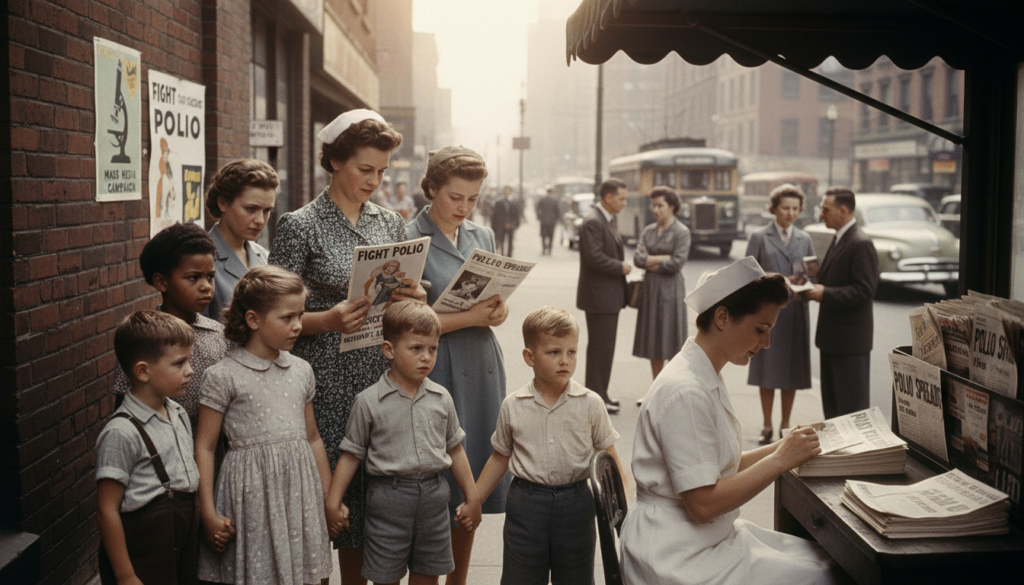
When polio outbreaks happened, the press was a key source of information. Editors shared what they knew, and readers got updates on cases and rules. These reports helped people understand how polio affected their lives.
Newspaper Reporting during Outbreaks
In 1916, New York City was hit hard by polio. Newspapers warned parents in clear terms. They told of closed playgrounds and hospitals full of patients.
In 1952, the U.S. faced another deadly wave. Newspapers gave updates and advice. They explained what paralysis was and why prevention was key.
On April 12, 1955, news of the Salk vaccine was big. Reporters explained the vaccine’s promise in simple terms. As more people got vaccinated, the focus shifted from fear to action.
Portrayal of Polio in Popular Culture
Popular culture showed polio in powerful images. The iron lung became a symbol of the pre-vaccine era. These images made polio hard to ignore.
Stories of survivors and fundraisers were common. They showed how people coped with disability. These stories kept polio in the public mind, even when cases were low.
| Media focus | Common format | What audiences learned | How it shaped behavior |
|---|---|---|---|
| Breaking reports during polio outbreaks | Daily headlines, case maps, public notices | Where risk seemed highest and which rules applied | Changed travel, gatherings, and summer routines |
| Polio epidemic milestone coverage | Science explainers, interviews, press briefings | How trials worked and what vaccination could prevent | Increased acceptance of clinics and immunization drives |
| Human-interest storytelling | Profiles, photo essays, community campaigns | The long recovery arc and lasting disability needs | Boosted donations, volunteering, and local support networks |
| Iconic treatment imagery | Photographs and newsreel-style visuals | A concrete sense of the impact of polio on breathing and mobility | Raised urgency around prevention and early care |
Lessons Learned from Pre-Eradication Polio Era
Before vaccines, public health learned a lot. Polio showed how fear spreads fast and how long-lasting disability can be. These lessons guide today’s fight against polio.
In the US and Americas, the focus shifted from reacting to preventing outbreaks. Polio prevention became a regular goal, not just a plan for emergencies. This change needed steady funding, clear messages, and quick-acting teams.
Strategies That Helped Mitigate Spread
High vaccination rates were key. Health experts say 95% coverage is critical to reduce polio risk. When rates drop, communities become more vulnerable, even if polio seems gone.
Polio vaccines need strong monitoring systems, not just supplies. Health departments use AFP surveillance in children under 15 to catch signs early. This approach helped keep the Americas polio-free for years.
Low immunization rates can lead to problems like circulating vaccine-derived polioviruses. In areas with low vaccine rates, weakened virus can change and spread, causing paralysis. This shows why keeping up with vaccines and tracking is so important.
| Mitigation tool | How it worked in practice | Why it’s important for the global polio eradication effort |
|---|---|---|
| 95% immunization coverage goal | Boosted community immunity to block polio spread | Reduces chances of outbreaks or reintroduction |
| AFP surveillance in children under 15 | Flagged possible cases early for quick action | Helps confirm polio-free status and detect threats fast |
| Rapid outbreak response campaigns | Targeted vaccination in high-risk areas | Limits spread when immunity gaps appear |
| Risk communication and clinician training | Improved recognition and reporting of symptoms | Keeps polio impact visible in health systems |
Importance of Community Engagement
Eradication efforts grew when communities were involved. The global effort involved over 200 countries and 20 million volunteers. This network helped vaccinate about 2.5 billion children, showing the power of trust and logistics.
Rotary International kept the momentum after smallpox was defeated. Their campaigns supported large-scale vaccination, like a project in the Philippines. This showed that vaccines work best when families expect and support them.
Community engagement also changed how health systems talk about risk. Clear messages, local leadership, and ongoing education keep the threat of polio in focus. This steady effort supports prevention without waiting for emergencies.
Reflections on the Pre-Vaccine Era
Before vaccines, polio changed life in ways we can’t fully imagine today. Ancient art hinted at paralysis, and by the 18th and 19th centuries, doctors could name the disease. By the 20th century, polio outbreaks made headlines, causing sudden illness, disability, and death.
The arrival of polio vaccines marked a big change. In the 1950s and 1960s, shots became common in the U.S. and other rich countries. This made polio rare, shifting care from crisis to routine.
The fight to end polio has made huge progress. Today, wild poliovirus is found in just two countries. Science has also wiped out two virus types: wild poliovirus type 2 in 1999 and type 3 in 2019.
In the Americas, the World Health Organization declared the region polio-free in 1994. This followed the last wild case in Peru in 1991. The case was in Luis Fermin Tenorio Cortez from Pichinaki in Chanchamayo Province, Junín Department.
But the fight is not over, even with strong vaccines. Oral polio vaccine can sometimes cause problems if too many are unvaccinated. This is why a 2022 polio case in New York was a big deal. Keeping vaccination rates high and watching for paralysis are key to preventing polio.
FAQ
What was polio like before modern eradication efforts?
What does polio do to the body?
How far back does the history of polio go?
When did medicine first describe polio as a distinct disease?
Why did polio become an epidemic in the early 20th century?
How big was the global polio epidemic before vaccines?
What were the most notable U.S. polio outbreaks?
What did polio treatment look like before vaccines?
Why is the iron lung so closely associated with polio?
What scientific discovery made polio vaccines possible?
What is the difference between the Salk vaccine (IPV) and the Sabin vaccine (OPV)?
How were the Salk vaccine trials conducted, and what happened after licensing?
Did Jonas Salk patent the polio vaccine?
How was the Sabin oral polio vaccine validated and adopted internationally?
When did national immunization campaigns begin in the United States?
When did routine polio immunization expand worldwide?
Why was polio recognized later as a major problem in developing countries?
What is the Global Polio Eradication Initiative (GPEI), and why was it created?
What role did Rotary International play in polio prevention?
How large was the global mobilization against polio after 1988?
What strategies helped reduce spread during the pre-eradication and early eradication era?
What vaccination coverage is needed to prevent polio from coming back?
How can low vaccination rates lead to vaccine-derived polio (cVDPV)?
How did the COVID-19 pandemic affect polio prevention?
What happened in New York in 2022, and why did it matter?
What was the economic and healthcare burden of polio before eradication-scale control?
How did media coverage influence public behavior during polio outbreaks?
Why did polio become “the most feared disease” in many communities?
How much progress has the global polio eradication effort made?
When were the Americas certified polio-free, and what case marked the end of wild polio there?
What lessons from the pre-vaccine era can we learn today?
Why is polio a concern even after decades of vaccine success?
Get More Medical History
Join our newsletter for fascinating stories from medical history delivered to your inbox weekly.