The History of Healing
 Unlock the Secrets of Shamanic Healing
Discover the fascinating trepanation history from ancient skull surgeries to modern neurosurgery, exploring reasons, techniques, and cultural significance.


Did you know that 5% of skulls from ancient burial sites show signs of surgery? These weren’t injuries from battles or accidents. People had intentionally cut into their skulls, and many survived.
In the 1860s, E.G. Squier found a skull in Peru. It had a big hole carved into it. This was from a pre-Columbian Inca cemetery.
Squier was amazed by the skull. He took it to New York in 1865. He showed it to the New York Academy of Medicine. He believed it was proof of ancient brain surgery.
The skull had marks made with a tool used for engraving. The bone around the hole showed new growth. This meant the patient had lived for at least a few weeks after the surgery.
This discovery opened a new chapter in understanding ancient trepanation. It’s one of the oldest surgeries known. It was practiced thousands of years ago, across many continents and cultures.
So, why did ancient people do this? Was it for medicine, rituals, or to release evil spirits? The answers are both strange and fascinating. Let’s explore them.
Key Takeaways
- Trepanation — the deliberate drilling of holes in the skull — is one of the oldest known surgical practices in human history.
- E.G. Squier’s 1865 discovery of a trepanned Inca skull in Peru brought ancient trepanation to the attention of modern medicine.
- Bone regrowth on ancient skulls proves many patients survived the procedure, sometimes by weeks or longer.
- Trepanation origins span thousands of years and appear across multiple continents independently.
- Ancient surgeons used surprisingly precise tools, including burins designed for engraving.
- The reasons behind trepanation ranged from treating head injuries to spiritual and ritualistic purposes.
What Is Trepanation? Defining the Ancient Practice
Here’s a wild fact: people have been drilling holes in each other’s skulls for thousands of years. This wasn’t just a fringe ritual. It happened all over the world, from ancient Greece to South America. Let’s look at what trepanation is, where it comes from, and its first medical mentions.
The Basic Definition
Trepanation means drilling, cutting, or scraping a hole in the skull. It’s done to expose the brain. It was used to treat head injuries and relieve pressure.
It’s one of the oldest surgeries, thousands of years before modern medicine.
First Mentions in Medical Literature
The first written records of trepanation are in the Hippocratic Corpus. This is a collection of ancient Greek medical texts from the 5th and 4th centuries BCE. Greek doctors described how to open the skull step by step.
Doctors kept doing trepanation until the early 1800s. Even in the 18th century, they used it to treat epilepsy and mental disorders.
Why the Name “Trepanation”?
The word “trepanation” comes from the Greek trypanon, meaning “auger” or “borer.” It’s fitting for a procedure that bores into bone. Today, we call it a craniotomy, a more advanced version of trepanation.
The roots of this surgery go back a long way. Understanding its history makes the story even more interesting.
The Origins of Trepanation: How Far Back Does It Go?
So, how old is trepanation? It’s really, really old. We’re talking thousands of years ago, before hospitals even existed. The story of how we found this out is quite amazing.
Neolithic and Paleolithic Evidence
Archaeology has found skulls with holes in them in Western Europe and the Americas. These skulls date back to the Neolithic period, and some are even from the late Paleolithic, over 10,000 years ago. Yes, you read that right. People were doing this before they even had metal tools.
It’s amazing how many societies tried this. Trepanation anthropology shows it wasn’t just one group or continent. It happened independently across cultures. This suggests a universal human need to heal or seek spiritual relief.
The Squier Skull Discovery
In the 1860s, a big change happened. Ephraim George Squier, an American diplomat, brought a trepanned skull from Peru to Paul Broca, a famous French surgeon. Broca was shocked to find out that Indigenous societies had been doing advanced surgery long before Europeans arrived.
This was a huge revelation. Western doctors couldn’t believe that non-European cultures could do such complex surgeries. In the 19th century, hospitals were very bad at keeping patients alive because of infections. How did ancient trepanation patients survive without modern medicine?
Broca’s endorsement changed everything. It led to a flood of discoveries in trepanation archaeology all over the world. Scientists started looking, and more trepanned skulls were found in digs everywhere.
- Squier’s Peruvian skull showed clear signs of bone healing — proof the patient survived
- Broca’s analysis challenged deep-seated European biases about Indigenous medical knowledge
- The discovery sparked a global search that revealed ancient trepanation on nearly every continent
Trepanation Tools and Techniques Across Cultures
Ancient people didn’t just guess when cutting into skulls. They used different trepanation techniques from culture to culture. Each method showed real creativity and care. Let’s explore what they used.
Prehistoric Instruments
The first trepanation tools were simple but effective. In ancient Peru, surgeons used a tumi knife for careful cuts. In Europe, flint and obsidian blades were used. In the South Pacific, seashells were sharpened for precise cuts.
These tools worked amazingly well. The success rates of Neolithic trepanation show these ancient surgeons were skilled.
The Evolution of Surgical Tools
Over time, trepanation tools got better. The ancient Greeks introduced the trephine, a drill for making round holes in skulls. This was a big improvement for trepanation everywhere.
| Culture/Era | Primary Tool | Technique |
|---|---|---|
| Neolithic Europe | Flint and obsidian blades | Scraping and cutting |
| Ancient Peru | Tumi (ceremonial knife) | Scraping grooves into bone |
| South Pacific | Sharpened seashells | Incising and cutting |
| Ancient Greece | Trephine drill | Circular boring |
| Renaissance Europe | Specialized surgical kits | Precision drilling |
By the Renaissance, trepanation was common. Doctors used special kits with many tools. The shift from seashells to steel shows our ability to solve problems with new technology.
Who Got Trepanned? Patients Young, Old, and Everything In Between
So we know how ancient surgeons drilled into skulls. But who were they actually operating on? The answer might surprise you. Trepanation practices weren’t limited to a specific age group, gender, or social class. Research in trepanation anthropology reveals that patients ranged from children to the elderly — men and women alike.
Demographics of Trepanation Patients
Skulls unearthed across multiple continents tell a pretty wild story. Ancient trepanation was performed on all kinds of people. Some skulls show clear signs of trauma — depressed fractures that gave surgeons an obvious medical reason to intervene. Others? No visible injury at all.
Take the famous skull discovered by Ephraim George Squier in Peru. It showed zero signs of a head wound. So why was the surgery performed? That’s the mystery that keeps researchers hooked on trepanation history.
Some patients even went under the blade more than once. Archaeologists have found skulls with multiple trepanation holes, each showing signs of healing. These people survived repeated surgeries in a world without antibiotics or sterile operating rooms.
Survival Rates That Will Blow Your Mind
Here’s where things get really impressive. Cognitive neuroscientist Charles Gross estimated survival rates that put ancient trepanation in a whole new light:
| Time Period | Estimated Survival Rate | Evidence of Long-Term Survival |
|---|---|---|
| Neolithic Era | 50–70% | Bone regrowth around openings |
| Pre-Columbian Peru | Up to 80–90% | Multiple healed trepanations per skull |
Many trepanned skulls show extensive bone regrowth — clear proof that patients lived for years, sometimes decades, after their surgery.
These survival numbers are staggering when you consider the conditions. No anesthesia, no sterilization, no post-op care as we know it. Yet these ancient surgeons pulled it off with shocking consistency. And that raises the big question: why did they do it in the first place?
Why Did Ancient People Drill Holes in Skulls? The Reasons Behind Trepanation
So here’s the big question — why on earth would anyone drill into a human skull? The answer isn’t simple. Trepanation practices varied wildly depending on where and when they took place. Some reasons were surprisingly logical. Others? Pretty wild.
Medical and Practical Motivations
John Verano, a prominent anthropologist at Tulane University, has spent years studying trepanation procedures in Peru. His research reveals something you might not expect: in Peru, the South Pacific, and many other regions, trepanation started as a very practical treatment for head injuries. It was used to clean out wounds, pull out broken bone fragments, and relieve brain swelling after trauma.
This isn’t just ancient guesswork — it’s solid medical logic. Modern eyewitness accounts from Africa and the South Pacific confirm that trepanation practices are used today. They treat head wounds, chronic headaches, and pressure buildup on the brain.
| Motivation | Region | Evidence Type |
|---|---|---|
| Head trauma treatment | Peru | Skull fractures near trepanation sites |
| Relieving brain pressure | South Pacific | Modern eyewitness accounts |
| Treating headaches | East Africa | Contemporary practice |
| Spiritual healing | Europe (Neolithic) | Skulls with no visible injury |
Spiritual and Ritualistic Theories
Now things get interesting. Trepanation anthropology has uncovered plenty of skulls with no signs of injury at all. No fractures. No disease. So why drill? In some cultures, trepanation procedures may have been performed to release evil spirits, treat epilepsy, or address mental illness.
Without written records, we can’t know for certain. That ambiguity is exactly what makes trepanation history so endlessly fascinating — and what keeps researchers digging (pun intended) for answers. The line between medicine and magic wasn’t always clear in the ancient world, and these skulls are living proof of that blurry boundary.
The Pain Factor: What Was Trepanation Actually Like?
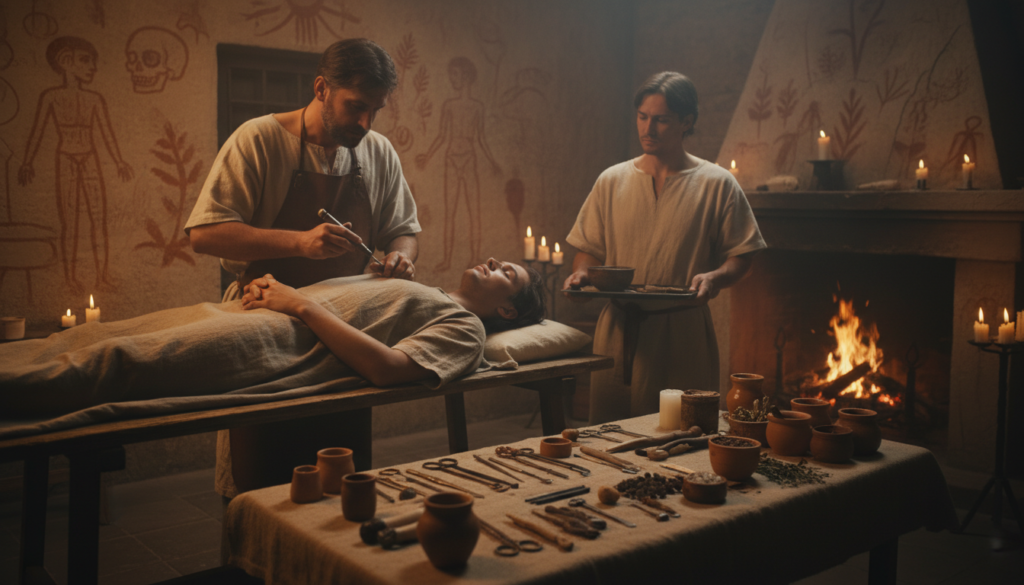
Imagine someone about to cut a hole in your skull while you’re awake. It’s a scary thought. Ancient trepanation was both frightening and fascinating.
Anesthesia (or Lack Thereof)
Most trepanation was done without anesthesia. Anthropologist John Verano says patients were likely awake. This was true unless they were already knocked out.
Verano notes that cutting the scalp is very painful. It’s full of nerve endings and bleeds a lot. But, the skull has few nerves, and the brain has none. So, once past the scalp, the pain lessened.
“The human skull is remarkably forgiving when handled with care — a fact that ancient healers understood long before modern textbooks existed.”
The Anatomy That Made It Survivable
So, how did people survive trepanation? The answer is in the technique. Surgeons didn’t cut through the dura mater, the tough outer brain membrane.
Touching this layer could lead to meningitis and death. Yet, ancient surgeons knew to stop before reaching it.
| Anatomical Layer | Nerve Sensitivity | Risk If Breached |
|---|---|---|
| Scalp | High (many nerve endings) | Heavy bleeding, intense pain |
| Skull Bone | Low (few nerves) | Minimal if properly managed |
| Dura Mater | Moderate | Meningitis, infection, death |
Whether from instinct or experience, these techniques show a deep understanding of anatomy. This is something modern medicine respects.
Trepanation in Ancient Greece and Rome
When we think of ancient trepanation, we might picture cavemen using sharp rocks. But the Greeks and Romans did it differently. They made skull surgery look like real medicine.
The Hippocratic Approach
The Hippocratic Corpus is key in trepanation history. It’s the first written mention of trepanation as a formal procedure. Before, skull surgery was practiced for ages without being written down. Greek physicians changed that.
The Hippocratic school created the trephine drill. This tool made precise holes in the skull. It was a big step up from the old ways of scraping and chiseling.
“No head injury is too trivial to ignore.” — Hippocrates
Greek doctors used trepanation to relieve pressure and remove bone fragments. It was no longer mystical. It was practical and documented.
Greco-Roman Surgical Advances
Roman surgeons improved on Greek knowledge. They made trepanation tools with crown-shaped cutting edges. This reduced the risk of damaging brain tissue.
| Feature | Prehistoric Methods | Greco-Roman Methods |
|---|---|---|
| Primary Tool | Obsidian blades, flint scrapers | Trephine drills, crown saws |
| Precision Level | Low — rough scraping | High — controlled boring |
| Documentation | None (oral tradition) | Written medical texts |
| Main Purpose | Ritual and trauma treatment | Trauma, fluid drainage, fractures |
This era marked a big step towards modern surgery. We’ll see how it led to the Renaissance next.
Trepanation Through the Renaissance and Beyond
You might think trepanation went away with better medicine. But it didn’t. It got more popular. From the Renaissance to the 1700s, it was big in Europe. Surgeons got creative with their tools.
Routine Renaissance Procedures
In the Renaissance, trepanation was common for head wounds. Surgeons used special tools. These tools were better than anything ancient times had.
Battlefield injuries kept surgeons busy. A skull injury? Drill time. These surgeries were taught in schools and manuals. By the 18th century, they treated more than just wounds.
The 18th and 19th Century Decline
By the 1800s, survival rates dropped. Hospital infections were the main reason. Surgeons worked in dirty conditions, leading to sepsis.
Think about it. Ancient people with stone tools had better survival rates. This irony made scientists like Ephraim George Squier and Paul Broca face opposition.
| Era | Trepanation Techniques Used | Estimated Survival Rate |
|---|---|---|
| Neolithic (5000+ BCE) | Scraping, grooving with stone tools | Up to 80% |
| Renaissance (1400–1600s) | Trephine drills, elevators | 60–70% |
| 19th Century Hospitals | Metal trephines, surgical saws | Below 50% |
It wasn’t until antiseptics came in the late 1800s that surgery improved. Ancient healers knew the importance of cleanliness.
Trepanation Across the Globe: A Worldwide Practice
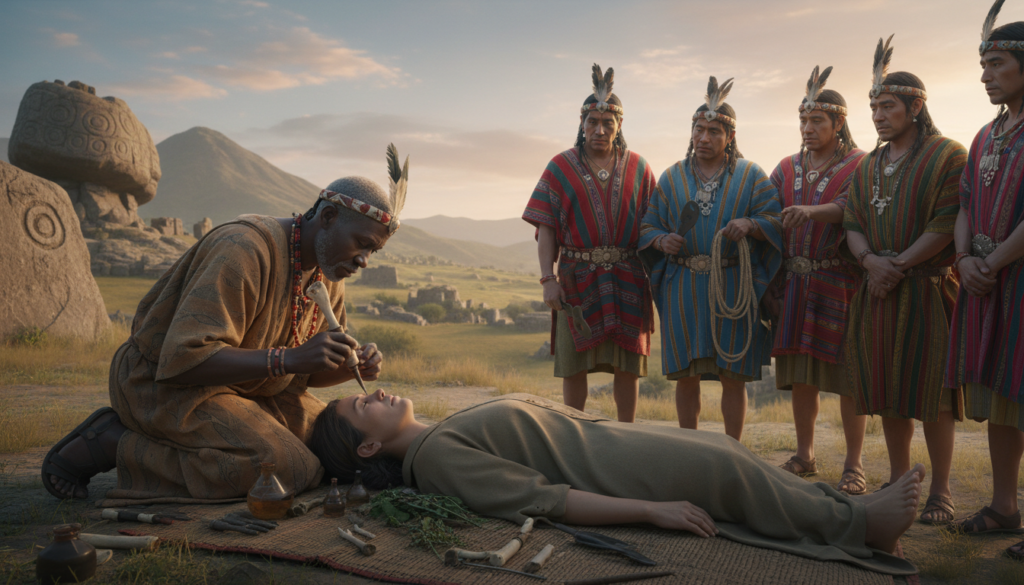
Here’s something wild. After Paul Broca confirmed the Squier skull in the 1860s, skulls with holes started showing up everywhere. This happened on every continent. It shows that people all over the world came up with the idea of drilling into skulls, all on their own, over thousands of years.
This global spread means a lot. It shows that drilling into the skull was not just a one-time thing. It was a common human response to injury, illness, or spiritual needs.
Peru and South America
South America, and Peru in particular, is a big deal in trepanation history. Peru has more skulls with holes than any other place. Ancient Andean surgeons used a tumi, a special knife, to make holes in skulls. Some places in Peru show that people survived this surgery at rates over 80%, even before antibiotics.
Africa, the South Pacific, and Europe
Trepanation wasn’t just for the Americas. It was found in many cultures around the world:
- In the South Pacific, healers used sharpened seashells to scrape through bone
- In Neolithic Europe, flint and obsidian were the tools of choice
- In parts of Kenya and Algeria, people saw this practice in the 20th century
| Region | Primary Tool | Time Period |
|---|---|---|
| Peru | Tumi knife | 400 BCE – 1500 CE |
| Neolithic Europe | Flint and obsidian | 5000 – 3000 BCE |
| South Pacific | Sharpened seashells | Pre-contact era to 20th century |
| East Africa | Iron scrapers | Documented into 1900s |
Trepanation is one of the most common surgeries in human history. It’s not an exaggeration. The bones tell us this.
Trepanation’s Legacy in Modern Medicine
That ancient practice of drilling into skulls? It never really went away. It just got a serious upgrade. The story of trepanation history stretches from stone scrapers on cave floors to precision surgical drills in sterile operating rooms. This throughline is one of the most remarkable in all of medicine.
From Trepanation to Craniotomy
In today’s hospitals, doctors don’t call what they do “trepanation.” They call it a craniotomy. But the idea is surprisingly familiar. Surgeons open the skull to relieve pressure, remove infected tissue, or explore the brain during complex procedures.
Ancient trepanation laid the groundwork for these life-saving operations. The techniques developed by prehistoric healers evolved into refined surgical methods we rely on today. As explored in the reference text A Hole in the Head: Trepanation: History, Discovery, Theory, this practice survived millennia because it actually worked.
| Feature | Ancient Trepanation | Modern Craniotomy |
|---|---|---|
| Primary Tools | Obsidian blades, flint scrapers | High-speed surgical drills |
| Anesthesia | Coca leaves, alcohol, none | General anesthesia |
| Imaging Guidance | None | CT scans, MRI |
| Infection Control | Herbal poultices | Sterile environments, antibiotics |
What Ancient Surgeons Teach Us Today
Prehistoric humans understood something profound — the brain controls the body. This realization is staggering. Trepanation procedures show us that early healers were observing, learning, and adapting.
What can we take from this? A few things:
- Innovation doesn’t require technology — just courage and curiosity
- Surgical skill developed through practice and passed-down knowledge
- Human survival instincts drove medical breakthroughs long before formal education existed
The next time you hear about cutting-edge neurosurgery, remember — it all started with someone brave enough to pick up a stone and try.
Why Trepanation History Stills Fascinates Us
So why do we keep talking about holes in ancient skulls? Trepanation history has captivated us for ages. E.G. Squier showed up at the New York Academy of Medicine in 1865 with a skull. Paul Broca then proved a patient could survive such a procedure.
John Verano at Tulane University keeps finding new evidence. This evidence changes what we thought we knew. The story just won’t end.
The questions keep us coming back. Why did healers drill holes in skulls without injury? Was it for spiritual reasons, medical needs, or just to see what happens? Trepanation anthropology gives us hints, but no clear answer.
Charles Gross found that survival rates were sometimes over 80% in some cultures. This makes us wonder how ancient people were so skilled at brain surgery.
Every new discovery in trepanation archaeology shows us our ancestors were not primitive. They were clever, brave, and very skilled. They managed to open skulls, keep patients alive, and let bones heal thousands of years before we had antibiotics or anesthesia.
This is not just fascinating. It’s humbling. Trepanation history shows us what humans have always done to help each other. And honestly? We’re amazed.
FAQ
What exactly is trepanation, and how is it different from a craniotomy?
How far back do the origins of trepanation go?
What was the Squier skull, and why was it so important to trepanation history?
What tools and techniques were used for ancient trepanation?
What were the survival rates for ancient trepanation patients?
Why did ancient people perform trepanation? Was it always for medical reasons?
Was trepanation performed without anesthesia?
How did trepanation work in ancient Greece and Rome?
Was trepanation common during the Renaissance?
Where in the world was trepanation practiced?
Is trepanation, or a form of it, practiced today?
Why does trepanation history continue to fascinate researchers and curious readers?
Get More Medical History
Join our newsletter for fascinating stories from medical history delivered to your inbox weekly.